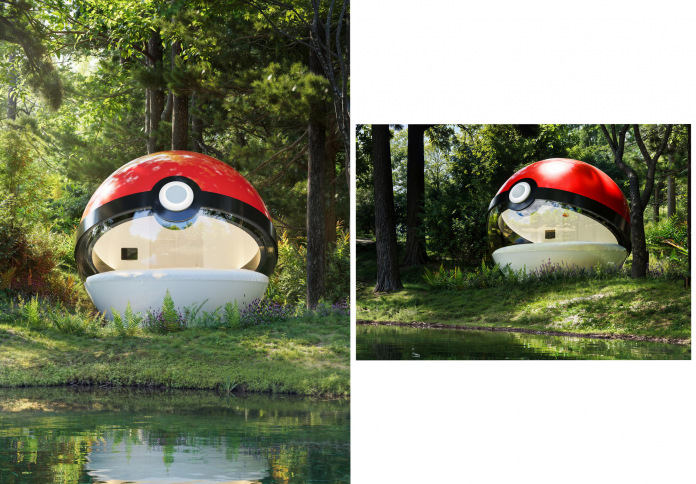
NOT A HOTEL and Pokémon Sleep turned the familiar Poké Ball form into an inhabitable hotel concept in Hokkaido. That fact pattern opens onto a broader conversation about form, circulation, and public experience. The names and immediate circumstances matter, but so do the systems around them: creative choices, commercial pressures, institutional habits, and the public language used to explain change. Seen in that context, the story becomes more than a conventional update. It shows how a focused development can reveal the direction of a much larger field without pretending that one moment proves an irreversible trend. The most useful reading is therefore attentive rather than breathless, interested in how image and substance interact and in what the subject tells us about the standards by which contemporary work is judged.
A Poké Ball Becomes the Entire Architectural Brief
At the center of A Giant Poké Ball Becomes a Place to Sleep is one confirmed development: NOT A HOTEL and Pokémon Sleep turned the familiar Poké Ball form into an inhabitable hotel concept in Hokkaido. The detail matters on its own, but it also opens a wider window onto site and spatial experience. That broader frame is useful because public attention naturally compresses complicated stories. It favors the visible result over the work, history, and trade-offs behind it. Restoring those layers does not make the story less immediate; it makes the immediate moment easier to understand without asking it to prove more than the evidence can support.
Public culture usually remembers the polished surface, but the decisive work happens earlier. In a story centered on a house, tower, arena, terminal, masterplan, or retreat, that means paying attention to massing, structure, material, light, circulation, and landscape. Those elements do not all carry equal weight in every case, yet they form the practical architecture around the headline. They show how creative or institutional intention becomes something people can actually see, use, watch, visit, buy, support, or debate. The more clearly that chain is understood, the less need there is for exaggerated language to make the development feel significant.

NOT A HOTEL Turns Fandom Into Hospitality
Attention is never neutral. In the case of A Giant Poké Ball Becomes a Place to Sleep, daily use and public perception influences which details become symbolic and which remain technical or peripheral. That process can be useful—it helps a broad public make sense of complexity—but it can also turn one vivid image into the entire story. A better reading keeps the emotional response without allowing it to erase context. The aim is not to cool enthusiasm or criticism, but to make both more precise by reconnecting reaction with the facts that triggered it.
This is where the relationship between image and inhabitation becomes especially important. The development may be discussed as a clean break, comeback, breakthrough, warning, or reinvention, but most real change is less tidy. New directions often borrow from old codes; institutions adjust unevenly; audiences accept some experiments and reject others. The useful question is therefore not whether the moment represents total transformation. It is what it makes newly possible, newly visible, or newly difficult inside contemporary architecture. That is a smaller claim, but it is usually the more revealing one.

The Interior Has to Balance Novelty With Livability
After first impressions, coherence becomes the harder measure. A Giant Poké Ball Becomes a Place to Sleep may initially be encountered through a striking name, image, result, or claim, but the longer life of the story depends on whether site and spatial experience aligns with daily use and public perception. That alignment is rarely perfect. Tension can be productive; contradiction can make a subject more interesting. The question is whether the tension reveals genuine complexity or simply exposes a gap between promise and reality. This is where patient attention often produces a more durable judgment than the first wave of reaction.
Scale changes the meaning of any creative or technical decision. Within contemporary architecture, institutions decide which experiments receive resources, which standards become normal, and which risks are considered acceptable. A Giant Poké Ball Becomes a Place to Sleep sits inside that environment. Its significance therefore depends partly on what others are able or willing to do in response. This is not a prediction about imitation. It is an observation about reference points: once a choice becomes visible at scale, it enters the field’s shared vocabulary and can be debated, adapted, rejected, or refined by people far beyond the original story.
The Project Shows How Pop Culture Can Become Place
What remains, then, is a set of questions with real editorial value. How much of A Giant Poké Ball Becomes a Place to Sleep is about this particular cast of people, institutions, and circumstances, and how much belongs to a wider shift in contemporary architecture? Which parts are likely to matter only in the short term, and which already reveal a deeper change in expectations? The answers may evolve. That is not a weakness. It is a reason to keep the analysis tied to evidence and to treat future developments as new information rather than confirmation of a narrative chosen in advance.
For now, the responsible reading is clear enough. Start with the confirmed fact, keep the surrounding context visible, and resist turning attention into certainty. A Giant Poké Ball Becomes a Place to Sleep matters because it concentrates several pressures already present in contemporary architecture and makes them easier to see at once. Its value as a story lies in that concentration. Even if later developments change the interpretation, the moment captures a revealing arrangement of ambition, constraint, image, and response. That is enough to make it worth examining carefully—and enough reason not to burden it with claims the evidence cannot yet carry.