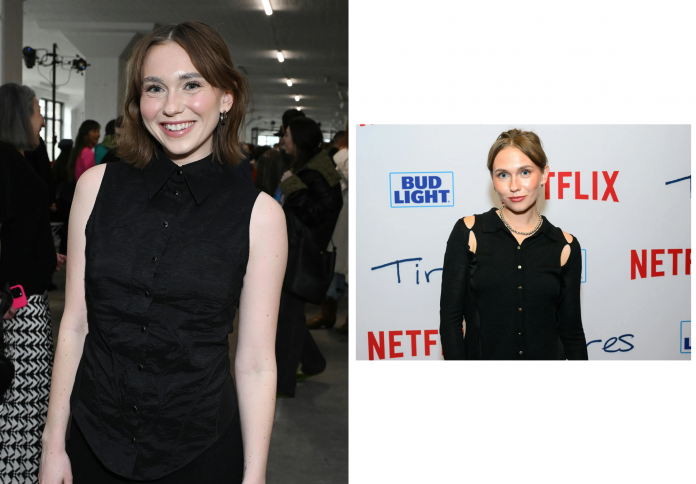
When Veronika Slowikowska joined Saturday Night Live as a featured player for Season 51 in 2025, she arrived from a comedy ecosystem very different from the one that produced many earlier cast members. The Canadian actor and comedian had built a substantial audience through short-form character sketches online, where a joke has seconds to establish a voice, premise, and visual rhythm. She also brought conventional training and screen credits, including work in I Like Movies, Poker Face, and Davey & Jonesie’s Locker. SNL placed those experiences inside a live institution that demands collaboration, rewriting, impression work, and the ability to survive material that can change hours before broadcast. Slowikowska’s path reflects a broader shift in comedy casting: social platforms are no longer merely promotional spaces comedians use after discovery. They are stages where performers develop characters, test timing, and build an audience before television catches up.
Short-Form Video Taught Her to Establish a Character Fast
Slowikowska’s online sketches often begin with a recognizable social type, vocal choice, or behavioral detail and push it into absurdity. The format rewards immediacy. A performer cannot spend several minutes establishing context when viewers can scroll away almost instantly.
That pressure can sharpen character comedy. Small gestures become exposition, and a voice can communicate an entire imagined biography. Slowikowska developed a style that feels casual enough to belong to the internet while remaining technically precise. The videos may appear tossed off, but the timing depends on understanding exactly how long a premise can hold before it needs escalation.
.jpg)
Her Career Was Not Built Online Alone
It would be misleading to describe Slowikowska as a social-media personality who suddenly became an actor. She trained in performance in Canada and accumulated screen work before joining SNL. Roles in projects such as I Like Movies and Davey & Jonesie’s Locker gave her experience with scripted ensembles, while appearances in series including Poker Face expanded that résumé.
That background matters in live sketch television. A performer who can create a funny thirty-second video still has to learn blocking, cue cards, costume changes, camera positions, writing-room collaboration, and the pressure of a broadcast schedule. Internet fluency is an asset, not a substitute for those skills.
SNL Is Almost the Opposite of the Personal Feed
A social account gives a comedian extraordinary control. The performer can choose the character, framing, edit, release time, and whether a failed idea is ever seen. Saturday Night Live operates through collective authorship. Writers, cast members, producers, designers, and directors reshape an idea before it reaches air, and a sketch may disappear entirely after dress rehearsal.
For a creator accustomed to owning the final post, that loss of control can be productive. SNL forces adaptation. A character must work with another performer’s rhythm. A joke may need to serve a host. The camera is part of a live system rather than a device held by the comedian herself.
Season 51 Represented a Generational Reset
Slowikowska joined a group of new featured players as SNL moved beyond its heavily commemorated fiftieth season. The timing gave the incoming cast an unusual task: follow a year dominated by the institution’s own history while helping establish what the next phase might sound like.
Her digital-native background offered one answer. SNL has always absorbed performers from the comedy venues of their era—clubs, improv theaters, stand-up circuits, television writers’ rooms. Short-form social video is now another legitimate venue in that pipeline. The skill is not “being viral.” It is learning how to make a character readable to people who have no prior context.
The Internet and Live Television Now Train Each Other
The relationship also works in reverse. SNL sketches are cut into clips, circulated on social platforms, turned into memes, and consumed by viewers who may never watch the full broadcast. A performer like Slowikowska already understands that second life. She knows how a facial expression, phrase, or compact character can detach from its original context and travel.
Her move into Studio 8H therefore feels less like leaving internet comedy behind than connecting two performance systems. One rewards speed, intimacy, and individual authorship; the other rewards ensemble craft, institutional discipline, and live risk. The most interesting new SNL players may be the ones who can move between both without treating either as secondary. Slowikowska entered with an audience, but the larger opportunity is learning what her comedy becomes when she no longer controls every edge of the frame.
Going Viral and Working Live Demand Opposite Relationships With Failure
Online, a comedian can make dozens of sketches, delete weak ideas, refine a premise privately, and publish only the version that feels ready. Live television concentrates failure into a public moment. A sketch can land unevenly in front of millions, and the performer still has to return after the commercial break. That difference makes SNL a particularly revealing next step for someone who developed a large digital audience.
Slowikowska’s internet experience gives her speed, but the show can teach a different kind of resilience. Not every character becomes a recurring hit. Some ideas vanish after dress rehearsal. Others work because a host, writer, or castmate changes the rhythm. The institution rewards performers who can detach ego from one sketch and keep contributing. That process may ultimately deepen the looseness viewers already like in her short-form work. The internet encourages creators to identify what “their thing” is and repeat it until the algorithm recognizes the pattern. SNL, at its best, forces a player to be useful in someone else’s thing too. The tension between those systems could become the most important training of Slowikowska’s next phase.