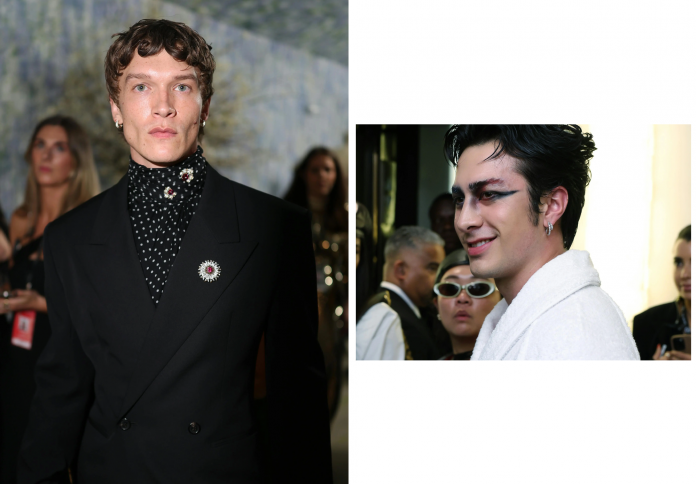
Connor Storrie and Hudson Williams arrived at the 2026 Met Gala as first-time guests carrying the momentum of Heated Rivalry, but their strongest red-carpet move was refusing to dress like a matched pair. Storrie wore Saint Laurent by Anthony Vaccarello, combining black tailoring and leather with a sleeveless polka-dot silk lavallière whose long bow introduced softness and movement. Williams took a more ornate route in custom Balenciaga by Pierpaolo Piccioli, wearing a pale-blue matador-inflected suit with embroidery and a dramatic black cape. Both looks used familiar menswear foundations, then unsettled them through fabric, exposure, decoration, and theatrical proportion. That difference mattered. Rather than turning two newly famous actors into a coordinated franchise image, the styling gave each one a distinct fashion argument. Their joint debut became a compact demonstration of how contemporary red-carpet menswear is expanding beyond the tuxedo without abandoning tailoring altogether.
A Joint Debut Did Not Require Matching
When two actors from the same breakout project arrive together at a major event, styling can easily become promotional shorthand. Matching colors or mirrored suits make the relationship instantly legible in photographs, but they can also reduce both people to a single marketing unit. Connor Storrie and Hudson Williams chose a more interesting approach at the 2026 Met Gala.
Their looks shared enough formality to belong in the same frame, yet they moved in opposite directions. Storrie’s Saint Laurent leaned dark, narrow, and sensual. Williams’ Balenciaga was pale, embellished, and historically theatrical. The visual contrast gave each actor a separate identity while preserving the chemistry of a paired arrival.
.jpg)
Saint Laurent Used Softness Against Leather
Anthony Vaccarello’s look for Storrie combined a black smoking jacket and high-rise leather trousers with a sleeveless black-and-white polka-dot silk muslin lavallière. Its extended bow dropped into a train-like vertical line, introducing movement to an otherwise controlled silhouette.
The combination depended on friction. Leather carries hardness, nightlife, and masculine rebellion; the lavallière brings drape, print, and a traditionally romantic softness. Putting them together did not erase masculinity so much as widen its available vocabulary. The outfit still read as tailoring, but it no longer relied on the standard white-shirt-and-bow-tie formula to communicate evening dress.
Balenciaga Looked Back to the Matador
Williams’ custom Balenciaga took a different route. Pierpaolo Piccioli drew on the house archive and the ornamental language of matador dress, creating a baby-blue ensemble with richly worked embroidery and a black cape. The open chest and decorative surface turned the suit into something closer to ceremonial costume than conventional black tie.
Historical reference can become theatrical very quickly, but the Met Gala is precisely the place where that risk can be productive. Under the “Fashion Is Art” brief, Williams’ look treated menswear as an object of craft and performance. The cape added movement, while the embroidery rewarded close inspection. A suit became a stage rather than an office-coded uniform.

New Fame Arrived With New Fashion Attention
The actors’ appearance also showed how quickly breakout screen success now converts into fashion visibility. Heated Rivalry gave Storrie and Williams a passionate audience, and the Met Gala placed them inside a much broader celebrity system only months later. That transition can be difficult because red-carpet dressing asks performers to define a visual identity before the public has settled on one for them.
Their debut succeeded by avoiding overexplanation. Neither outfit attempted to dress literally as a character or reference the project that made them famous. Instead, the clothes suggested two different temperaments. Fashion gave the actors room to separate themselves from the roles while still benefiting from the excitement that brought them to the carpet together.
Menswear Is Most Interesting When the Rules Stay Visible
The expansion of men’s red-carpet fashion does not require abandoning suits. In fact, both Storrie and Williams demonstrate why tailoring remains useful: the familiar structure gives designers something to push against. A bow becomes more dramatic when attached to a smoking-jacket silhouette. Embroidery feels more transgressive when it covers a garment associated with restraint.
That is the broader lesson of their Met Gala debut. Contemporary masculine dressing gains energy not by declaring the old rules dead, but by making them negotiable. Leather can sit beside silk. A cape can accompany trousers. A pale matador reference can share a carpet with severe black Saint Laurent. Storrie and Williams looked connected without looking identical, which may be the more modern image of a duo: two people occupying the same cultural moment while refusing to collapse into the same style.
Their Debut Also Shows How Quickly Television Can Reorder Fashion’s Guest List
The Met Gala has always mixed established stars with people whose cultural momentum is still accelerating. Storrie and Williams entered that second category. Heated Rivalry gave them a concentrated burst of attention, and fashion responded almost immediately by offering two of the industry’s most recognizable house identities. The speed is a feature of contemporary celebrity: a breakout performance can become a global style opportunity before an actor has accumulated a conventional decade-long résumé.
That speed creates pressure to define oneself too early. A debut look can become a template that stylists and audiences expect to repeat. The smartest choice, then, is not necessarily the loudest one but the one that leaves room for future movement. Saint Laurent and Balenciaga gave the actors clear but very different starting points. Storrie can move away from dark sensual tailoring later without contradicting himself; Williams can step out of embroidered romanticism without losing credibility. The evening established range by beginning with contrast. Fashion did not need them to arrive fully formed. It only needed each actor to look as though the clothes belonged to a person worth watching beyond one television role.