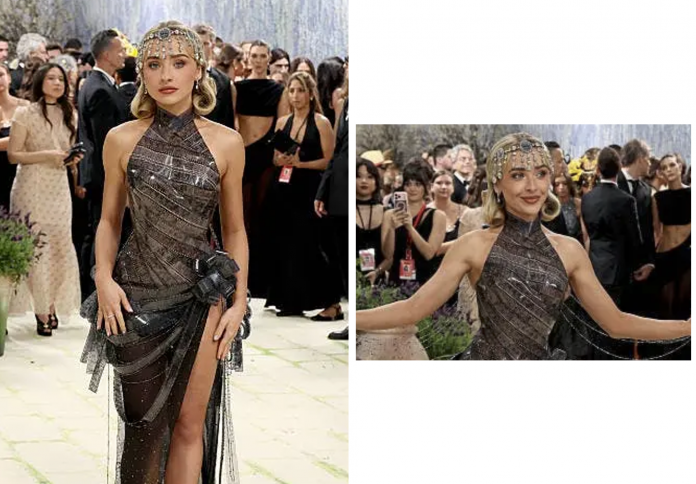
Sabrina Carpenter’s 2026 Met Gala dress turned an old Hollywood coincidence into material. For the “Fashion Is Art” dress code, Jonathan Anderson created a custom Dior look incorporating film strips connected to the 1954 movie Sabrina, the Audrey Hepburn classic that happens to share the singer’s name. The idea extended Carpenter’s increasingly cinematic pop image while giving the evening’s art theme a concrete medium: not a print inspired by film, but film as part of the garment’s visual language. Rhinestone detail and a headpiece kept the construction in the realm of red-carpet fantasy, yet the reference remained playful rather than solemn. Carpenter has spent the past several years building a stage persona that borrows from pinup photography, mid-century entertainment, and knowingly exaggerated femininity. At the Met, Dior connected that persona to an actual artifact of screen history, collapsing singer, character, movie, and dress into one carefully engineered joke.
A Shared Name Became the Concept
The most obvious link between Sabrina Carpenter and Billy Wilder’s 1954 film Sabrina is also the most useful: the title is her first name. Rather than avoiding that easy association, Dior treated it as a conceptual shortcut. Audrey Hepburn’s film belongs to a world of romantic glamour and transformative dressing, two ideas that already sit comfortably inside Carpenter’s public image.
The reference could have become a literal costume. Instead, the design used film itself as a material cue. That decision turned a naming coincidence into something physical and let the garment speak to cinema without requiring Carpenter to impersonate Hepburn. She remained recognizably herself while carrying an older image culture around her body.

Jonathan Anderson Found a Material Answer to the Theme
“Fashion Is Art” invited broad interpretation, and one risk of such an open dress code is that every look can be justified after the fact. Anderson’s approach was stronger because the artistic medium was visible. Film strips introduced the physical technology of cinema into couture, creating a surface whose meaning depended on both image and object.
That idea also fits Anderson’s work at Dior, where archive awareness often meets an interest in materials and cultural objects. The dress did not need to resemble a movie screen. Its construction could instead ask what happens when a medium associated with projected images becomes something to be looked at directly on a body.
Carpenter’s Pop Persona Was Already Cinematic
Long before the 2026 gala, Carpenter had been shaping a performance identity filled with visual references to old entertainment culture. Her stage styling often plays with bombshell silhouettes, lingerie codes, sparkle, theatrical hair, and humor. The result is less historical reenactment than an updated version of classic show-business femininity, aware of the camera and amused by its own excess.
That made the Sabrina reference feel earned. A performer whose concerts and videos already use cinematic framing can absorb a film-history concept without it appearing imposed by a stylist overnight. The dress added another chapter to the same visual world, using a specific movie to sharpen an aesthetic that audiences already recognized.
The Met Gala Rewards a Concept You Can Explain in One Sentence
Some of the night’s strongest looks have elaborate making processes but simple central ideas. Carpenter’s was easy to communicate: Sabrina wears Sabrina. That clarity matters in a media environment where a red-carpet image travels faster than a designer statement. The first impression can be immediate, while the craftsmanship and historical references unfold afterward.
The trick is avoiding gimmick. A pun becomes fashion when the execution gives it enough visual and technical substance. The film-strip construction, jeweled finish, and Dior proportions provided that substance. The joke opened the door, but the garment still had to work after the explanation was over.
A Dress Can Turn an Archive Into Pop Culture Again
Using material tied to an older film also demonstrates what fashion can do with archives. Museums preserve objects by protecting them from ordinary use; fashion often revives references by placing them back into circulation, sometimes in transformed form. Carpenter’s gown brought a mid-century movie into feeds populated by fans who may know her music far better than Hepburn’s filmography.
That does not make the dress a history lesson, and it does not need to. Its value lies in creating a bridge. A contemporary pop star, a 1954 romantic comedy, an old Hollywood style icon, and a modern Dior collection briefly occupied the same cultural frame. On a night devoted to fashion’s relationship with art, Carpenter’s look made the argument through entertainment: archives survive not only when they are protected, but when new generations find playful reasons to look at them again.
Carpenter’s Fashion Humor Works Because the Craft Is Never the Punch Line
A dress made from a concept as obvious as “Sabrina wears Sabrina” could easily collapse into novelty. The reason it survives is that the joke opens the idea rather than replacing the design. Dior still had to solve proportion, movement, surface, and red-carpet impact. The film reference becomes the premise; couture execution gives the premise staying power.
That balance mirrors Carpenter’s broader pop persona. She frequently uses innuendo, visual jokes, and theatrical exaggeration, but the humor lands because the songs, vocals, and staging remain technically controlled. She is not asking audiences to choose between seriousness and fun. The work assumes that polish can make play more effective. At the Met, the old film strips did something similar. They let a fashion-history audience appreciate material and archive while fans could understand the shared-name joke instantly. A good celebrity look often needs both levels. It should reward the viewer who sees only one photograph and the viewer who reads the making-of story afterward. Carpenter’s Dior moment succeeded because neither audience was treated as more legitimate than the other.