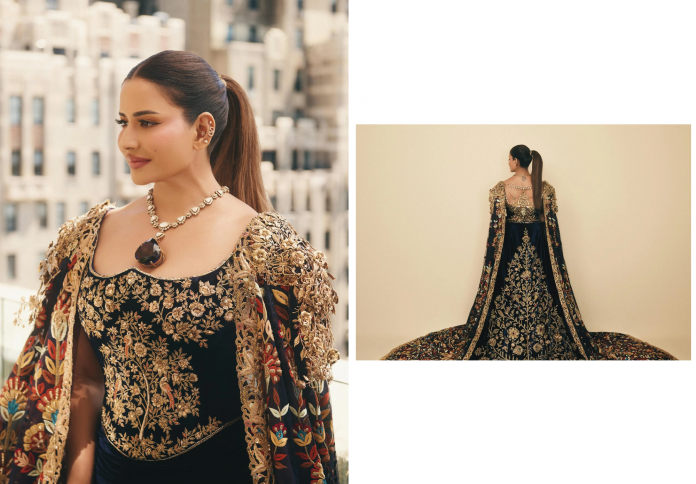
Sudha Reddy’s 2026 Met Gala look approached “Fashion Is Art” through craft rather than abstraction. Working with Manish Malhotra and stylist Mariel Haenn, the Hyderabad-based philanthropist and businesswoman wore a royal-blue ensemble titled “The Tree of Life,” rooted in Kalamkari traditions from Andhra Pradesh and Telangana and covered with references to regional flora, fauna, mythology, and celestial imagery. More than ninety artisans contributed thousands of hours of work to the couture, while a sculptural metal vine extended the storytelling beyond embroidery. Reddy paired the garment with extraordinary jewelry from her personal collection, including a necklace centered on a 550-carat violet-blue tanzanite. The scale was unmistakably Met Gala, but the deeper force came from specificity. Rather than treating Indian craft as generalized “heritage,” the look named techniques, symbols, materials, and a place, turning red-carpet visibility into a form of cultural authorship.
The Tree of Life Was Built From Regional Language
The custom Manish Malhotra look began with Kalamkari, a textile tradition strongly associated with southern India and particularly Andhra Pradesh and Telangana. Instead of borrowing a generic ornamental vocabulary, the design incorporated motifs connected to Reddy’s home region, including birds, trees, flowers, and celestial symbols. The references were arranged across a deep royal-blue ground that gave the embroidery unusually strong contrast.
The train extended roughly seven meters, allowing the surface to function almost like a narrative textile. Peacock imagery, botanical forms, and symbolic elements traveled across the garment rather than being confined to a decorative border. That scale helped the look answer the Met Gala’s demand for spectacle while still keeping the storytelling anchored in specific craft traditions.

Thousands of Hours Became Visible as Surface
Reports on the garment credit more than ninety artisans and over three thousand hours of labor. Those numbers can become empty luxury statistics if they are used only to prove expense. In this case, they matter because the techniques are visible: zardozi, marodi, resham work, sculpted velvet elements, metallic embroidery, and a separately crafted vine structure made with metals including brass, copper, and silver.
The ensemble therefore makes a useful distinction between decoration and labor. The richness of the surface is not a digital print pretending to be embroidery; it is accumulated handwork. On a carpet consumed mainly through photographs, that labor risks disappearing into one spectacular image. Naming the processes helps restore the human scale behind the spectacle.
Jewelry Operated at an Almost Architectural Scale
Reddy’s necklace became one of the most discussed jewelry moments of the night because it featured a 550-carat violet-blue tanzanite surrounded by diamonds. The piece, from her personal collection, was valued in reports at approximately $15 million. Additional large gemstone rings extended the scale of the jewelry story beyond a single center stone.
Yet the necklace worked because it was not treated as an unrelated display of value. Its deep blue-violet tone sat within the garment’s color world, while the size echoed the monumentality of the embroidered train and sculptural back detail. The jewelry and couture were both operating beyond normal proportions, which allowed them to feel like parts of the same visual argument rather than competing status symbols.
The Met Gala Rewards Cultural Translation
Red carpets frequently use traditional craft as surface inspiration without explaining where it comes from. Reddy’s look was more effective because the translation was deliberate. Kalamkari was not reproduced as a museum object; it was reinterpreted through contemporary couture construction, metalwork, corsetry, and the exaggerated scale required by the Met steps.
That translation is where the design becomes interesting. Cultural preservation does not require freezing a technique in one historical form. It can also involve placing craft in new contexts while retaining enough specificity that its origin remains visible. The risk is always that spectacle flattens nuance, but the involvement of Indian designers and artisans gave this look a stronger claim to continuity than a superficial motif borrow would have had.
Visibility Matters When It Leads Back to the Makers
The Met Gala is one of the world’s largest fashion image generators. A successful look can circulate millions of times within hours, but attention often settles on the celebrity wearer and the designer’s name. Reddy’s “Tree of Life” is most valuable when the conversation moves one step further toward the artisan labor and regional traditions embedded in the garment.
That is the larger opportunity of craft-led red-carpet dressing. A spectacular dress can function as an entry point into techniques that might otherwise remain outside global fashion coverage. Reddy used her 2026 appearance to make Indian material culture visible at the exact moment the museum was asking whether fashion belongs inside art history. Her answer was not theoretical. It arrived as embroidery, metal, stone, and thousands of hours of skilled work carried up the stairs.
Craft Gains Power When the Story Can Be Traced Backward
A red-carpet garment can produce instant awe, but craft becomes culturally meaningful when viewers can move backward from the image to the techniques, regions, and makers that created it. Sudha Reddy’s “Tree of Life” ensemble offers that route because its visual richness is tied to named traditions rather than a vague claim of inspiration.
That traceability matters in global luxury, where handwork is frequently celebrated while individual craft communities remain invisible. Naming Kalamkari, zardozi, resham work, metal techniques, and artisan labor turns “heritage” from a flattering adjective into a set of practices. It also invites further questions: who is trained to do this work, how knowledge moves between generations, and whether the global attention around a Met Gala look produces sustained value beyond the night itself. Couture cannot answer those questions alone, but it can make them harder to ignore. Reddy’s appearance was most successful not because it proved Indian craft could be spectacular enough for the Met; that was never in doubt. It showed that spectacle can become a doorway into specificity when the people explaining the garment are willing to name where its beauty comes from.