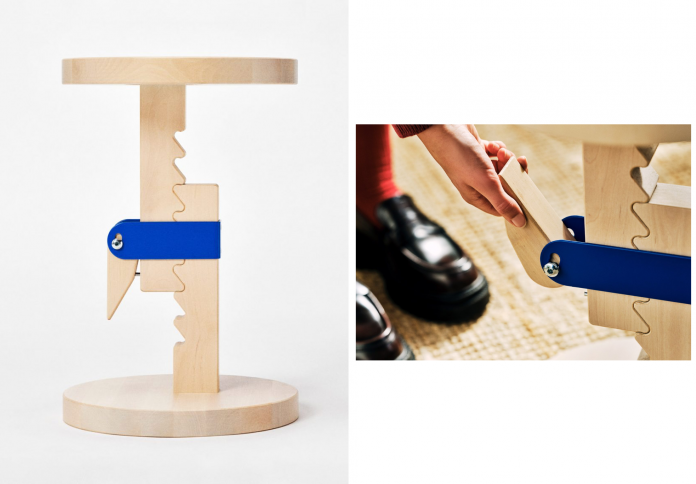
Mikael Axelsson’s bright blue stool for IKEA PS 2026 is an unusually clear example of what the collection means by playful functionality. Made from solid birch, the compact seat can be set to three heights—41, 45, and 49 centimeters—through a visible ratcheting mechanism. It can serve as an extra seat or a small side table, and the act of changing its height is deliberately tactile rather than electronically hidden. The stool emerged from hands-on testing, including feedback from Axelsson’s own family, and its appeal comes from how little explanation it needs. Many adjustable products bury their intelligence in levers, buttons, or instructions. This one turns the mechanism into the character. In doing so, it demonstrates a useful principle for mass-market design: an object feels smarter when the user can understand why it moves, not simply when movement is technically possible.
Three Heights, One Immediately Legible Idea
The stool has a straightforward specification. Its circular seat is approximately 32 centimeters in diameter, and the overall height can be set at 41, 45, or 49 centimeters. The frame and seat are made from solid birch with a clear finish and a vivid blue treatment that makes the object visually assertive despite its small scale.
What distinguishes it is the way the height changes. A ratchet-like mechanism allows the user to reposition the seat in visible increments. There is no motor and no attempt to make the transformation mysterious. The action is part of the experience, which means the user quickly understands the product through touch. That clarity is especially valuable in an object likely to be moved around a home and used by different people.

Adjustability Works When People Actually Use It
Furniture is full of features that sound useful in a catalog and remain untouched after purchase. The reason is often friction. If adjusting a chair requires turning it upside down, finding a tool, or remembering a hidden control, most people simply adapt themselves to the furniture. Axelsson’s stool lowers that barrier by making change easy and visible.
Three settings are also a smart limit. Infinite adjustability can be technically impressive but cognitively unnecessary for a small stool. Fixed steps provide enough variation for different users and tasks without making the product feel mechanical. The design recognizes that flexibility is valuable only when the interaction is simpler than the compromise it is meant to solve.
A Stool Is Already a Flexible Typology
The choice of a stool is important. Stools are among the most mobile and ambiguous pieces of furniture in a home. They become extra seating, bedside tables, plant stands, surfaces for a bag, or temporary perches in kitchens and hallways. Adding height adjustment intensifies an adaptability that already exists in the typology rather than forcing a complicated new behavior onto it.
That is why the product can move between seat and side table without needing a transforming top or hidden storage. The change in height subtly changes its relationship to the body and surrounding furniture. At the lowest setting it can feel more casual; higher up, it aligns differently with a table or work surface. Small shifts create multiple use cases without increasing the number of parts dramatically.
Family Testing Keeps the Mechanism Human
Accounts of the stool’s development note that Axelsson tested the mechanism with his daughters. That detail is valuable not as sentiment, but as evidence of how interaction design improves. A mechanism that seems obvious to a designer may not be obvious to someone encountering it without explanation. Watching people pull, push, hesitate, or misuse a prototype reveals where the object is asking too much.
For a product sold by IKEA, that user diversity is fundamental. The stool must work across ages, languages, and domestic cultures. Its tested load is specified up to 110 kilograms, but usability involves more than structural strength. The person should understand how to adjust it without a demonstration. The visible ratchet turns that requirement into a design feature.
The Best Trick Is the One You Understand
The stool belongs to a collection full of movement and surprise, yet its strongest quality is restraint. It does not try to perform multiple transformations at once. One mechanism changes one dimension, and that change expands how the object can be used. The bright blue color gives it presence, while the birch construction keeps the material language familiar.
That simplicity makes the piece a useful model for interactive furniture. Smart design does not always need sensors, apps, or hidden engineering. Sometimes intelligence is mechanical, local, and obvious. Axelsson’s stool invites a user to adjust it because the operation is satisfying enough to repeat. If a small piece of furniture can make people notice how it works and then forget about the complexity, it has achieved something more valuable than novelty: it has made flexibility feel natural.
The Stool Makes Adaptability Legible Without an Instruction Manual
Adjustable furniture often hides its mechanisms in the name of visual cleanliness. Mikael Axelsson’s stool takes a more direct approach by making change part of the object’s expression. When the user can understand how height or position shifts by looking at the product, adjustability stops feeling like a technical feature buried in specifications and becomes part of everyday use.
That clarity is especially valuable in multi-use homes. The same seat may need to serve a child, an adult, a desk, a kitchen counter, or an improvised side table across the week. Furniture that can respond without tools or complicated hardware gives a small space more flexibility without requiring multiple specialized objects. The design’s humor helps because it lowers the barrier to interaction; a mechanism that looks approachable invites people to test it. This is a recurring strength of IKEA PS at its best: engineering is not presented as hidden expertise but as a visible invitation. The stool does not ask owners to admire how cleverly it was solved. It asks them to touch it, change it, and discover that the cleverness is useful.