New York’s 2026 design week unfolded through galleries, showrooms, fairs, and temporary installations rather than a single defining venue, and its product launches reflected the city’s appetite for pluralism. New furniture and lighting moved between sculptural statement pieces, adaptable domestic objects, hand-finished work, and products designed to make ordinary rituals feel more considered. Presentations at Colony, The Future Perfect, WSA, ICFF, and independent studios demonstrated how little interest contemporary designers have in a single house style. One object might lean toward weighty material presence, another toward playful light, another toward flexible modularity. The common thread was not appearance but attitude: many launches treated furniture as something that should earn attention through how it is made, moved, adjusted, or lived with. In a market saturated with images, physical behavior is becoming one of design’s strongest forms of distinction.
New York’s Design Week Rewards Difference
NYCxDesign has always been less centralized than Milan’s Salone del Mobile, and that fragmentation can be an advantage. In 2026, visitors moved among commercial fairs, gallery programs, independent studios, and temporary presentations across the city. ICFF brought hundreds of exhibitors to the Javits Center, while events at WSA, Colony, The Future Perfect, and other venues created smaller contexts where objects could be read more slowly.
The result was not a single aesthetic forecast. New York instead offered multiple answers to the question of what contemporary furniture should do. Some designers emphasized material mass and handwork; others used lightness, humor, or technical flexibility. That variety reflects the city’s market, where hospitality, residential interiors, collecting, and contract design overlap. A product rarely needs to belong to everyone, but it does need to communicate clearly to the audience it wants.

Sculptural Furniture Still Has to Invite Use
Several launches treated furniture as a strong visual presence rather than background. At Colony, Sarah Sherman Samuel’s “Weight & Wonder” collection explored substantial form and tactile materiality, showing how a piece can feel almost architectural at domestic scale. The attraction of this approach lies in the way mass changes a room: a table or seat becomes an anchor rather than a neutral support.
Yet the best sculptural furniture avoids becoming unusable sculpture. A chair still has to meet the body; a table has to accommodate movement; a cabinet has to open without turning ritual into inconvenience. New York’s stronger presentations understood that tension. The object may command attention in a photograph, but the design earns longevity through repeated contact. Visual drama begins the relationship; proportion, comfort, and function decide whether it continues.
Lighting Became an Experiment in Atmosphere
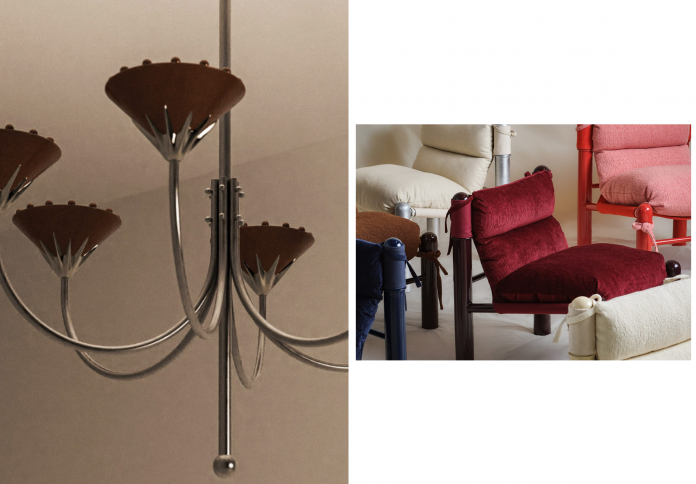
Independent lighting launches also showed how much emotional range can be created from relatively small objects. Designers including Christopher Merchant and Kawabi worked with new fixtures that treat light source, shade, and support as compositional elements rather than hiding the mechanism completely. Elsewhere, smaller studios used portable or low-scale lighting to challenge the assumption that a lamp must be fixed to one task or position.
This matters because lighting is one of the easiest ways to change a room without replacing its architecture. A movable fixture can turn a dining table into a workspace, a shelf into a display, or a dark corner into a place to sit. Designers are increasingly treating that adaptability as part of the object’s personality. The lamp is not simply delivering lumens; it is helping users rewrite the room over the course of a day.
Flexibility Is Replacing the Perfect Room
Many contemporary homes are asked to perform too many functions for furniture to remain static. Work, exercise, dining, socializing, and rest can occur in the same limited floor area. The most relevant products at NYCxDesign acknowledged that condition through pieces that move, rotate, stack, reconfigure, or serve more than one role. Flexibility no longer necessarily means anonymous office modularity.
Designers are giving adaptable objects more character because users do not want their homes to look like diagrams of efficiency. A stool can be a side table and still have a memorable silhouette. A modular sofa can reconfigure without resembling contract furniture. The design challenge is to make transformation intuitive enough that people actually use it, rather than turning adjustability into a feature that exists only in product literature.
Physical Experience Is the Competitive Advantage
The flood of design imagery online has made it easier than ever to encounter new work and harder than ever to remember it. NYCxDesign’s value lies in restoring scale, weight, texture, sound, movement, and comfort to the evaluation process. A chair that looks spectacular in a feed can feel wrong when sat in; a quiet object can become compelling when its joinery or surface is experienced up close.
That physical test explains the importance of product launches even when audiences have already seen preview images. Furniture remains stubbornly material. Its success is measured over months and years of touch, wear, cleaning, rearrangement, and use. The strongest 2026 launches did not try to compete with digital culture by becoming louder images. They offered reasons to encounter the object in person. In a week full of novelty, that return to bodily judgment felt like the most durable trend.
Product Launches Matter More When They Reveal a Shift in Behavior
A design week inevitably produces a flood of new furniture, lighting, surfaces, and accessories. The temptation is to evaluate each object as an isolated image, but the more useful question is what patterns appear across the launches. Are people living in smaller spaces? Are workplaces becoming more domestic? Are buyers asking products to move, fold, repair, or adapt more easily? New forms often make the most sense when read as answers to those behavioral changes.
NYCxDesign is especially suited to that kind of reading because New York places extreme pressures on space, logistics, retail, hospitality, and housing. A table that collapses or a lamp that moves may carry different significance in a compact apartment than in a large showroom. The strongest launches translate those pressures without becoming crude “solutions” to urban life. They preserve pleasure, proportion, and personality while acknowledging how objects will actually be used. Seen together, the week’s products function almost like a material survey of current anxieties and desires. Novelty is the visible layer. Underneath it is a record of how designers think everyday behavior is changing—and what they believe people will want around them as it does.