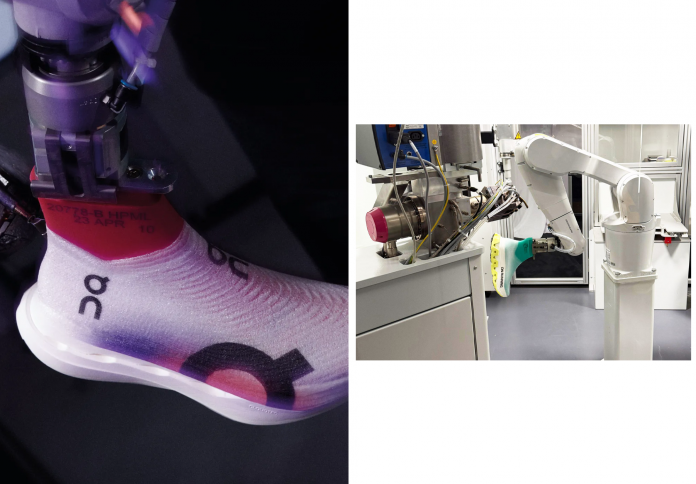
The most radical part of On’s LightSpray footwear is difficult to appreciate from a finished product photograph. Instead of cutting, stitching, and gluing a conventional textile upper from multiple pieces, the Swiss brand uses a robotic arm to spray a continuous thermoplastic filament directly over a shoe last. In 2026, that technology moved further into fashion through the Loewe x On LightSpray Cloudmonster, pairing the sprayed, laceless upper with the exaggerated cushioning associated with the Cloudmonster line. The process promises speed, fewer components, and a different relationship between design and manufacturing, while On has also reported a substantially lower carbon footprint for LightSpray racing uppers compared with its conventional equivalents. Beyond the performance claims, the project is a compelling design experiment because the form of the shoe cannot be separated from the machine that makes it.
The Upper Is Built in the Air
Most athletic shoes begin as flat materials that are cut into patterns, stitched into shape, reinforced, and attached through a sequence of specialized operations. LightSpray replaces much of that choreography with a robotic arm that deposits a fine thermoplastic filament around a three-dimensional last. The upper emerges as a continuous shell rather than a garment assembled from many separate panels.
That change is immediately relevant to designers because it collapses the distance between drawing and production. A line in software can become a change in density, structure, or reinforcement without requiring a new cutting pattern. The manufacturing tool is not simply executing a finished design; it participates in defining what kinds of forms are possible. As with 3D printing, the production method becomes part of the aesthetic vocabulary.

Fewer Steps Can Mean Different Economics
On has emphasized the speed of the process, with an upper produced in minutes rather than through a long chain of cutting and stitching operations. The LightSpray construction also reduces the number of components and removes conventional laces, glue-heavy upper assembly, and much of the stitching associated with standard footwear. These efficiencies could matter for more than factory throughput.
A production method that relies on compact robotic equipment may eventually support manufacturing closer to where shoes are sold, although the economic reality depends on machine cost, material supply, quality control, and scale. The interesting possibility is a footwear system less dependent on huge inventories of pre-cut components. If designs can be changed digitally and produced with fewer physical tooling steps, product development can become faster and potentially more responsive.
The Loewe Collaboration Makes Technology Visible
The 2026 Loewe x On LightSpray Cloudmonster brings the technology into a fashion context where the process itself becomes part of desirability. The laceless upper is paired with the substantial Cloudmonster Hyper sole platform, creating a silhouette that looks futuristic without hiding the sprayed construction behind decorative layers. White and silver keep the material language unusually direct.
That visibility is important. Performance innovations often disappear into midsole foams, membranes, or technical specifications that a wearer cannot see. LightSpray is legible from the outside. Its fine web-like surface communicates that the shoe was made differently. A luxury-fashion collaboration amplifies that distinction, turning manufacturing into part of the visual narrative rather than a backstage fact.
Environmental Claims Need Process-Level Scrutiny
On has reported significant reductions in carbon emissions for LightSpray racing-shoe production compared with some of its conventional footwear processes. The company attributes part of the improvement to fewer components and a simplified upper-manufacturing sequence. Those figures are encouraging, but any environmental assessment of footwear needs to consider the full product: energy, polymer sourcing, outsole and midsole materials, transportation, durability, and end-of-life options.
The most credible sustainability argument is therefore not that robotic spraying solves the environmental problem of sneakers. It is that manufacturing simplification can remove certain material and process burdens while opening new design possibilities. That is a narrower claim, but a more useful one. Better footwear systems are likely to emerge through many such reductions rather than a single miracle technology.
A Shoe Becomes a Software-Material System
LightSpray points toward a future in which footwear is designed as code, material behavior, and robotic motion at once. That could change the role of designers, who may need to understand deposition paths and machine parameters alongside shape, color, and ergonomics. It could also make the boundary between prototype and production less rigid, because the same digital instructions can guide both.
The technology is still young, and conventional shoe manufacturing remains extraordinarily sophisticated and scalable. LightSpray does not invalidate that history. It introduces another route. Its importance lies in demonstrating that even a mature product category can be reorganized when designers question the sequence by which it is made. The finished shoe is interesting, but the larger design object is the process: a robot drawing a wearable surface directly into existence.
Automation Is Most Convincing When It Removes Material Rather Than People
LightSpray is easy to describe through the spectacle of a robot arm coating a shoe, but the more important design question is what the process eliminates. Traditional uppers can involve patterns, cutting, stitching, adhesives, multiple components, and substantial offcut waste. A sprayed construction proposes a different chain in which material is deposited only where the digital model requires it.
That does not make automation inherently sustainable or socially neutral. Energy use, chemical composition, factory labor, maintenance, and end-of-life recovery still matter. The value of the system is that it exposes manufacturing as part of the design rather than an invisible step after styling. On can adjust performance zones through code and process, making the method itself a product feature. For consumers, the shoe may still register first as a silhouette and a feeling on foot. For the industry, however, the experiment points toward a future in which footwear design includes deciding how matter is placed by machines. The robot is not interesting because it looks futuristic. It is interesting if the resulting system can make fewer steps, less waste, and more precise use of material genuinely routine.