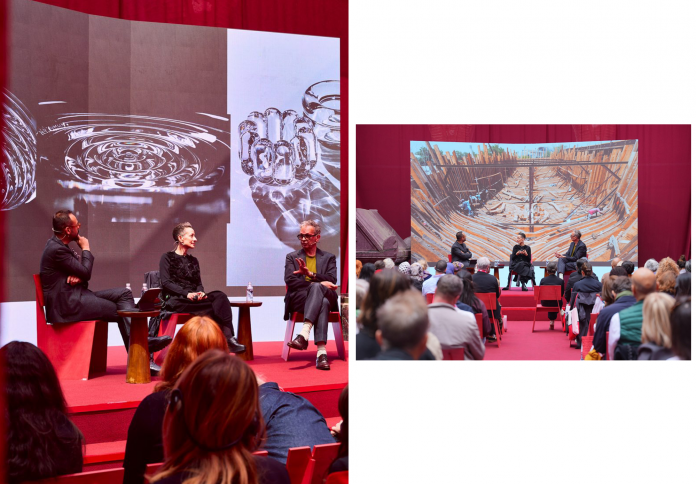
The inaugural Global Design Forum Istanbul arrived in May 2026 at a moment when design culture is negotiating two opposing accelerations. Artificial intelligence can generate images and proposals faster than ever, while climate, material scarcity, and cultural preservation are pushing designers to look more carefully at place, construction, and long-term consequence. Under the theme “Worlds in Contact,” the forum brought together figures including Lina Ghotmeh, Tom Dixon, Marina Tabassum, Lesley Lokko, Liam Young, and Ma Yansong across historic sites in Istanbul. The setting made the tension unusually vivid. Digital culture encourages frictionless circulation; Istanbul is a city where histories, materials, languages, and infrastructures visibly overlap. The most useful conversations at the forum were therefore not about choosing technology or craft. They were about deciding what design should remain accountable to when images can be produced far more quickly than buildings, objects, and communities can change.
A Forum About Contact Needed This City
Istanbul is an unusually apt place for a design forum organized around “Worlds in Contact.” The city’s built environment makes contact visible: Byzantine, Ottoman, republican, and contemporary layers coexist across streets, shorelines, monuments, infrastructure, and everyday commerce. Hosting conversations at sites including the Hagia Irene complex, Kabataş High School, and the Museum of Turkish and Islamic Arts gave the program a physical counterweight to abstract global themes.
That matters because design conferences can easily become placeless. The same slide deck about technology or sustainability can travel from city to city without changing. In Istanbul, the surroundings insist that every design claim has a context. Preservation, development, tourism, seismic risk, public space, craft, and global capital are not theoretical categories. They are active forces shaping the city. The forum’s ambition becomes stronger when read against that density.

AI Makes Images Cheap, Judgment More Valuable
Artificial intelligence was one of the unavoidable topics. Generative tools can now produce architectural and product images with extraordinary speed, which has changed how concepts circulate on platforms such as Instagram. The resulting abundance creates both opportunity and confusion. A persuasive image no longer proves that a project is buildable, original, ethically sourced, or even attached to a coherent brief.
For designers, the central skill therefore shifts from producing images to judging them. What should be made? What is structurally plausible? Which references are being borrowed, and from where? Who benefits from the proposal? Those questions are slower than image generation, which is precisely why they matter. AI can accelerate variation, but the value of design still depends on selecting, testing, and taking responsibility for a choice in the material world.
Material Worlds Resist Frictionless Thinking
A session bringing Tom Dixon and Lina Ghotmeh into conversation around material worlds offered a useful contrast to algorithmic speed. Dixon’s industrial product experience and Ghotmeh’s architecture both involve materials that carry cost, weight, sourcing histories, manufacturing constraints, and physical behavior. A chair or building cannot be regenerated endlessly without consequence.
Material attention is not nostalgia for a pre-digital era. It is a way to make design accountable. Timber species, metal fabrication, earth construction, stone, textiles, composites, and recycled inputs all demand decisions that an image may hide. The more effortless visualization becomes, the more valuable those difficult facts can be. A beautiful rendering can suggest atmosphere in seconds; a material specification determines whether that atmosphere can exist, age well, and be maintained.
Global Voices Complicate a Single Design Center
The speaker list also reflected a design culture that no longer accepts London, Milan, Paris, or New York as the only centers from which serious ideas flow. Marina Tabassum’s work in Bangladesh, Lesley Lokko’s writing and institutional leadership, Ma Yansong’s architecture in China, and the forum’s Turkish context create multiple ways of understanding modernity rather than a single export model.
That multiplicity is essential when discussing AI. Training data tends to reproduce what is already visible and well documented, which can amplify dominant visual languages. Global design discourse has a responsibility to do the opposite: make less represented knowledge, climates, materials, and social practices harder to ignore. “Worlds in Contact” becomes meaningful when contact changes the participants, rather than simply placing different names on the same stage.
The Future Is Not Digital or Material
The most productive reading of the forum avoids a false choice between technological optimism and craft romanticism. Designers will use AI, and they will continue to work with physical materials, regulation, labor, budgets, and clients. The problem is not that one world will replace the other. It is that the speed of the digital layer can obscure the slower consequences of the physical one.
Istanbul offered a useful setting for holding both realities at once. The city is saturated with images and tourism, but its complexity cannot be flattened into a feed without losing what makes it valuable. Design faces the same risk. The next generation of tools can expand imagination, but only judgment can decide which images deserve to become objects, buildings, and systems. The forum’s most durable message may be that contact is not simply exposure. It is the moment when different realities force a designer to become more precise.
The Design Profession Now Has to Separate Image Skill From Design Skill
Generative tools have made it possible to produce convincing visual proposals before many practical questions have been answered. A chair can look resolved without having a viable joint. A building can appear atmospheric without a workable envelope. A material can be rendered with a texture that has no relationship to how it behaves in the world. That gap between image and object is becoming one of design culture’s central literacy problems.
The Istanbul discussion matters because designers are increasingly evaluated inside feeds where visual speed is rewarded. An AI-generated image can circulate farther than a carefully developed prototype simply because it is immediate. The response cannot be to reject images; representation has always been part of design. The challenge is to restore friction between representation and consequence. Who makes the thing? What is it made from? How is it repaired, transported, inhabited, and discarded? Those questions are slower than prompting, but they are where design becomes accountable. Social media may continue to accelerate taste. The profession’s task is making sure acceleration does not become a substitute for making decisions that can survive contact with reality.