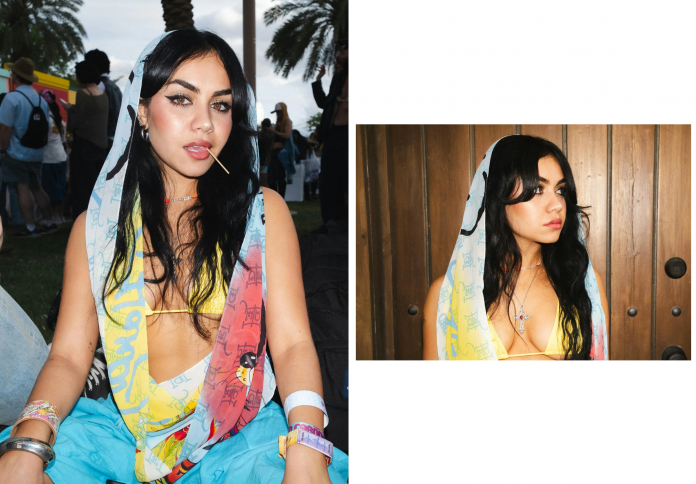
Tara Yummy arrived at Coachella 2026 with the instincts of an experienced festivalgoer and the ambitions of someone who wants to return on the other side of the barricade. Her weekend mixed handmade styling, thrifted Ed Hardy, a revived 2016-era headscarf, and a schedule shaped as much by Addison Rae, Jane Remover, and PinkPantheress as by content obligations. The internet personality and DJ has been attending the festival since she was 17, which gives her perspective on how its fashion codes have shifted. She is also clear about the future: one day she wants to DJ Coachella herself, ideally with her own music in the world and guests joining her onstage. That goal gives the wardrobe diary a second narrative. She is dressing for the festival she loves while imagining herself inside its lineup.
Dressing From Memory, Not a Trend Report
Tara Yummy’s Coachella wardrobe in 2026 did not begin with a single polished theme. It developed through pieces that carried different histories: a lace shirt she improvised from shorts the night before, a cross-motif headscarf that recalled mid-2010s styling, and an archival Ed Hardy scarf found secondhand. The combination feels less like a costume assembled for a desert weekend and more like a personal archive being reopened in public.
That distinction matters because festival fashion has spent years being flattened into recognizable clichés. Tara’s approach is more convincing when it looks idiosyncratic. She wanted comfort and intentionally pulled back from some of the fur-heavy styling she had embraced before. The result is not anti-fashion; it is evidence of taste becoming more selective. Repeating yourself is easy when a visual identity performs well online. Editing that identity is a more useful sign of growth.
The Bag Tells the Practical Story
A festival outfit is photographed from the outside, but the real day is often determined by what fits inside the bag. Tara’s essentials included Loops earplugs, a portable charger, Chapstick, and sunglasses. None of those objects makes a dramatic image, yet together they describe the actual demands of hours spent under sun, around amplified sound, and on a phone that is simultaneously map, camera, communication device, and work tool.
That practical layer is especially important for someone whose festival experience doubles as content production. Tara’s Coachella is both leisure and labor. She has to be visible enough to do the job associated with her online career without allowing the entire weekend to become an endless shoot. Her preference for Weekend Two helps create that balance. There is slightly more space to choose when to film and when to disappear into the crowd.
Music Is More Than Background Content
The artists Tara wanted to see—among them Addison Rae, Jane Remover, and PinkPantheress—also map the kind of pop ecosystem her audience inhabits. These are performers whose careers blur familiar boundaries between internet culture, alternative scenes, celebrity, and mainstream pop. Tara understands that overlap because her own path has moved from social media toward DJing and, potentially, original music.
Her enthusiasm for the festival’s music and arts side keeps the diary from becoming a purely fashion-centered exercise. Coachella is one of the few places where highly mediated celebrity culture and the physical unpredictability of a live crowd remain tightly fused. A person may arrive because a clip is already viral, then discover that the performance changes the song. Tara’s repeated attendance since her teenage years suggests that this transformation—from screen object to live memory—is part of what keeps her returning.
The Dream of Crossing Onto the Stage
Tara has said she wants to DJ Coachella someday. It is a simple ambition, but it reorganizes the meaning of the weekend. She is no longer only an attendee documenting a scene; she is also studying a professional environment she hopes to enter. The stages, transitions, crowd energy, and artist choices can function as informal education for someone building a performance identity.
She imagines reaching that stage after releasing music of her own and bringing out special guests. The specificity is useful. Internet fame can create the illusion that every career lane is immediately available, but live performance requires a separate set of skills: pacing, selection, technical preparation, and the ability to control a room without the editing tools of a feed. Wanting the stage is therefore less interesting than learning how to deserve it.
A Festival Is Only as Good as the People Beside You
For all the focus on clothes and celebrity sightings, Tara’s most practical festival advice returns to company. Long days produce dehydration, sore feet, scheduling conflicts, and moments when the polished fantasy falls apart. The people around you determine whether those inconveniences become funny memories or reasons the weekend collapses.
That observation gives her Coachella story a human scale. The festival is marketed through monumental images—stages, headliners, fashion, installations—but experienced through small negotiations among friends. Who wants to wait for a set, who needs water, who is willing to change plans, who can laugh when everyone is exhausted: these decisions shape the memory as much as any look. Tara’s wardrobe may attract the camera, but her longer relationship with Coachella suggests she already knows the more durable rule. Style can frame a weekend; the people and music are what make it worth repeating.
Festival Dressing Works Best When It Survives the Festival
The real measure of Tara Yummy’s Coachella wardrobe is not whether each outfit photographs as “festival fashion.” That category is already saturated with fringe, boots, cutouts, sunglasses, and references recycled from earlier festival eras. More revealing is whether the clothes still look connected to the person once the desert backdrop disappears.
For a creator whose audience follows personality as closely as styling, that continuity matters. A highly produced festival look can become costume if it seems borrowed only for the event; an outfit becomes more convincing when it exaggerates habits the wearer already has. Tara’s approach benefits from treating Coachella as permission to turn the volume up rather than to invent a stranger. The hair, makeup, accessories, and silhouettes can be louder because the setting rewards excess, but the attitude has to remain recognizable. That is also why a diary or getting-ready format is useful. It restores process around a final image. Viewers see decisions, interruptions, weather, timing, and the social energy of dressing with somewhere to go—the parts of style that a polished carousel can erase.