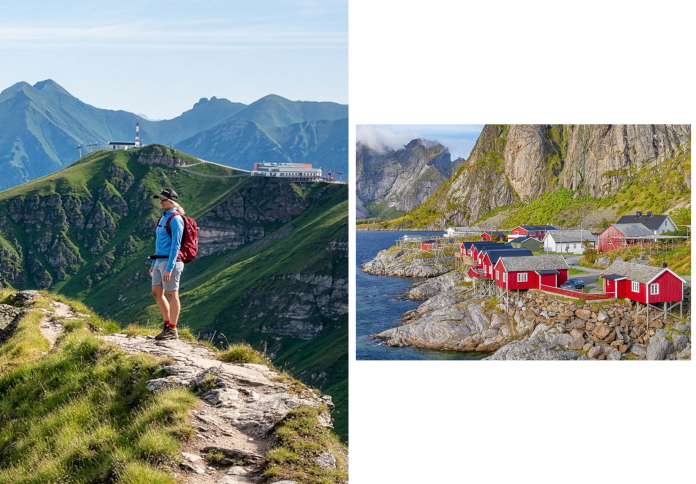
In an era increasingly defined by digital immersion and relentless urban expansion, the Norwegian wilderness offers a profound, visceral antidote. Far beyond a mere collection of dramatic fjords, towering peaks, and icy expanses, the great outdoors in Norway represents a fundamental way of life, encapsulated by the cultural philosophy of friluftsliv, or "open-air living." This is not about conquering nature, but rather seeking a harmonious, everyday coexistence with the elements. From the jagged archipelagos of the Arctic north to the plunging valleys of the southern interior, the landscape demands active participation. Whether trekking sunlit alpine ridges, paddling silently through deep glacial waters, or embracing the stark beauty of the winter snowfall, travelers are discovering that true luxury lies in a deliberate return to the wild.
The Philosophy of the Open Air
In a world increasingly insulated by concrete and glass, the Norwegian concept of friluftsliv serves as a radical counter-narrative. First popularized by the playwright Henrik Ibsen in an 1859 poem about a farmer abandoning civilization for the mountains, the term literally translates to open-air living. However, to translate it merely as a preference for outdoor recreation is to misunderstand its cultural weight. For Norwegians, stepping into the wild is a daily necessity, a democratic right, and a spiritual baseline.
Recent national surveys suggest that an overwhelming majority of the population—roughly nine out of ten citizens—actively participate in this lifestyle. This commitment does not hibernate when the harsh Scandinavian winter sets in. It is an entirely ordinary sight to witness locals marching through heavily snowed trails in the dead of December, their path illuminated only by the sharp beam of headlamps. Conversely, during the brief but glorious summer months, the midnight sun turns the landscape into a playground that never closes, blurring the lines between day and night in a continuous celebration of the elements.
Trails That Span a Nation
To understand the infrastructure of this outdoor obsession, one must look at the nation's sprawling network of trails and its enshrined legal right to roam. This principle ensures that the vast majority of the countryside is accessible to anyone, provided they tread respectfully. It is an ethos that turns the entirety of Norway into a public estate. For many locals, embarking on an epic multi-day trek is considered a foundational rite of passage rather than a simple holiday.
Among the most revered of these journeys is the Norge På Tvers, or Norway Across. This demanding seventy-five-mile route stretches from Stjørdal in the west all the way to the Swedish border in the east. Hikers navigating this path find themselves traversing icy river crossings and sweeping glacial valleys where herds of wild reindeer still roam freely.
For those seeking a slightly more condensed communion with the mountains, the Trekanten route offers a brilliant alternative. Spanning thirty-five miles in the central Trollheim region, this three-day expedition weaves through dramatic mountain summits and skirts the edges of shimmering, mirror-like lakes. The route is cleverly anchored by a series of three well-maintained mountain huts, allowing trekkers to experience the ruggedness of the high altitude without sacrificing the warmth of a secure shelter at nightfall.
Gliding Through the Glacial Waters
While the interior mountains command a fierce loyalty, Norway is fundamentally defined by its relationship with the ocean. Boasting the second-longest coastline on the planet, the country's edges are spectacularly fractured into deep fjords and scattered with hundreds of thousands of islands. To truly comprehend the scale and silence of these waterways, one must descend to surface level and take command of a kayak.
The Lofoten archipelago, thrusting out into the Norwegian Sea far above the Arctic Circle, presents one of the most surreal paddling environments on Earth. Despite its high latitude, the region features paradisiacal, ivory-sand beaches and vibrant marine ecosystems that look startlingly tropical against a backdrop of jagged granite peaks. Guided kayaking expeditions through these pristine inlets and sheltered harbors offer paddlers a front-row seat to the region's rich biodiversity. Here, the rhythmic dip of a paddle is often accompanied by the sudden surfacing of seals, the majestic flight of sea eagles, and, for the fortunate few, the haunting silhouette of migrating whales cutting through the arctic swells.
The Rhythm of the Winter Terrain
When the snows arrive, the national focus shifts seamlessly to cross-country skiing. More than a sport, strapping on a pair of narrow skis and rhythmic poles is an essential mode of winter transport and a deeply ingrained cultural ritual. The season, which often stretches from late November well into May, transforms the landscape into a sprawling, white canvas of marked and meticulously maintained trails.
Nowhere is this winter devotion more apparent than in Jotunheimen National Park, famously dubbed the Land of the Giants. The park’s vertiginous, snow-draped scenery provides a dramatic amphitheater for both elite athletes and casual weekend gliders. The trail networks here are vast, catering to every level of ambition—from gentle, rolling valley floors to demanding high-altitude ascents.
For newcomers looking to find their balance before tackling the giants, the village of Beitostølen serves as a perfect winter laboratory. Its accessible mix of forested paths and rolling hillside tracks allows beginners to experience the hypnotic, meditative rhythm of cross-country skiing without the immediate peril of steep alpine drops. By late spring, as the days lengthen dramatically, skiers can spend hours gliding beneath sweeping mountain vistas, perfectly encapsulating the joy of winter friluftsliv.
Pedaling the Historic Valleys
Beyond the snow and surf, Norway has quietly evolved into a premier destination for two-wheeled exploration. The nation's cycling infrastructure is remarkably robust, blending dedicated urban cycle lanes with an expansive network of rural trails and adrenaline-pumping downhill parks. The recent surge in e-bike popularity has further democratized the country's notoriously steep topography, allowing even casual riders to conquer mountain passes that once required elite physical conditioning.
The crown jewel of Norwegian cycling is undoubtedly the Rallarvegen. Originally constructed as an access road during the building of the Bergen Railway, this historic fifty-one-mile trail stretches from the high-altitude plateau of Finse down to the fjord-side village of Flåm. As cyclists navigate the gravel paths, they are treated to an intense visual distillation of the Norwegian landscape, rolling past ancient blue glaciers, plunging waterfalls, and rivers teeming with wild salmon and trout. It is a journey that feels less like a physical workout and more like a pedaled tour through a moving landscape painting.
The Sanctuary of the Hytte
Ultimately, the physical exertion of hiking, skiing, or paddling is only half of the Norwegian outdoor equation. The counterpart to this activity is hyttekos, a term that loosely translates to cabin coziness. It is estimated that nearly half of all Norwegians own, or have access to, a rural cabin. These structures—ranging from primitive, off-grid wooden shelters to modern architectural marvels—serve as vital sanctuaries where families retreat to decompress from modern life.
The true essence of friluftsliv is fully realized in the quiet hours following a long day in the elements. It is found in the simple, deliberate acts of gathering wood, lighting a fire, and sharing a meal in near-absolute isolation. For those looking to experience this profound stillness, rental cabins are scattered across the country's most remote corners.
Properties like Øvergården, a traditional log cabin situated on the island of Leka off the central coast, offer a glimpse into this minimalist luxury. Surrounded by a striking, almost extraterrestrial landscape of yellow and red rock formations, such retreats provide a necessary pause. They remind us that embracing the great outdoors is not merely about conquering mountains or enduring the elements, but about finding a quiet corner of the wild in which to simply exist.