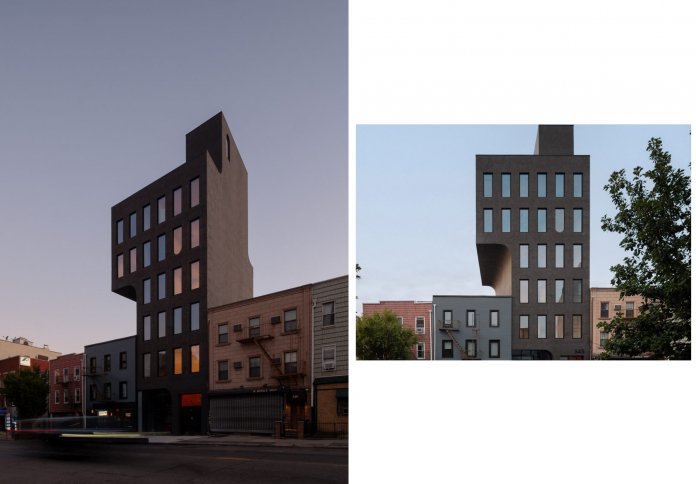
In the dense, competitive urban fabric of Williamsburg, Brooklyn, space is often measured not just in square feet on the ground, but in the unseen potential of the air above. Local studio Commoncraft has recently completed 545 Metropolitan, a six-story mixed-use building that serves as a masterclass in navigating the labyrinthine complexities of New York City zoning. Located directly across from the busy Lorimer L subway station, the structure utilizes a dramatic cantilevered volume to curve over its neighbor, reclaiming unused square footage from an adjacent lot. It is a building born of necessity and constraints, where the limitations of Floor Area Ratio (FAR) and subterranean transit infrastructure have been molded into a singular, sculptural form. By blending a monolithic black exterior with moments of architectural playfulness, Commoncraft has created a residence that is both a practical solution to urban scarcity and a bold statement on the Williamsburg skyline.
Navigating the Zoning Labyrinth
The genesis of 545 Metropolitan was dictated by a complex set of site restrictions that required the architects to think vertically and laterally simultaneously. The project’s unique form was primarily shaped by the relationship of its total square footage to its footprint—a metric known as the Floor Area Ratio (FAR). The zoning lot included an existing three-story building that remained untouched, meaning the unused air rights from that structure could be transferred to the new development. Commoncraft co-founder Tony-Saba Shiber noted that early design studies were discarded in favor of a strategy that reclaimed this floor area through a cantilever extending above the neighbor.
Beyond air rights, the building had to contend with its proximity to the Lorimer MTA station. Construction and foundation work required rigorous coordination with transit authority requirements to ensure the stability of the underground infrastructure. These “invisible” constraints—zoning laws and subway tunnels—effectively acted as the primary sculptors of the building’s envelope. The result is a structure that slots its narrow base into the lot before widening its upper floors into the cantilever, maximizing living space in a way that feels like a geometric puzzle solved in real-time.
Monolithic Texture and Subtle Glimmer
Visually, 545 Metropolitan is designed to read as a dark, singular monolith, a stark contrast to the eclectic mix of brick and glass that defines this section of Metropolitan Avenue. The building is wrapped in a black stucco finish from the manufacturer Sto, which contains mica chips to give the surface a subtle, metallic glimmer when caught by the afternoon sun. This texture prevents the dark volume from feeling oppressive, instead lending it a tactile quality that changes with the movement of the light. Rounded corners further soften the building’s edges, allowing the massive cantilever to feel more like a fluid extension than a jagged imposition.
The facade is punctuated by rows of slim rectangular windows, but Commoncraft introduced moments of eccentricity to break the grid. Most notably, a single “inverted arch” window sits on the front side, serving as a focal point that disrupts the building’s structural rhythm. Additionally, a top-level window reveals a staircase painted in a vibrant, glowing orange—a playful “hidden” detail that becomes apparent only upon closer inspection. These small gestures of whimsy are intended to call back to the neighborhood’s artistic spirit while embracing the building’s inherent peculiarity.
Functional Stratification and Light
The interior program of 545 Metropolitan is a study in vertical efficiency. The ground floor is dedicated to commercial space, extending to the back of the site where it is illuminated by a row of industrial-style skylights. Above this commercial base, the building transitions into residential apartments, with terraces integrated into both the backside and the roof. This stratification allows for a clear separation of public and private functions while ensuring that even the most deeply embedded interior spaces receive ample natural light.
The residential units are designed to leverage the building’s unusual volume, offering floor plans that are uniquely shaped by the cantilever. While some critics have questioned the furniture layouts of such “unconventional” spaces, the architects maintain that the project was realized using construction methods largely consistent with standard mid-scale residential types. The primary innovation here is not in the materials used, but in how those materials were deployed to navigate the specific urban pressures of Brooklyn. The building serves as a vital case study in how to provide more housing in “unbuildable” locations.
A Polarizing Presence in the Block
As with many bold architectural interventions in Brooklyn, 545 Metropolitan has generated significant debate among residents and critics alike. Some see the cantilever as a blunt and aggressive “middle finger” to the existing block, a physical manifestation of the relentless drive for square footage in a hyper-gentrified neighborhood. Others praise the design for its ingenuity, viewing it as a clever use of air rights that adds a touch of “De Chirico-esque” surrealism to the streetscape. The building does not seek to blend in; it seeks to exist within the narrow margins allowed by the law.
Ultimately, 545 Metropolitan is a building that could only exist in New York. It is a physical embodiment of the city’s zoning code—a structure whose “playful” form is a direct result of serious legal and structural calculations. Whether one views it as an “ugly” exploitation of air rights or a handsome example of functionalist innovation, it is an undeniable feat of urban navigation. Commoncraft has proven that in Williamsburg, even a narrow lot and a subway tunnel can provide the foundation for architecture that reaches out and claims its space in the world.