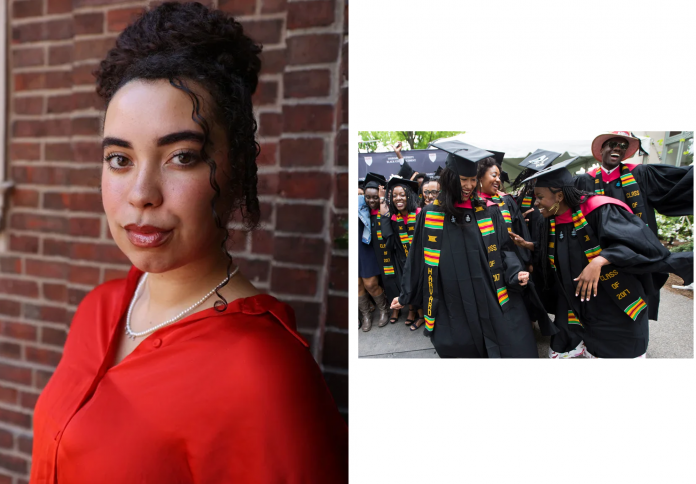
Across the United States, students are scrambling to preserve cultural and identity-based graduation ceremonies after universities — facing pressure from the Trump administration — have begun cutting support for diversity, equity, and inclusion (DEI) programs. From Black student celebrations to Lavender Graduations for LGBTQ+ students, these once school-sanctioned events are being forced off campus. But students are not letting these traditions disappear without a fight.
Traditions interrupted at elite institutions
Elyse Martin-Smith had envisioned a celebration of Black excellence. The Harvard undergraduate and leader of the Harvard Undergraduate Black Community Leaders had worked for months to plan the university’s Black graduation ceremony — complete with musical performances, poetry, and a keynote from Pulitzer Prize-winning journalist Nikole Hannah-Jones. The event was to be held at Harvard’s Memorial Church, a historic and symbolic venue on campus.
Then, in early May, just weeks before the event, Harvard informed her that the ceremony could no longer be held on university property. The administration had quietly begun rolling back DEI support in response to federal threats to revoke research funding and accreditation for noncompliance with new anti-DEI directives. By late April, the university had renamed its DEI office and halted all financial support for affinity graduations.

“This isn’t the first time the university has catered to PR concerns rather than student concerns,” Martin-Smith said. But she didn’t back down. Between finals, she searched for off-campus venues, eventually securing support from Harvard’s Black Graduate Student Alliance and Black Alumni Society to hold the event independently on May 27. “It’s an undue burden that continues to be placed upon Black students to create the change that we want to see,” she said.
Anti-DEI mandates reshape student life
Harvard isn’t alone. Institutions across the country, including the University of Kentucky, have begun dismantling DEI infrastructure under pressure from federal and state mandates. In Kentucky, university officials announced the cancellation of all identity-based celebrations, citing new laws and directives that barred support for “special-interest” graduation ceremonies.
For students like Kristopher Washington, the news was devastating. A graduating senior at the University of Kentucky and member of Alpha Phi Alpha Fraternity, Inc., Washington had looked forward to the Black graduation for years. Undeterred, he and his fraternity brothers organized their own off-campus event, dubbed “Senior Salute,” at Lexington’s Lyric Theatre & Cultural Arts Center. The ceremony invited all students to participate and encouraged them to wear attire that reflected their cultural identities.
“I feel it’s important to show that there are people coming from underprivileged areas and different backgrounds and still making it over to the UK and getting their degree,” Washington said. “It’s a tremendous achievement.”

More than a ceremony: Honoring identity
Affinity graduations have long offered a space where students from marginalized communities could honor their heritage, culture, and resilience in ways traditional commencements often overlook. These ceremonies typically highlight music, language, dress, and rituals that reflect the identities of Black, Hispanic, Asian, first-generation, and LGBTQ+ students.
According to Antar Tichavakunda, a professor at the University of California, Santa Barbara, the standard commencement format itself is deeply rooted in European traditions — from graduation gowns to “Pomp and Circumstance,” composed by Englishman Edward Elgar. Affinity graduations, he argues, offer a much-needed counterbalance. “Giving us a space to celebrate like we’d like to and not be policed, play music that feels more affirming and culturally responsive in a smaller setting really just makes that moment of completing a degree that much sweeter,” said Tichavakunda, who is also the author of Black Campus Life.

These events aren’t just about celebration, he said — they are acts of resistance, pride, and community building in institutions where students often feel isolated or marginalized.
Lavender Graduations and LGBTQ+ resistance
It’s not only racial or ethnic affinity groups that are affected. Lavender Graduations — ceremonies that honor LGBTQ+ students — are also vanishing from campuses. The loss has been especially pronounced in states like Utah, where Republican Governor Spencer Cox signed legislation banning DEI programs in all public institutions, including colleges.
As a result, resource centers supporting gender and identity diversity have closed, and universities have withdrawn all support for LGBTQ+ graduation events. But students and advocates have stepped in. Jacey Thornton, executive director of Project Rainbow Utah and a recent graduate of Weber State University, helped organize an alternative Lavender Graduation for students from several Utah institutions. Held at a local church adorned with pride flags, the event provided stoles and tassels in traditional LGBTQ+ colors.

“We are holding space to celebrate the obstacles we have overcome as queer people,” Thornton said. “A lot of us lose biological families in the process of transitioning or coming out. This supports that space for us to come together and find a new chosen family.”
The future of affinity graduations
What once were campus-sanctioned celebrations are increasingly being pushed underground or off-campus — surviving through student determination and community support. But the larger question remains: how long can these traditions persist without institutional backing?

Tichavakunda warns that universities’ withdrawal from affinity events sends a clear message to marginalized students: that their cultures and communities are not prioritized. He encourages students to consider Historically Black Colleges and Universities (HBCUs) or institutions with a firm commitment to inclusive practices. “For future classes, I think this administration is forcing students and faculty to think creatively beyond the university and work around it,” he said. “But I don’t think this will be the end of culturally specific graduations. I just think it might be the end of universities supporting them.”
For now, the students aren’t giving up. From Harvard to Kentucky to Utah, they’re reclaiming their milestones — in church basements, historic theaters, and community halls. Their message is simple: the ceremonies may be off-campus, but their pride is front and center.