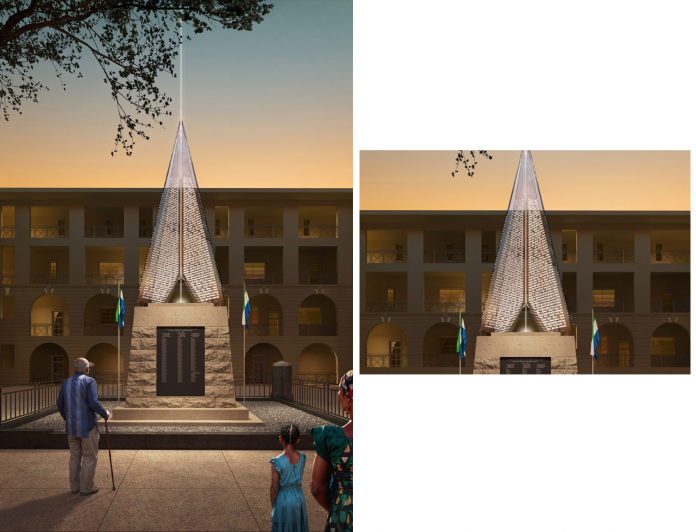
Lagos-based Oshinowo Studio has revealed an evocative new design for a war memorial in Freetown, Sierra Leone, dedicated to the overlooked members of the Sierra Leone Carrier Corps who died during World War I. Commissioned by the Commonwealth War Graves Commission, the project pairs the historic gravitas of an original Edwin Lutyens-designed stone plinth with a soaring new glass addition etched with the names of 946 fallen men, illuminating a long-silenced chapter of African history.
Honoring the invisible heroes of war
For over a century, the Sierra Leone Carrier Corps—African men conscripted to carry equipment, supplies, and provisions for British and Allied forces during World War I—remained unrecognized in the country’s principal war memorials. The new intervention by Oshinowo Studio seeks to correct this historical omission with a structure that is as conceptually powerful as it is visually striking.
“The main concept for the memorial was to strongly, visually and materially pay homage, and give some kind of celebrated acknowledgement to the Carrier Corps, who had not previously been commemorated,” said architect and studio founder Tosin Oshinowo. The project is part of a broader initiative by the Commonwealth War Graves Commission to revisit how war memory is shaped and to include the stories of those who have long been sidelined in official narratives.
Light and memory woven in glass
The site of the new memorial is modest—a six-by-seven-meter courtyard overlooked by government buildings in central Freetown. Yet its symbolism looms large. At the center stands a stone plinth, originally designed by renowned British architect Edwin Lutyens in 1930. The names of fallen soldiers are inscribed on its surface, but until now, the Carrier Corps were notably absent.

Oshinowo’s intervention takes the form of four vertical glass panels that will rise nine meters above the existing base. The etched-glass screens will carry the names of 946 identified members of the Carrier Corps, carefully uncovered by historians and heritage consultants working with local communities. “The relationship between stone and glass was selected to reflect a feeling of permanence of the existing structure, and a more ephemeral nature of the addition,” Oshinowo explained.
The choice of materials also expresses the relationship between past and present, solidity and spirit. The enduring weight of the stone grounds the structure in historical continuity, while the light-filled glass evokes presence, transparency, and belated visibility. The addition doesn’t overshadow Lutyens’ original monument—it elevates its purpose.
A beacon for the entire city
Given the memorial’s location in a secure area with limited public access, the design needed a solution to extend its reach beyond its physical footprint. The response was both poetic and practical: a beacon of light will be embedded into the center of the memorial, shining vertically through the glass panels. The beam will be visible from up to 2.5 kilometers away, serving as a silent but powerful signal of remembrance to the broader city of Freetown.
“As the site sits in a restricted area, with public access limited, we wanted to ensure the monument remains as a symbol for all people across Freetown,” said Oshinowo. This visual gesture ensures that even those who cannot physically visit the memorial can still bear witness to its message.
Extending the legacy across Sierra Leone
In recognition of the widespread enlistment of the Carrier Corps across various regions of the country, the memorial initiative also includes four satellite sites in the provinces. These smaller monuments will act as local touchpoints for remembrance, further decentralizing the act of commemoration and anchoring it within communities historically affected by the war effort.
This layered and decentralized approach reflects a growing movement in contemporary memorial architecture—one that moves beyond monumentalism to prioritize inclusivity, access, and historical nuance. Rather than focusing on heroic narratives alone, it acknowledges the quiet labor, sacrifice, and trauma of those who were long relegated to the margins of history.
Architecture as reparation and renewal
This memorial represents more than an architectural statement; it’s a step toward historical repair. In restoring the names and dignity of the Sierra Leone Carrier Corps, the project invites public reflection on the complexities of colonial history, war, and memory. Oshinowo Studio, known for blending contextual sensitivity with expressive form, has previously completed projects such as a villa in Lagos and an Adidas flagship wrapped in perforated aluminum. This latest work marks a turn toward civic remembrance, but continues the studio’s commitment to material storytelling and cultural resonance.
As construction is set to begin later this year, the memorial already offers a model for how architecture can move beyond symbolism to serve as an act of justice. Through a careful balance of permanence and lightness, history and hope, the etched-glass monument stands as both a tribute and a testament.
A broader moment in memorial architecture
The Freetown memorial arrives amid a wave of new public commemorations seeking to grapple with complex legacies. In London, prominent studios such as Foster + Partners, Heatherwick Studio, and WilkinsonEyre have recently proposed memorials to Queen Elizabeth II and the Grenfell Tower fire. These projects reflect a growing understanding that memory—like architecture—is never static, but must be continuously reshaped in response to evolving cultural awareness.
Oshinowo Studio’s design in Sierra Leone adds to this evolving discourse. By foregrounding voices and stories once left untold, it helps to reshape not only the architectural landscape but the historical record itself.
In glass, light and stone, the forgotten are finally seen.