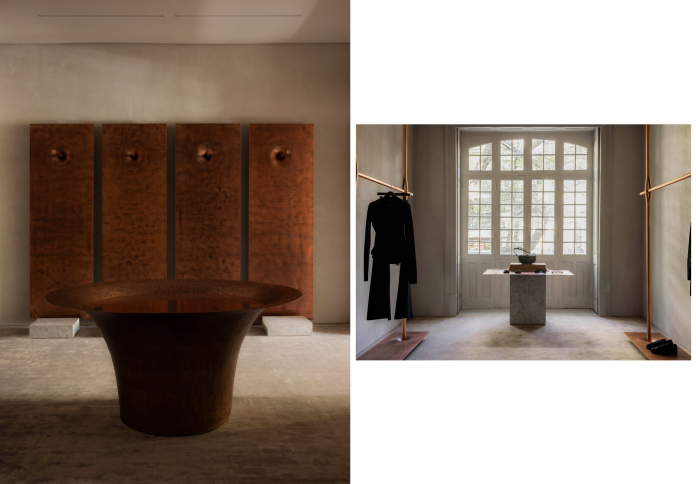
At first glance, the Colima 162 fashion boutique in Mexico City looks like a story about newness; in practice, it says more about how a restrained interior can use one locally crafted material to create identity without overwhelming a historic shell. The boutique occupies Colima 162, a Porfirian-era house in Mexico City's Roma Norte neighborhood that dates to 1919. Designers Laura V Lasagabaster and Manuel Bañó approached the interior with a strategy of minimal intervention. The recycled copper works because it is both contemporary display infrastructure and a visible link to Mexican metalworking, allowing the new retail layer to carry its own history. Rather than treating the moment as a checklist of products, names, or announcements, the more useful approach is to ask what changes for the people who actually use, watch, enter, or live with it. Adaptive reuse makes that task
From Concept to Occupation
The boutique occupies Colima 162, a Porfirian-era house in Mexico City's Roma Norte neighborhood that dates to 1919. Designers Laura V Lasagabaster and Manuel Bañó approached the interior with a strategy of minimal intervention. Copper changes with touch, light, and oxidation, which makes it a particularly apt material for a new layer inside a century-old building. The important point is not simply that these details exist, but that together they define the conditions of the story: who is making the decision, what has changed, and why the moment now feels different from an ordinary product release, workplace adjustment, episode recap, or interior refresh.
Adaptive reuse makes that task more demanding because the designer is working with two timelines at once. Existing structure carries physical and cultural information, while new uses require comfort, accessibility, services, and a clear identity in the present. In this case, that context sharpens how craft can function as retail infrastructure rather than cultural decoration. It also keeps the article from mistaking visibility for significance; the most photographed or repeated detail may open the story, but it is the relationship among the details that gives the subject its editorial weight.
Craft, Light, and Movement
Custom hand-hammered recycled copper elements were produced with artisans in Santa Clara del Cobre, a town known for copper craft. The copper appears in furniture and display supports rather than as a decorative surface applied indiscriminately across the rooms. Those facts create a more useful frame than hype alone. They show how the subject works at the level of format, process, casting, policy, material, or service rather than leaving it as an abstract trend. Using artisans for functional pieces gives the material a job to do and lets the making process remain connected to daily store operations.
Material choices matter most when they are tied to behavior. Timber can soften a retail room, metal can make a new intervention legible against an old shell, and movable furniture can turn a fixed shop into an event space; the effect comes from use, not from material prestige alone. That makes comparison important. The relevant question is not whether every consumer, institution, viewer, or visitor should respond in the same way, but which conditions make the idea work and which conditions expose its limits.
Commercial Space as Social Space
Existing historic character remains visible, allowing the new metallic elements to read as insertions rather than reconstruction. Lime-plastered walls create a quiet background whose texture contrasts with the reflective warmth of the copper. This is where the story moves from announcement to experience. The subject is interpreted through repeated choices: what gets emphasized, what becomes optional, what is standardized, and what remains dependent on individual judgment. The restrained background also prevents the copper from becoming a motif repeated until it loses meaning.
Preservation is therefore not synonymous with keeping everything untouched. In many projects, continuity comes from proportion, craft, structure, or ritual while new elements make the building usable again. The design judgment lies in deciding what deserves emphasis and what can change. For the Colima 162 fashion boutique in Mexico City, the tension is particularly visible in the commercial desire for a strong visual signature and the ethical need to avoid treating regional craft as an exotic styling device. That tension is productive when it leads to better choices and clearer expectations rather than simply producing another layer of marketing language or speculation.
The Discipline of Restraint
A bamboo-silk and wool rug adds another soft material layer to the retail environment. The boutique sits inside a mirrored historic house, giving the intervention an additional dialogue with reflection and symmetry. Those details also define the boundary of what can responsibly be claimed. Craft references are most persuasive when makers, technique, material origin, and function are genuinely embedded in the project rather than borrowed as surface imagery. An editorial reading can still be enthusiastic, skeptical, or aesthetically engaged without turning uncertainty into certainty.
The central tension is between atmosphere and legibility. A space can be theatrical without becoming confusing, and it can preserve traces of history without freezing them into décor. The best interventions make the relationship between old and new easy to feel even when it is not explicitly explained. The point is not to remove pleasure from the story. It is to make the pleasure more durable by separating what has been demonstrated from what is merely possible, and by recognizing that users and audiences bring different needs, tastes, and tolerances to the same idea.

When the Idea Survives Use
The project demonstrates how a limited palette can support luxury retail by making craft and proportion more memorable than visual abundance. As the metal develops patina, the interior may become richer rather than less perfect, allowing the new installation to acquire its own visible age. Seen this way, the subject is not a finished verdict but a snapshot of a system in motion. Products will be reformulated, software will be updated, series will continue, stores will age, and cultural labels will change; the useful editorial task is to identify which underlying choices are likely to remain meaningful when that happens.
That is why the project matters beyond its visual signature. It shows how design can turn constraints into character, using what is already present as a framework rather than treating the past as an obstacle. The boutique's luxury comes from editing: one material is given enough room to carry both function and memory. The strongest takeaway is therefore not a command to buy, believe, visit, or predict. It is a clearer understanding of why this moment matters now and what evidence will matter next.