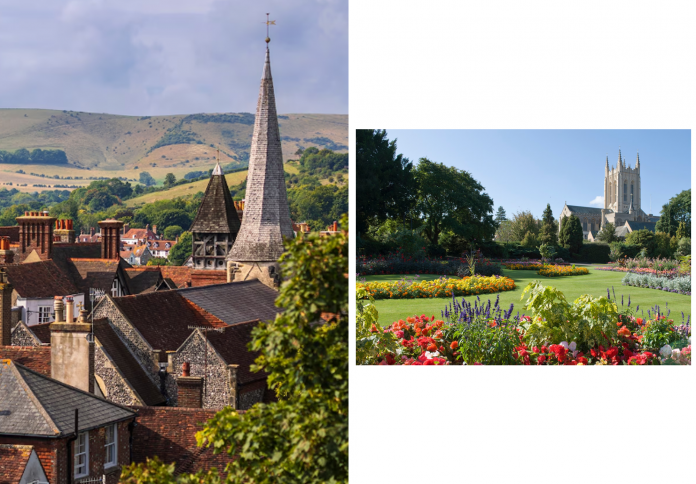
London’s greatest day-trip advantage is not a single attraction but the density of rail lines radiating from the capital. Within roughly two hours, travelers can exchange dense city streets for market towns, cathedral precincts, chalk hills and landscapes that feel distinctly local. The best rail escapes work because the station is not merely an arrival point; it is the start of a walkable day. Tring, for example, sits on the edge of the Chiltern Hills and pairs a compact market town with a free natural history museum and direct access to countryside trails. Similar journeys across southern and eastern England show how rail can turn a spontaneous free day into a complete change of pace without renting a car.
Tring Puts the Countryside Close to the Platform
Tring is a useful model for what makes a strong rail day trip. The journey from London Euston takes well under an hour, yet the town sits at the edge of the Chiltern Hills, where footpaths and reservoirs quickly replace urban traffic. The Natural History Museum, built around Walter Rothschild’s remarkable Victorian collection of zoological specimens, gives the town a substantial indoor attraction that is also free to enter. From there, travelers can walk through Tring Park or connect with routes into the hills. This combination matters. A successful day trip should not require perfect weather or complicated local transport. Tring offers a museum, a town center and countryside within a compact radius, which makes the journey feel flexible rather than scheduled.
Market Towns Reward Slow Exploration
England’s smaller towns often preserve patterns of urban life that central London has largely lost: market squares, historic high streets, parish churches, old coaching inns and footpaths that begin at the edge of residential streets. Rail travel allows visitors to encounter these places without the distraction of parking or major road routes. Bury St Edmunds, for instance, combines a cathedral with the 14-acre Abbey Gardens and a center shaped by medieval and Georgian history. Other well-connected towns offer their own combinations of literary associations, river walks or local food. The pleasure lies in modest scale. Instead of crossing a metropolis to reach the next attraction, travelers can spend hours within a few streets, then step into nearby countryside before returning to the station.

The Two-Hour Rule Is More Powerful Than It Sounds
A two-hour rail radius from London reaches surprisingly deep into southern and eastern England. That creates a psychological advantage: places can feel rural and historically distinct while remaining realistic for a same-day return. The trick is to choose destinations where the train delivers you close to the experience rather than to a distant suburban station. Direct services reduce the risk of missed connections, and towns with walkable centers keep the day from turning into another transport exercise. Travelers should also think about the return journey before leaving London, especially on Sundays or during engineering works. The freedom of a rail day trip depends on knowing that the evening train still exists. A little timetable discipline creates much more spontaneity once you arrive.
Walking Turns a Day Trip Into a Landscape Trip
The most satisfying rail escapes often combine a town with a walk. Tring’s access to the Chilterns is one example, but the principle applies broadly: use the train to cross the metropolitan boundary, then let footpaths determine the pace. This changes the experience from sightseeing to immersion. A morning coffee and museum visit can lead into several hours of fields, woodland or riverside paths before dinner back in town. Because England’s rights-of-way network is extensive, walkers can often build loops without private transport. Good footwear and weather awareness matter, but the logistical barrier is lower than many international visitors expect. Rail and walking together create an unusually low-friction form of travel in which movement itself becomes part of the day rather than wasted time between attractions.

Leave London Without Treating the Town as an Escape Room
Day trips can become competitive when travelers try to maximize every hour, but small towns resist that mindset. Their value is often atmospheric: a market at midday, a quiet churchyard, a local museum, an unexpected café and the sense that the streets are not organized around tourism alone. Rail makes this kind of travel easy because returning to London requires no hotel check-in or complicated road navigation. The city remains your base while the surrounding region becomes a sequence of temporary worlds. The best approach is therefore to pick one or two anchors and leave the rest open. London’s rail map is not simply infrastructure. For visitors willing to use it imaginatively, it is a menu of landscapes, histories and scales of life that sit much closer to the capital than they appear.
Rail Travel Is Also a Sustainability Choice
Choosing the train for short escapes reduces the need for rental cars and often makes the journey itself calmer. Central London stations connect directly to town centers, eliminating airport-style transfers and allowing travelers to begin walking immediately. The environmental advantage is meaningful, but convenience is what makes the behavior repeatable. A day trip that requires fewer decisions is more likely to become a habit for residents as well as visitors. Rail also supports local economies differently from driving to a large attraction: passengers arrive on foot and tend to move through high streets, cafés and small shops. The model works best when fares remain understandable and services reliable, two areas in which British rail can still frustrate travelers. Even with those caveats, the network remains one of London’s most underused travel assets. The city’s surrounding towns are not separate vacations; they are extensions of what a London base can make possible.