Play is often framed as a structured, rule-bound activity, yet the most enduring innovations in childhood development occur when those structures are dismantled. At a high school in Ingré, France, architecture studio Exercice has introduced “Ping Pong Park,” a series of four unconventional table tennis tables that defy the traditional rectangular constraints of the sport. By reimagining the ping-pong table as a sculptural object, the studio has transformed the school playground into a dynamic social laboratory. These tables do not merely facilitate a game; they invite students to negotiate, invent, and collaborate, proving that when the rigid rules of competition are removed, the resulting space becomes a fertile ground for social bonding and creative expression.
Sculptural Landmarks and Social Catalysts
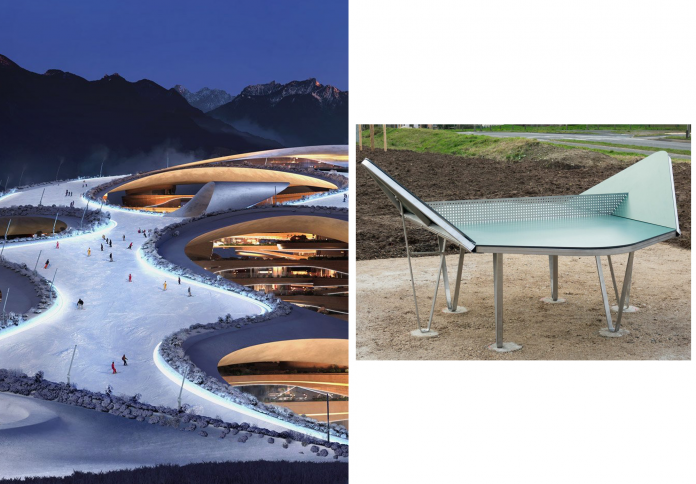
The “Ping Pong Park” project was conceived as a landmark within the school’s playground, shifting the focus from individual athletic achievement to collective participation. The four tables—each defined by a distinct aesthetic identity—are constructed from robust materials like galvanized steel and high-pressure laminate, designed to withstand the rigors of daily school life. More importantly, they are designed to be autonomous artworks, sculptural objects that stand as focal points even when not in use.

According to Exercice, the participatory nature of these objects ensures that the way they are used is constantly evolving. As students interact with the tables, they are required to define their own rules, creating a process of dialogue, negotiation, and shared decision-making. This approach moves the experience away from the “us versus them” mentality typical of competitive sports, fostering a more collaborative and imaginative environment where the students themselves become the co-creators of their own games.
Reimagining the Geometry of the Game
Each of the four tables introduces a unique geometric challenge that disrupts the standard gameplay:
- The Rebound: A futuristic-looking design with raised sides, this table forces players to anticipate complex ball trajectories as it rebounds vertically, requiring a new level of spatial awareness.
- The Golf: Featuring an organic shape that narrows toward the center, this table encourages longer shots. The inclusion of holes on either side allows players to incorporate custom rules, such as treating the holes as scoring targets or penalties.
- The Rotating: A circular table designed for tournante—the popular multi-player variant where players run around the table—the round form facilitates safe, continuous movement, allowing up to seven players to join the action simultaneously.
- The Trio: Informed by the “triolectical” theories of artist Asger Jorn, this three-part arrangement challenges the traditional two-sided configuration of most sports. It forces players to form temporary alliances and adapt their strategies to compete against stronger opponents through teamwork and negotiation.
A Universal Language of Connection
Exercice’s exploration of play as a “universal language” is evident in the studio’s broader body of work, which frequently examines how design can generate social bonds in public spaces. By stripping away the prescriptive rules of traditional table tennis, the studio has allowed the inherent, spontaneous creativity of the children to flourish. These tables are not just pieces of equipment; they are catalysts for social interaction that turn a standard recess break into a sophisticated, ever-changing game of social strategy.

The reception to the project has been overwhelmingly positive, with the design community praising the studio’s “genius” approach to transforming a simple leisure activity into a more meaningful social intervention. By proving that “play” can be a powerful architectural tool, Exercice has successfully highlighted the potential for designers to reshape institutional environments into more human-centric, collaborative spaces. In doing so, they have reminded us that sometimes the most effective design solution isn’t about solving a technical problem, but about creating an environment that invites people to think, connect, and play differently.