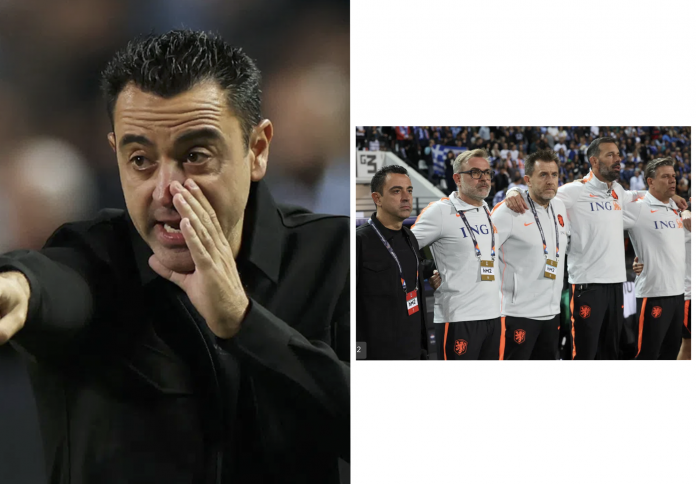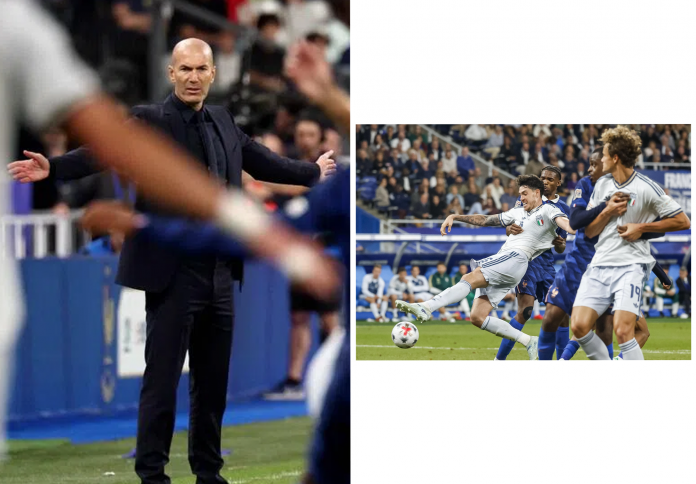
The scoreline at the Stade de France offered a useful correction to the celebratory mood around Zinedine Zidane's first home appearance as France manager. Two narrow away victories had launched his tenure, and Michael Olise's second-half strike appeared to be extending that sequence against Italy. Instead, a defensive mistake gave Alessandro Bastoni the opening to equalize, while Dayot Upamecano's late dismissal complicated an evening shaped by expectations as much as football. The 1-1 draw on October 2 left France top of their Nations League group, but it also exposed the distance between controlling a match and managing its decisive moments. With Italy finding its way back into a contest that France frequently directed, the new coach's return to familiar surroundings became a test of his team's precision, patience and defensive judgment.
An Emotional Return Meets a Relentless Opponent
Zinedine Zidane had little need for an introduction to the Stade de France. As a player, he had delivered some of the national team's defining moments, and the sight of him on the sideline as manager inevitably connected the present squad with a longer football history. Italy sharpened that connection. It was the team France faced in the 2006 World Cup final, the last international match of Zidane's playing career and one remembered for both its penalty shootout and his dismissal in extra time.
The symbolism did not guarantee a comfortable evening. France arrived with 1-0 Nations League wins over Turkey and Belgium, having established early results without overwhelming opponents on the scoreboard. For Zidane, this third match presented a different examination: a home crowd, a historically significant opponent, and the need to convert territorial control into a score that could withstand the opposition's next attack.
Italy did not approach the fixture as a passive guest. Roberto Mancini's side had the ability to absorb pressure and then break decisively. The contest demonstrated that a side can spend extended periods defending without losing the capacity to create the more dangerous opening. France enjoyed spells of fluent possession, but Italy's early chances served notice that the home side's dominance was not complete.
Possession Without the First-Half Reward
The clearest early warning came from Moise Kean, who found an opportunity inside the French area but shot at Mike Maignan. For France, the episode suggested that advancing numbers and circulating the ball around Italy's defensive shape could leave openings elsewhere. The hosts were making the game, yet they were also being asked to respond quickly when possession changed hands.
Olise supplied France's most threatening attacking gestures before the interval. One deflected delivery struck the crossbar, but the consistent pressure did not produce a first-half goal. Italy's Davide Frattesi also threatened, his attempt diverted behind for a corner. These chances gave the match a different texture from a simple account of French dominance: the teams were creating danger in contrasting ways, one through sustained pressure and the other through more selective bursts.
The absence of a breakthrough placed greater weight on Zidane's halftime adjustments and on the quality of the players operating between the Italian lines. A packed defense can survive passing sequences that look sophisticated from the stands. It is the timing of a final pass, a changing angle, or an individual strike that forces a goalkeeper into a meaningful intervention.

Olise Finds the Angle Donnarumma Cannot Cover
France began the second half with sharper intent. Gianluigi Donnarumma had to deal with efforts from Désiré Doué and Ousmane Dembélé in quick succession, then stretch to deny an Olise attempt. Those saves mattered because they kept Italy level during the period when the home side's attacking combinations were at their most dangerous.
The breakthrough arrived in the 55th minute through a set piece. Rayan Cherki played the ball to Olise, who curled his shot in off the crossbar. It was an emphatic finish and an illustration of why set-piece variation can unlock a compact opponent when open-play movement has not done so. Rather than relying on another long spell of circulation, France created a direct shooting angle and took it.
Olise had been among the night's most influential French players, and the goal gave the home crowd the kind of moment the occasion had promised. But a single-goal lead is also fragile, especially against an opponent that remains alert to defensive errors. France now had to make choices about tempo: whether to continue hunting a second goal or control possession with a different degree of caution.
The value of Donnarumma's earlier saves became clearer as the match went on. Had France converted one of those opportunities, the later defensive mistake might have been less costly. Instead, the goalkeeper's resilience allowed Italy to remain within one action of restoring parity.
Bastoni Punishes a Moment of Uncertainty
Italy's equalizer in the 68th minute was not the culmination of a long, ornate move. France tried to play out of defense, but Lucas Da Cunha failed to secure a pass. Bastoni seized the ball, surged forward and beat Maignan. A defender had suddenly become the decisive attacker, illustrating how quickly the shape of a game can reverse when possession is lost in a vulnerable area.
The mistake crystallized the central tension of Zidane's early tenure. France wanted to dictate how the ball moved, and the team had shown the technical ability to do so. Yet the same insistence on building from the back could become hazardous when a receiver was hurried or a pass lacked precision. The relevant lesson was not that France should abandon construction from deep. It was that every player participating in it must recognize the changing risk around the ball.
Italy had achieved its immediate task: keep the match alive, wait for a chance and take it. The equalizer did not erase France's opportunities or the attacking quality that produced them. It did change the result, which is the stubborn fact around which a football match is ultimately judged.

A Red Card and a Table Still Open to Debate
France searched for another goal, and Eduardo Camavinga drew an excellent save from Donnarumma. But a late second yellow card for Dayot Upamecano left Zidane's side with ten players in the closing minutes. The dismissal added another disruption to a night already defined by the inability to turn a lead into victory. A team still trying to find its rhythm under new management had to finish in reduced numbers.
Elsewhere in the group, Belgium beat Turkey 3-0, with Kevin De Bruyne scoring twice. France consequently stayed first on seven points, one ahead of Belgium, while Italy sat on four. That position offered reassurance: a draw against Italy had not undone the two wins that preceded it. Yet the narrow margin also meant that the team's next assignment against Belgium would arrive with the standings tightly contested.
This was a match in which two kinds of progress existed side by side. Zidane's players created enough to win, showed encouraging energy after halftime, and found a fine goal through Olise. They also surrendered the advantage through an avoidable error and completed the contest a man short. Those details made the result more instructive than the scoreline alone.
For the new manager, the challenge after this home debut was less about revisiting the emotional significance of France versus Italy than about refining the ordinary mechanics of winning. The pass out of defense, the finishing touch after a goalkeeper's save, and the discipline to finish with eleven players are rarely as photogenic as a curling free kick. At the Stade de France, however, they were exactly what separated a compelling occasion from a third consecutive victory.