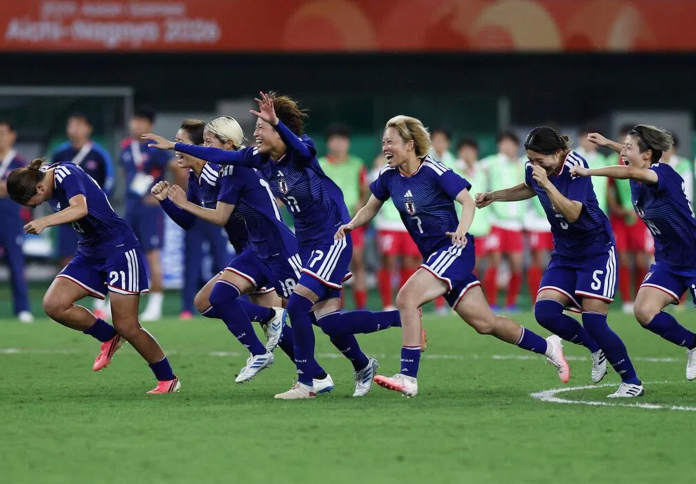
For much of the Asian Games women’s football final on October 2, 2026, North Korea appeared ready to end Japan’s run at the top of the competition. The hosts had scored first, lost control of the lead and then watched their opponents turn the match around. With four minutes of regulation time remaining, Japan still trailed. Hanon Nishino’s late equalizer changed the atmosphere at Shizuoka Stadium, forcing extra time and ultimately a penalty shootout. Goalkeeper Shu Ohba then made the decisive intervention, saving a North Korean penalty before Yuzuho Shiokoshi converted the kick that secured a 5–3 shootout victory. The final was a striking reminder that championship football is shaped not only by quality sustained over ninety minutes but by particular moments: a team’s refusal to accept a narrowing clock, a goalkeeper’s judgment and the composure required to finish a final under pressure.
Japan Took the Lead, but Not Control
The final at Shizuoka Stadium began with Japan taking the first significant advantage. Mami Ueno scored in the 32nd minute, giving the hosts the lead over a North Korean side with the capacity to contest the match at a high level. In knockout football, an opening goal can alter the balance between risk and caution. It did not, however, give Japan an uncomplicated path to gold.
North Korea equalized through Jong Kum shortly after halftime, in the 47th minute. Then Jon Ryung Jong scored in the 69th, completing a turnaround that positioned the visitors to win. Japan now faced a different tactical and emotional problem: finding a second goal before time expired while remaining alert to further damage against a team whose confidence had grown through two unanswered goals.
A final often seems to have a single decisive turning point, but this one contained several shifts in its internal logic. Japan had the early scoreboard advantage. North Korea demonstrated that a deficit was recoverable. By the final quarter-hour, Japan had become the chasing team and North Korea the side trying to preserve a narrow lead. That reversal made the closing minutes a test of composure rather than merely an exercise in attacking ambition.
Four Minutes from the End
Hanon Nishino’s equalizer came in the 86th minute. The exact timing matters. With regulation time almost complete, the opportunity for a conventional comeback was disappearing; a late goal was no longer just one contribution among many but the intervention that kept the final alive. It also meant Japan could contest the title in extra time rather than leaving the tournament with silver.
The second Japanese goal changed the contest for both teams. For the hosts, an apparently lost final suddenly offered a new beginning. For North Korea, the challenge was to regroup after seeing an advantageous position disappear so close to the end. Neither emotional response is unusual, but both become unusually intense when a continental title is at stake and the match has exhausted nearly its full regulation period.
Extra time produced no winner. The absence of another goal did not make that period irrelevant: by preserving the tie, the teams transferred responsibility to a different kind of contest. A shootout requires technical skill, but the basic circumstances differ drastically from open play. There is no system of overlapping runs or coordinated pressing to disguise an individual decision. Each taker walks to the spot carrying a visible share of the result.
Shu Ohba's Defining Intervention
Penalty shootouts can create unlikely protagonists or confirm a player’s importance in a sudden, highly public manner. Shu Ohba became central to Japan’s victory when she saved Jong Kum’s attempt in the third round. Her intervention broke the symmetry of the kicks and handed Japan a critical advantage. Goalkeepers spend much of a match protecting space and organizing teammates; in a shootout, one correctly timed movement can become the image by which an entire final is remembered.
The pressure did not end with the save. Japan still needed its kickers to complete the job. Yuzuho Shiokoshi ultimately struck the winning penalty, completing the 5–3 shootout score and turning Ohba’s stop into the decisive separation between the teams. Their contributions illustrate the shared nature of what is often presented as an individual hero moment. A saved penalty matters most when teammates capitalize on it, and a winning kick depends on everything the team did to reach that point.
North Korea’s disappointment should not obscure how close the side came to victory. It recovered from falling behind in the first half, scored twice and held the advantage deep into the second. The eventual defeat followed a late Japanese recovery and a single saved attempt within the shootout. Those details make the final more revealing than a simple record of the winners and runners-up.
A Third Consecutive Asian Games Crown
Japan’s win extended an exceptional run in the women's event. It was the country’s third consecutive Asian Games title and fourth overall. Records of this kind inevitably compress individual matches into neat sequences, yet the 2026 final was anything but routine. Maintaining a winning streak required a late equalizer and the ability to withstand the specific tension of penalties after two hours of football had failed to settle the title.
The setting strengthened the occasion's significance. Japan was playing at a home Asian Games, with the medal contest taking place in Shizuoka. Home conditions can create familiarity, expectation and a stronger sense that a sporting result belongs to a larger national event. None of those advantages puts the ball in the net. The match’s final sequence showed that Japan still had to respond to adversity in real time rather than relying on its record.
Successive gold medals also reflect the depth of competitive standards expected of a national program. Players change between tournaments, the opposition adapts, and the route to a final is never identical. Sustained success is therefore better understood as repeated solutions to new circumstances than as a single inherited entitlement to win. In 2026, Japan's answer required both a forward capable of scoring with time running out and a goalkeeper able to make the crucial save.
The Score Beyond the Shootout
There is a temptation to describe any match decided on penalties as a lottery. That metaphor captures the suspense but risks missing the work behind each kick. The shootout at Shizuoka followed a game containing five major changes of scoreboard position or momentum: Japan's opener, North Korea's equalizer, North Korea’s lead, Japan’s late leveling goal and, finally, Ohba’s save. The outcome was shaped by the teams’ actions long before the final ball reached the net.
For Japan, the title will be attached to a specific group of players whose composure survived the final's most difficult moment. For North Korea, the match stands as evidence of a team capable of forcing the reigning champions to the limit, even though its advantage ultimately slipped away. Both stories belong to the same final, and neither can be reconstructed from the penalty score alone.
The enduring scene is not simply a player celebrating a winning spot kick. It is the chain that made that kick possible: Nishino scoring when the clock was nearly exhausted, Ohba anticipating and stopping a shot, and Shiokoshi accepting the responsibility of the final attempt. Japan's gold was secured in the shootout, but it was rescued four minutes before regulation time ended.