At 40, Joshna Chinappa has little left to prove about her place in Indian squash, yet she is still finding reasons to compete. The 2026 Asian Games in Japan offered another measure of her endurance: a mixed doubles bronze alongside Velavan Senthilkumar, bringing her career Asian Games medal count to six. Her record seventh appearance at the continental competition would be remarkable even without the physical setbacks that have complicated her career. Chinappa’s story is not simply that of an established athlete resisting retirement. It is about learning how to remain competitive while the sport, its younger challengers and the demands on her own body keep changing. For an Indian squash generation approaching Olympic opportunity, her longevity offers a particularly tangible example of what sustained commitment can look like.
A bronze that carries twenty years of context
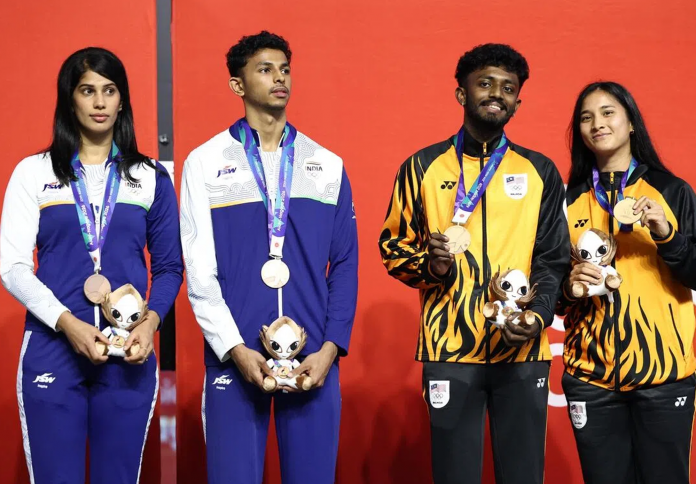
The podium in Nagoya was not the kind of finish that usually announces the beginning of an athletic career. Chinappa stood with Velavan Senthilkumar after India's mixed doubles campaign, part of a medal ceremony that also featured the Malaysian pair Ameeshenraj Chandaran and Rachel Mae Arnold. Yet the bronze was a significant addition to an already extensive Asian Games record: six medals, gathered across a career long enough to encompass dramatic changes in the Indian squad.
Chinappa had secured that podium finish when she and Senthilkumar reached the mixed doubles semifinals. Their quarterfinal victory over the Philippine pair David Pelino and Jemyca Aribado came in straight games, 11-3 and 11-5. A scoreline like that can make progress look straightforward. At a major multisport event, however, the effectiveness of a partnership depends on movement, communication and choices made under pressure, particularly when opponents aim to expose gaps between two players.
The sixth medal also mattered because it belonged to her seventh Asian Games. Participation on that scale puts an athlete in conversation with several different eras of competition. Teammates grow up, new rivals appear and expectations surrounding the national team change. The simplest description, that she is still playing at 40, does not capture the continual adjustment required to reach another podium.
The work that remains after injury
Serious knee injuries have interrupted Chinappa's career, making longevity an issue of practical management rather than personal mythology. Squash asks players to accelerate, stop abruptly and recover their position in restricted space. Even a small loss of confidence in the knee can change how someone enters a rally. Recovery therefore concerns decision-making as well as physical capacity, and competitive readiness cannot be measured only by whether a player has returned to the court.
Chinappa has pointed to disciplined fitness work and the support of people around her as important to remaining active. The value of that support is easy to underestimate. Coaches, trainers and medical professionals can help an athlete interpret fatigue, manage setbacks and avoid treating every difficult session as a referendum on their future. There is an emotional element too: training must still feel worthwhile when a younger opponent can recover faster or attack a rally differently.
Age can also change the way a player uses experience. Anticipation and court positioning cannot replace movement altogether, but they may reduce needless movement. Choosing when to lengthen an exchange, when to cut it short and when to take a calculated risk becomes an important form of efficiency. Such refinements make later-career performances distinctive rather than an imitation of an athlete's earlier style.
Mixed doubles brings a different calculation
Singles squash offers one player complete responsibility for the geometry of the court. Mixed doubles introduces another problem: responsibility has to be shared. Chinappa's partnership with Senthilkumar illustrated why a veteran's contribution should not be reduced to an age-related headline. Tactical awareness and communication acquire a different weight when two players are trying to occupy an exceptionally demanding playing space.
Senthilkumar belongs to a different phase of India's squash development, and their Asian Games medal connects those periods. The pairing was not merely a ceremonial combination of established and emerging talent. It produced a competitive result against an international field. Its success underscores the value of making experience useful in the present, rather than treating it as a historical credential.
That lesson extends beyond their own court. India's tournament also featured young talent: Anahat Singh advanced to the women's singles semifinals, while Abhay Singh reached the men's singles last four. Within the same event, Indian squash could display both the accumulated knowledge of a long-serving competitor and the energy of athletes building their own records.
An Olympic horizon for the next generation
Squash is scheduled to make its Olympic debut at Los Angeles 2028. The sport's new place on that stage changes the ambitions available to players who once regarded the Commonwealth and Asian Games as their principal multisport showcases. For India's younger athletes, preparation now includes a visible Olympic target, not simply the hope that the sport might eventually join the program.
Chinappa has expressed belief in younger Indian players' medal potential. Her perspective is informed by years of competition rather than a promise that an Olympic result will follow automatically. The difference matters. Talent needs sustained high-level exposure, coaching and physical development. It also needs a national program able to carry momentum from one promising tournament into the next season.
In that context, veteran role models provide something specific. They reveal what top-level careers require between the televised moments: repeated conditioning, willingness to adjust and the ability to return after disappointment. A successful sports system needs those less glamorous examples as much as it needs a breakthrough performance.
Not yet a farewell
An Asian Games gold remains a goal that Chinappa has not discarded. The ambition complicates any neat story about a 40-year-old player who has already achieved enough. She can be proud of six medals while still regarding an unfinished objective as worth pursuing. Such a position is more credible than the familiar assumption that every veteran appearance must be framed as a goodbye.
There is no reason to pretend that competing indefinitely is simple. The physical demands of squash remain severe, opponents continue improving and careful management is not a guarantee against injury. But her record shows that adaptation can produce more than respectable appearances. In Nagoya, adaptation helped produce another actual medal.
Chinappa's place in Indian sport is now both historical and immediate. The record of seven Asian Games trips belongs to the past; the bronze with Senthilkumar belongs to 2026. The combination explains why her career remains relevant. She is not merely someone whose achievements younger athletes inherit. She is still participating in the competitions that will shape what those athletes attempt next.