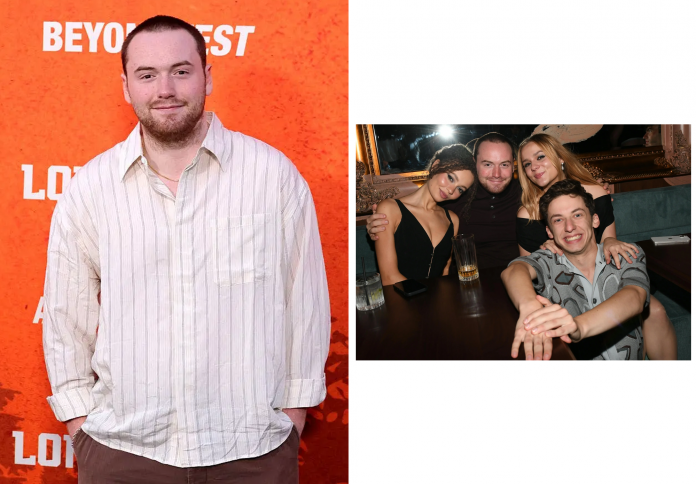
Cooper Hoffman entered film with a surname that already carried enormous weight. The son of Philip Seymour Hoffman, he made his screen debut in Paul Thomas Anderson’s Licorice Pizza in 2021, playing Gary Valentine opposite Alana Haim. The role immediately placed him under the double gaze faced by children of celebrated actors: audiences were evaluating both the performance and every trace of resemblance to a parent whose work remains deeply admired. Hoffman followed that debut with projects including Saturday Night and the 2025 adaptation of Stephen King’s The Long Walk, gradually establishing a screen identity built around openness, awkwardness, intensity, and an absence of conventional leading-man polish. The useful question is not whether talent can be inherited. It is how a young performer converts access and comparison into choices that feel personally authored. Hoffman’s early career suggests the answer is to keep working in roles that make comparison less important.
Licorice Pizza Was an Unusually Exposed Debut
Most actors are allowed to learn on screen before a large audience knows their family history. Cooper Hoffman did not have that luxury. Paul Thomas Anderson cast him as Gary Valentine in Licorice Pizza, a sprawling adolescent entrepreneur whose confidence repeatedly outruns his experience. Anderson had worked closely with Philip Seymour Hoffman, making the casting emotionally charged before filming even began.
The performance succeeded because Cooper did not appear to imitate his father. Gary is impulsive, funny, pushy, romantic, and physically unguarded. Hoffman’s lack of a polished star persona became an advantage. He looked like a teenager inventing himself in real time, which matched the film’s loose, episodic portrait of 1970s San Fernando Valley youth.

The Family Name Creates Opportunity and Pressure at Once
It would be artificial to discuss Hoffman’s career without acknowledging access. Being the child of an acclaimed actor creates proximity to filmmakers, sets, cultural knowledge, and networks that most aspiring performers do not possess. That reality is part of the story.
But access does not determine what happens once a camera is running. A famous surname can also make failure unusually visible. Every gesture risks comparison with a parent whose performances in Capote, The Master, Doubt, and countless stage and screen roles have been extensively studied. Cooper’s challenge is therefore not to prove that the connection does not exist. It is to build enough work that the connection stops explaining everything.
Saturday Night Put Him Inside an Ensemble Machine
In Saturday Night, Jason Reitman’s film about the chaotic lead-up to the first broadcast of Saturday Night Live in 1975, Hoffman played Dick Ebersol. The ensemble format was useful after a debut in which he carried enormous narrative weight. It required him to contribute to rhythm and atmosphere rather than function as the singular discovery at the center of the film.
That kind of supporting work can be especially valuable for a young actor with immediate name recognition. It shifts attention from biography toward craft: listening, timing, reaction, and the ability to occupy a larger group without demanding that every scene prove star potential.
The Long Walk Asked for a Different Kind of Endurance
The 2025 adaptation of Stephen King’s The Long Walk placed Hoffman in a harsh dystopian story centered on young men forced into a deadly endurance contest. As Raymond Garraty, he moved from the conversational looseness of Licorice Pizza into material where physical exhaustion, fear, and moral pressure shape nearly every interaction.
The contrast helped widen his screen identity. A career becomes more durable when an actor can alter the emotional temperature around familiar qualities. Hoffman’s openness can read as comic innocence in one film and vulnerability under threat in another. That flexibility is more useful than chasing roles designed to showcase resemblance to his father’s intensity.
The Most Respectful Legacy May Be an Independent One
Philip Seymour Hoffman’s career was defined partly by a refusal to divide roles into glamorous leads and supposedly lesser character parts. He could dominate a film from the side, make unpleasant people human, and move between theater and cinema without simplifying his choices into a single star brand.
Cooper Hoffman is far too early in his career for meaningful equivalence, and comparisons can become unfair to both actors. Yet there is one productive lesson in the family legacy: specificity matters more than image maintenance. His strongest path is not to become “the next” Philip Seymour Hoffman. It is to keep choosing work that requires a new problem each time. The surname will remain part of every profile, but a filmography can gradually become a stronger introduction than a family tree.
Hoffman’s Early Roles Benefit From a Lack of Manufactured Cool
Hollywood often introduces young male actors by polishing them into an immediately marketable image. Cooper Hoffman’s screen appeal has moved in the opposite direction. He can be loud, awkward, physically unguarded, overconfident, or frightened without seeming concerned about protecting conventional leading-man glamour. That quality was essential to Licorice Pizza and remains useful as he moves into darker material.
It also creates distance from the easiest form of comparison with his father. Philip Seymour Hoffman’s power came from enormous specificity, but his characters were rarely arranged around vanity. Cooper does not need to imitate that style to inherit a useful lesson from it: interesting behavior matters more than looking impressive. The more varied his roles become, the less every performance needs to carry the burden of family explanation. A young actor cannot control the surname printed in every profile, but he can control whether the work keeps providing new evidence. If Hoffman continues choosing characters who are messy enough to resist branding, the filmography itself can gradually become the answer to the question people currently ask through biography.