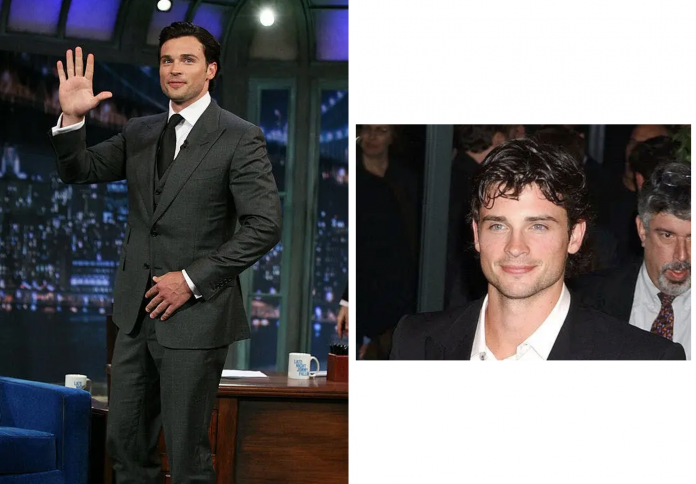
Looking back at young photos of Tom Welling is less about early-2000s celebrity nostalgia than about remembering a different phase of superhero culture. Welling became a star as Clark Kent on Smallville, which premiered in 2001 and spent ten seasons imagining Superman before the cape. The series focused on adolescence, family, friendship, romance, and the slow discovery of power rather than rushing toward the fully formed icon. Welling’s own image fit that approach: he looked less like a distant myth than a strikingly normal young man who happened to be carrying extraordinary potential. Outside the show, he moved into films including Cheaper by the Dozen and The Fog, then later returned to television and eventually revisited the Smallville world through retrospectives and his Talk Ville podcast with co-star Michael Rosenbaum. The photos now document a pre-cinematic-universe era when becoming Superman could take an entire decade.
Smallville Made Delay Its Superpower
Smallville began with a premise that now feels almost radical in its patience: Clark Kent would spend years becoming the person audiences already knew he was destined to be. The show treated the Superman mythology as a coming-of-age structure, allowing powers to emerge alongside ordinary problems involving parents, school, friendships, romance, and responsibility.
Tom Welling was central to making that delay believable. His Clark needed to look physically capable of becoming Superman while still feeling uncertain enough to remain a teenager and young adult. The tension between strength and hesitation gave the series its emotional engine. The cape mattered precisely because it remained in the future.

Welling’s Face Became Part of Early-2000s Television Culture
Young photographs of Welling carry the visual codes of their period: premiere photography, magazine shoots, simpler red carpets, and a celebrity ecosystem that had not yet been reorganized around social media. Actors could become globally recognizable television stars without maintaining a daily public feed or continuously narrating their private lives.
That distance helped Welling’s Clark retain a degree of mystery. Viewers encountered him primarily through the series and traditional entertainment media. Today, when superhero casting can generate years of online analysis before a project premieres, the relative quiet around the early Smallville era feels almost unfamiliar.
The Series Arrived Before the Shared-Universe Machine
Smallville premiered years before the Marvel Cinematic Universe and before interconnected superhero franchises became one of Hollywood’s dominant industrial models. Its storytelling could therefore be expansive without constantly serving a larger theatrical slate. DC characters appeared and mythology deepened, but the series’ central obligation remained Clark’s personal development.
That context helps explain why Welling’s performance still occupies a distinctive place among Superman interpretations. He spent far more screen time on Clark Kent’s unfinished self than most actors ever receive. The audience watched him fail, learn, resist, and mature across ten seasons rather than meet him after the mythology had already solidified.
Film Roles Let Him Step Outside the Cape Question
During and after Smallville, Welling appeared in projects including Cheaper by the Dozen, Cheaper by the Dozen 2, The Fog, and later Draft Day. These roles offered different tones but could not fully escape the cultural shadow of Clark Kent. A decade-long television part can become less a credit than a permanent association.
Welling generally avoided chasing another superhero identity immediately, which helped preserve Smallville as its own chapter rather than the first step in a franchise-focused career. Later television appearances, including Lucifer, allowed him to return to genre work from a different stage of life.
Revisiting Smallville Turned Nostalgia Into Conversation
Welling eventually began looking back at the series more directly, including through Talk Ville, the rewatch podcast he hosts with Michael Rosenbaum, who played Lex Luthor. The format transforms nostalgia from a gallery of old images into an active reconsideration of how television was made, what the actors remember, and how the show looks with distance.
That is why young photos of Welling feel more culturally specific now. They capture an actor becoming famous at the same time superhero entertainment itself was changing. Smallville belonged to an era before every cape was expected to anchor an interconnected commercial universe. Its pleasure came from watching a person grow toward a symbol slowly. Welling’s early image remains inseparable from that idea: Superman, not yet Superman, standing in the long space between ordinary youth and cultural myth.
Smallville’s Slowness Looks More Radical in the Streaming Era
Ten seasons allowed Smallville to repeat, delay, contradict, and revise Clark’s development in ways a two-hour origin film cannot. Not every storyline benefited from that length, but the accumulation created a rare sense that becoming heroic was a habit rather than a single revelation. Clark made similar mistakes more than once. Relationships changed gradually. Responsibilities became clearer because viewers spent years watching him resist them.
Contemporary streaming series are often shorter and more tightly serialized, while superhero films must serve large franchise schedules. Smallville came from broadcast television, where twenty-plus-episode seasons could create vast amounts of ordinary time around mythology. That ordinary time is part of why Tom Welling’s Clark remains distinct. Viewers saw him at school, on the farm, at work, with parents, friends, and romantic partners long before the final symbolic transformation. Young photos of Welling therefore evoke more than a face from the early 2000s. They evoke an industrial model of television capable of letting a superhero story linger inside adolescence for years—a luxury of duration that may now be harder to reproduce than any special effect from the series.