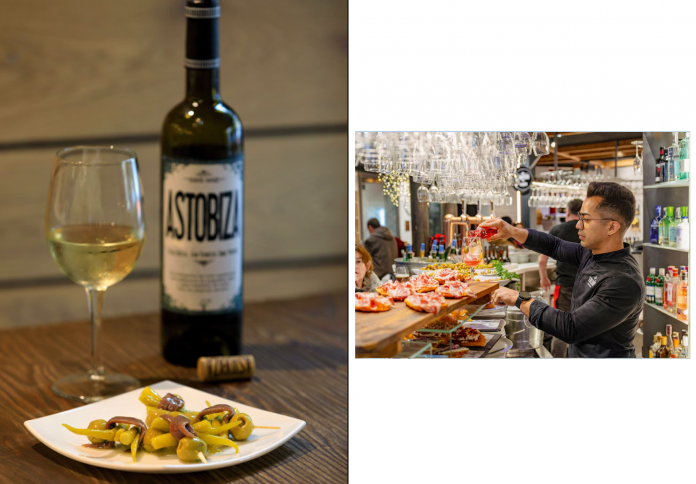
While San Sebastián often steals the culinary spotlight in the Basque Country, another city is quietly crafting some of Spain’s most inspired pintxos. Welcome to Vitoria-Gasteiz—the region’s political capital and a gastronomic treasure trove where tradition, creativity, and community thrive. Join us for a poteo through this underrated city’s vibrant pintxos bars, from cobbled alleyways to elegant plazas.
A different kind of Basque experience
At El Toloño, one of Vitoria-Gasteiz’s most beloved pintxos bars, head chef Josu Armiño offers insight into what makes the city’s culinary identity so distinct. “What we have here is simplicity,” he says, neatly dressed in chef’s whites. “It’s all about the quality of the ingredients. That’s our secret.” He leans against the polished bar beneath the arches of the neoclassical Plaza de la Virgen Blanca, as plates of intricate pintxos are carefully lined up for the lunchtime rush.
Unlike some kitchens in nearby San Sebastián, El Toloño doesn’t lean on avant-garde techniques or foams. Instead, the focus is on tradition—classic Basque flavours elevated just enough to feel modern without losing their soul. The bar’s gilda is a perfect example: a plump olive, pickled guindilla pepper and an anchovy skewered together in salty, spicy harmony. Named after Rita Hayworth’s character in the 1946 film Gilda, the pintxo has the same bold, unforgettable bite.
The poteo: Pintxos with a pulse

Vitoria-Gasteiz’s food culture is built around the poteo—a Basque tradition of hopping from bar to bar, sharing pintxos and sipping small glasses of wine or beer. It’s a culinary ritual that turns a simple meal into an evening of conversation, connection, and discovery.
As the gilda pairs beautifully with a cold pour of txakoli—the Basque’s beloved lightly fizzy white wine—the atmosphere inside El Toloño begins to swell. The chatter of middle-aged men in puffer jackets and sharply dressed professionals bounces off the slate-toned walls and black-and-white tiled floors. Despite the buzz, there’s none of the elbow-jostling you’d expect in San Sebastián. Vitoria moves at its own rhythm—unhurried, open, and refreshingly local.
Innovation with a sense of humour
A short walk through the elegant, tree-lined avenues brings me to PerretxiCo, a modern pintxos bar known for playful innovation. Among its award-winning creations is La Vacuna—”the vaccine”—a cleverly conceived beef meatball encased in golden batter, topped with flying fish roe and served with a plastic syringe filled with beef jus.
Head chef Josean Merino, dressed in a black apron and brimming with energy, explains the origin of the dish: “It was during the pandemic. We wanted to inject a bit of humour—literally and figuratively.” But there’s more to it than novelty. “Pintxos are among the most challenging dishes to prepare. You need to concentrate layers of texture and flavour into just one or two bites.”

The result is as thoughtful as it is theatrical. The savoury warmth of the gravy seeps into the tender meat, perfectly balanced by the crunch of the coating and the briny pop of roe. Here, technique serves emotion, and the emotion is joy.
History served on a slice of bread
Winding uphill into the medieval Old Quarter, I find myself beneath the shadow of Vitoria’s 13th-century cathedral and among the crooked timber-framed houses that mark its oldest streets. My next stop, El Portalón, is set in a 15th-century inn once used by traders and travellers. Today, it’s one of the city’s most cherished restaurants—and a place where the past meets the plate.
Sitting in the cobbled courtyard, I’m served pulpo carpaccio—thin slices of octopus dusted with sweet paprika, served atop crusty house-baked bread. It’s a dish that feels simple, almost rustic, yet every detail has been refined. Dried red peppers add texture and a mellow heat, highlighting the octopus’ tenderness.
El Portalón’s head chef and manager, Alberto Ortiz de Zárate, explains the philosophy behind the city’s food culture: “It’s about quality, yes—but also about time. Time at the table. Time with people you care about. That’s what matters here.” He smiles warmly, recalling the years he spent learning under his father in this very kitchen. “When people appreciate good food, they’re willing to invest in it. That allows us, as chefs, to source better ingredients and honour the traditions that raised us.”
More than just a meal
While Vitoria-Gasteiz may lack the seaside glamour of San Sebastián or the international acclaim of Bilbao, it offers something arguably more rare: authenticity without pretense. Its inland setting gives it access to both the rich produce of the Basque countryside and the seafood bounty of the Bay of Biscay. This geographical advantage, paired with a strong communal culture of eating and gathering, has fostered a food scene as grounded as it is imaginative.

The lack of a nearby airport or beachfront might deter some tourists—but that’s part of the charm. In Vitoria, you can eat extraordinarily well without the crowds, and every meal feels like a discovery shared by locals and a few lucky visitors.
How to visit
Getting there: Vitoria-Gasteiz is easily reached from Bilbao, which has the nearest international airport. Direct buses from Bilbao city centre take around one hour.
Where to stay: The centrally located NH Canciller Ayala Hotel offers modern rooms just minutes from the medieval quarter. Rooms start from €120 per night, including breakfast.
Vitoria-Gasteiz doesn’t shout to be noticed—it simply cooks, serves, and shares. For anyone willing to stray from the Basque mainstream, it’s a city full of bite-sized masterpieces, rich tradition, and a table always ready for one more guest.