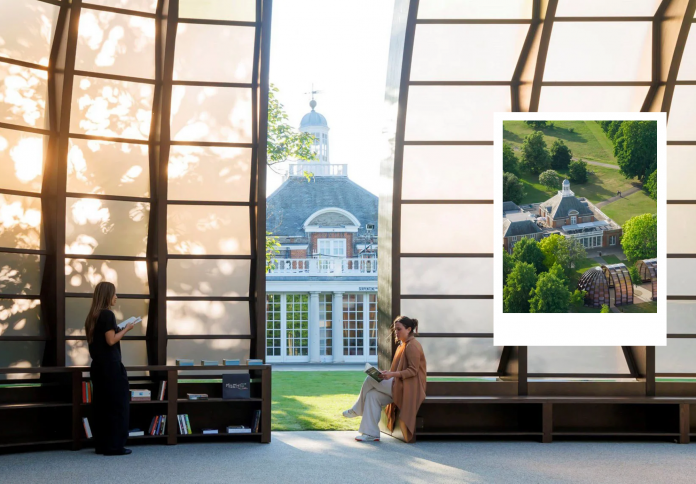
Bangladeshi architect Marina Tabassum’s 2024 Serpentine Pavilion is more than a temporary architectural installation—it’s a meditation on light, impermanence, and the dissolution of spatial boundaries. Designed with a poetic sensibility rooted in her native landscape, the pavilion is both a structure and a story, unfolding over a summer and leaving behind a legacy of form, memory, and resilience.
A pavilion that breathes with the park
Set against the lush expanse of London’s Kensington Gardens, A Capsule in Time emerges not as a monolithic intervention, but as a light-filled, almost ethereal structure. Designed by Marina Tabassum Architects for this year’s Serpentine Pavilion commission, the building consists of four timber-arched modules arranged around a central courtyard. The design creates a partially enclosed yet porous environment, embodying the architectural sensibility of Bangladesh, where architecture often blurs the lines between inside and out.
“[The pavilion] has this very archaic form and has a certain sense of enclosure,” Tabassum explained. “But we’ve made these cuts, and that also creates a connection to the park and the surrounding. There is a blurring of the boundaries.”

In Tabassum’s view, this openness isn’t just aesthetic—it’s cultural and climatic. In Bangladesh’s subtropical context, the fundamental requirement of shelter is simply a roof. This minimalism allows nature and structure to coexist, a principle she has translated to the heart of London.
Light as material, not metaphor
What sets A Capsule in Time apart is not just its architectural form but the way it harnesses and celebrates light. Constructed with glued laminated timber (glulam) frames and wrapped in translucent polycarbonate panels framed in steel, the pavilion appears to glow from within. The panels are arranged in a gentle gradient, capturing and refracting the changing light of the day.
“Light, to me, is an important material in architecture,” Tabassum said. “I don’t see it just as a byproduct, but I design with light.” The colored panels draw inspiration from the surrounding landscape—the green of trees, the blue of the sky—imbuing the structure with a living, breathing quality. The space changes with the weather, the time of day, and the angle of the sun. It’s a reminder, Tabassum suggests, that architecture need not be static. Instead, it can respond and adapt, becoming part of its environment rather than set against it.
A living center and a lasting legacy

At the heart of the pavilion is a small courtyard dominated by a single gingko tree. Carefully aligned with the bell tower of the adjacent Serpentine South gallery, the tree introduces an axis of contemplation into the structure. But its symbolism goes far deeper.
“The gingko tree is one of the most resilient trees, one of the oldest trees that are still surviving,” said Tabassum. “There’s this fan-shaped leaf, which is really beautiful.” The tree, with its golden transformation in autumn, becomes a living chronometer marking the pavilion’s presence and eventual disappearance. As the summer ends and the pavilion is dismantled, the tree remains—an intentional, quiet footprint of the architecture that once surrounded it.
A second life for a temporary space

For Tabassum, the life of the pavilion does not end in October. Instead, she envisions a future where the structure is repurposed as a public space, potentially a library—a haven for knowledge, community, and contemplation.
“The afterlife for the Serpentine Pavilion is quite important in our mind,” she explained. “It has to have a certain purpose to it. And for us, it would be really nice if this can be turned into a library.” This vision is rooted in a deeply political and cultural urgency. “At a time when book bans and all kinds of knowledge are being threatened in many parts of the world,” Tabassum added, “this would be an apt space where knowledge and the institution of library can really take place.”
By imagining an afterlife for the pavilion, Tabassum challenges the notion of ephemerality that usually defines such projects. She proposes not just sustainability in materials, but in purpose—creating an architecture that lives beyond its initial context, continuing to serve, inspire, and educate.
Memory in place

Ultimately, Tabassum’s Capsule in Time is as much about memory as it is about material. While the physical structure will leave the park, the gingko tree will remain—rooted in the garden, a quiet monument to the summer of 2024.
“As the pavilion [is] packed up and maybe going to its next afterlife, the tree will remain in the park and will find a new life,” she said. “So someday, when I come back, a part of the pavilion will still remain in the garden.” In this poetic gesture, Tabassum redefines the temporal role of architecture. The pavilion becomes a vessel of memory, an installation that not only reflects the landscape but contributes to it. Like a capsule, it contains a moment in time—but one that, rather than fading, takes root and endures.
Through light, material, and space, Marina Tabassum’s Serpentine Pavilion offers more than shelter. It invites visitors to pause, reflect, and consider architecture not as a static object, but as a dialogue with time, nature, and community.