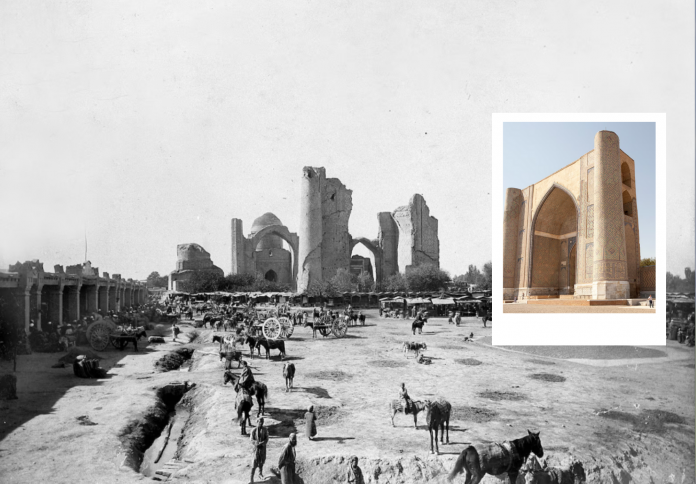
On the ancient Silk Road, the fabled city of Samarkand, Uzbekistan, stands as a mesmerizing spectacle. Its turquoise domes and dazzling geometric mosaics beckon to visitors, promising a direct link to a glorious past ruled by the warlord Timur, known in the West as Tamerlane. The grand Bibi Khanym Mosque, for example, with its towering walls and exquisite tilework, seems to be everything a visitor could hope for. But a closer look reveals a startling truth: much of the mosque’s splendor is a modern creation. Its domes were rebuilt, its calligraphy is a 20th-century addition, and its walls are now taller than they once were. This paradox lies at the heart of a heated debate that has simmered for decades: Do the restorations of Samarkand’s ancient wonders preserve history, or do they risk erasing it in a pursuit of perfection?
The Lure of the Silk Road: Restoring a Grandeur

For centuries, Samarkand has captured the Western imagination. Writers from Christopher Marlowe to Edgar Allan Poe extolled its mythical beauty without ever having set foot in the city. This powerful, romantic allure has been harnessed by successive Uzbek governments to forge a new national identity and to attract vital tourism income. Through extensive restoration work, particularly on the Bibi Khanym Mosque and the three colossal madrassas of the Registan public square, they have sought to recreate the city’s legendary past. The entrance to Timur’s mausoleum has been rebuilt and its surfaces re-tiled, now glowing with kaleidoscopic patterns.
Proponents of the restorations argue that without them, Uzbekistan’s history might have been lost forever. Over time, the magnificent structures had been ravaged by earthquakes and scavenged for construction materials, leaving them in a state of near-collapse. In their view, the repairs were not just aesthetic improvements but a necessary act of preservation. Many visitors are delighted by the results, marveling at the splendor of the tiled porticos and iridescent domes. It’s a feeling that resonates with locals as well. As guesthouse owner Odil Jahangirov notes, visitors from the nearby capital of Tashkent are frequently amazed by the grandeur, seeking to connect with the “old spirit” of a city that feels, for them, “a little exotic.”
The Critic’s Eye: Authenticity vs. Artifice

Despite the undeniable visual appeal, the restorations have drawn strong criticism from scholars and historians. For many, the gleaming, perfect surfaces of the rebuilt mosques and mausoleums have become sanitized and artificial, more akin to “theme park exhibits” than genuine historical sites. Robert Hillenbrand, a leading scholar of Islamic art, has openly condemned the restoration of the Bibi Khanym Mosque, citing what he sees as inaccurate and poorly executed attempts to replace and repair original portions of the buildings. These critics argue that the modern work, though beautiful, lacks the authenticity and character of the original structures, which bore the subtle marks of centuries of history and aging.

The debate centers on a fundamental question: When does a restoration stop being a faithful repair and start becoming a form of artifice? For many, the answer lies in the over-conservation of the most famous landmarks. The use of modern designs that poorly replicate medieval patterns and the reconstruction of elements, such as domes that were once cracked or had entirely collapsed, fundamentally changes the nature of the sites. The focus on a flawless, gleaming exterior, critics argue, sacrifices the very history and organic decay that make these ancient monuments so valuable to begin with.
Erasing the Urban Fabric: A City Divided
While the controversy over the monuments themselves simmers, it is local residents who have been most deeply affected by the government’s conservation approach. The focus on a few select landmarks has come at a great cost to the surrounding urban landscape. As researcher Ona Vileikis notes, Samarkand’s monuments have been “disconnected from their urban fabric.” In the drive to create a grand, photo-ready tourist destination, the local, vernacular architecture has been largely ignored. Walls have been built, literally dividing the city into neighborhoods considered “tourist-worthy” and those that are not.

In a process that has been repeated across many towns and cities in Uzbekistan, old markets and houses—particularly those around the central Registan square—have been cleared to make way for new roads and apartments. These demolitions, sometimes leading to protests and accusations of a lack of compensation, have eroded the very neighborhoods that once gave the famous monuments their context and life. Even UNESCO has repeatedly warned of this damage, criticizing the lack of appropriate regulation and expressing deep concern about the “urban regeneration” that prioritizes a sanitized aesthetic over the preservation of the city’s holistic history and living communities.
A New Path Forward: Collaboration and Sustainable Conservation
After decades of simmering debate and international criticism, a new dynamic may finally be emerging. Recent initiatives suggest a growing recognition of the need for a more collaborative and sustainable approach to preservation. The Uzbek government, locals note, is becoming more cautious in its restorations, and a new generation of local engineers and architects are becoming increasingly involved in conservation efforts. In a significant move, UNESCO and the Uzbek government announced a new initiative in 2021 to work more closely together to protect and preserve the country’s monuments.
This new approach seeks to engage local communities and experts, moving beyond the traditional “Silk Road” fantasy to protect a more complete and authentic version of Uzbek history. Although some debates are likely to continue, many now seem to agree on certain key issues: that restoration work should be historically accurate, that it should protect original materials rather than replacing them, and that the preservation of Uzbekistan’s history should cater to the needs of locals as well as tourists. This shift suggests a hopeful future for Samarkand, one where the enduring soul of the city is preserved not just for visitors, but for the people who call its ancient streets home.