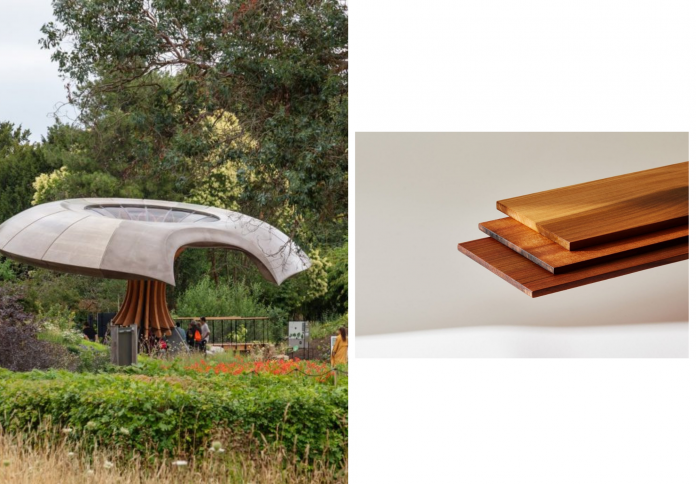
In the heart of Kew Gardens’ Carbon Garden, a striking new pavilion has taken root—not just as a structure, but as a living symbol. Designed by Mizzi Studio, this poetic, plant-like form channels the regenerative power of fungi, the silent labor of roots, and the invisible networks that sustain the Earth. More than an architectural gesture, it’s a call for consciousness—about climate, carbon, and the ways design can become dialogue.
A structure that grows from the ground, not just stands on it

The pavilion doesn’t simply sit within the garden—it seems to rise from it, like a mushroom after rain. Mizzi Studio has crafted a form that mimics the natural world with reverence: a canopy that fans open like a carnivorous bloom, a glulam frame branching upward like mycelium searching for light, and a central timber column that anchors the whole structure like a rooted spine. The design is biomimicry in its most expressive form—less about replication, more about evocation.
Its organic silhouette is not arbitrary. It references the fungal networks that cycle carbon underground, feeding forests and binding ecosystems together. This unseen complexity is given form in the pavilion’s curvature and canopy, making the invisible visible, and inviting visitors to think about the stories happening just beneath their feet.
Sustainability shaped into every seam and surface
Mizzi Studio’s use of materials tells its own story of responsibility. Instead of carbon-heavy steel or concrete, the pavilion embraces natural, renewable sources: a translucent canopy made of flax fiber composite—innovative yet grounded in nature—and a glulam structure of European larch that is both lightweight and strong. The base uses larvikite stone, a Norwegian granite chosen for its durability and low environmental impact.

This careful material curation underscores the pavilion’s mission—not only to demonstrate sustainable design, but to embody it. It’s a working manifesto, showing what architecture can look like when it learns from ecosystems rather than imposing on them.
Where function meets philosophy: learning under leaves
The Carbon Garden is not only a showcase of biodiversity—it’s a classroom. The pavilion offers shelter, seating, and storytelling space amid a landscape intentionally zoned to represent different climate realities. Plantings shift from wildflower meadows to drought-tolerant species, revealing how flora may adapt—or struggle—in the face of rising temperatures. Channels within the structure funnel rainwater into bioswales, connecting water flow to educational purpose.
Within this context, the pavilion acts as a frame for inquiry. Visitors are not merely protected from the sun—they are placed at the intersection of science, design, and living systems. Architecture becomes interpreter, not just ornament.
A poetic intersection of research, craft, and climate action
The collaboration between Mizzi Studio and Kew Gardens’ horticultural scientists signals something rare: a true integration of design and ecology. This is not an art piece installed into nature—it is a vessel grown from it, with intention and narrative depth. As the centerpiece of the Carbon Garden, it invites visitors to reflect on carbon not as a vague enemy, but as a life force that must be understood and respected.
What Mizzi Studio offers is more than aesthetics—it is a vision for the future of public architecture. One where structure is inseparable from story. Where design becomes a lens for ecological urgency. And where beauty and biosphere meet, not in competition, but in care.