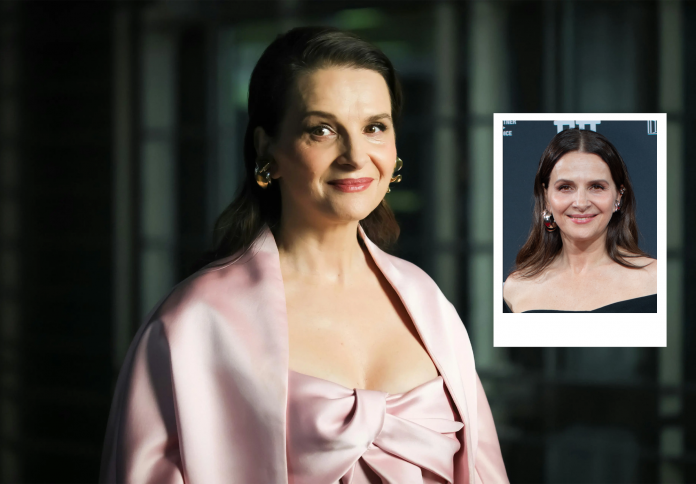
Four decades after her first steps on the Croisette, Juliette Binoche returns to Cannes in the most prestigious role of all—President of the Jury. The French actor and international screen icon succeeds Greta Gerwig, bringing with her a legacy of fearless artistry, cultural openness, and bold activism. This year, she’ll help decide which film earns the coveted Palme d’Or.
A full-circle moment on the Croisette
Juliette Binoche’s appointment as President of the Jury for the 78th Cannes Film Festival is not just a recognition of her artistic accomplishments—it’s also a deeply personal return. In 1985, a 21-year-old Binoche made her first Cannes appearance in Rendez-vous, directed by André Téchiné. Now, exactly 40 years later, she ascends the Palais steps once again—this time to preside over the very institution that once launched her into global stardom.
Reflecting on the honor, Binoche said, “In 1985, I walked up the steps for the first time with the enthusiasm and uncertainty of a young actress; I never imagined I’d return 40 years later in the honorary role of President of the Jury. I appreciate the privilege, the responsibility, and the absolute need for humility.” Her statement echoes the humility and artistic rigor that have defined her career, making her an ideal figure to lead Cannes’ celebration of global cinema.
A legacy of boundary-breaking performances

Juliette Binoche is not just a French star—she’s a global cinematic force. Her career is marked by artistic daring and an eagerness to challenge cultural, linguistic, and aesthetic boundaries. In 2010, she earned the Best Actress Award at Cannes for Certified Copy, directed by Iranian auteur Abbas Kiarostami. The film, shot in Tuscany with a British opera singer as her co-star, is a fitting symbol of her boundary-defying ethos.
Binoche has collaborated with an extraordinary roster of international directors: Michael Haneke, David Cronenberg, Claire Denis, Hirokazu Kore-eda, Olivier Assayas, and Naomi Kawase, to name just a few. These filmmakers represent an eclectic mix of styles and nationalities, but all have seen in Binoche a muse capable of extraordinary emotional range and artistic truth. Her filmography is a masterclass in choosing projects that prioritize authenticity over formula.
Rather than building a brand, she has built a body of work—one that spans continents, genres, and emotional registers. Whether in the intense psychological dramas of Haneke or the poetic realism of Kore-eda, Binoche’s presence is both grounding and elevating.
A woman of conviction—on and off screen
Cannes has always celebrated not just film, but the spirit of its creators. In this sense, Juliette Binoche is a fitting torchbearer for the festival’s legacy. Beyond her artistry, she is also a passionate activist who has consistently used her platform to speak out on issues that matter. Her causes have ranged from environmental justice to human rights and immigrant support.
One of her most defining moments came during the 2010 Cannes Festival, when, while accepting her Best Actress Award, she held up the name of Iranian director Jafar Panahi, who was then imprisoned by his government. It was a bold gesture, one that reminded audiences that art is always political—and that silence is a choice.
Binoche’s activism aligns her with past trailblazing women in Cannes history, such as Olivia de Havilland, who became the first female Jury President in 1965. As the second consecutive woman to hold the role after Greta Gerwig, Binoche’s appointment speaks to a slow but meaningful shift toward greater gender parity at one of cinema’s most prestigious institutions.
Steering cinema’s future from its most iconic stage
On May 24, Juliette Binoche will lead her jury in awarding the Palme d’Or, the highest honor of the Cannes Film Festival. It is not just a vote of confidence in her taste or cinematic knowledge—it is a nod to the ideals she represents: freedom, cultural exchange, boldness, and emotional truth.
Binoche’s role as Jury President is also symbolic in a broader sense. At a time when the global film industry faces constant disruption—from streaming platform wars to political censorship—her presence is a reminder that cinema’s power lies not in trends, but in its ability to connect people across cultures and generations.
In the words of the festival’s own tribute, Binoche “embodies a certain idea of cinema, one that is free and universal.” That is the spirit she brings to Cannes this year—not just as a judge of art, but as a custodian of its future.
A bridge between the past and the future
As Cannes continues to evolve, welcoming new filmmakers and fresh perspectives, Juliette Binoche stands as a bridge—between the old guard and the new wave, between tradition and innovation. Her career honors the past, while her choices continue to pave the way for tomorrow’s cinema.
This year’s festival will undoubtedly feature dazzling premieres, bold political statements, and unforgettable performances. But perhaps its most meaningful gesture is the quiet, powerful presence of an actress who has spent four decades choosing truth, complexity, and courage. With Juliette Binoche at the helm, the 78th Cannes Film Festival is in deeply capable hands.