For the last fifty years, a good education meant preparing kids for high-paying knowledge work in science and technology. But with generative AI now capable of writing code, drafting reports, and analyzing data, those rules may be changing. Teachers and parents alike are now asking what skills children will need in a world infused with AI. The answer isn’t to double down on what machines can do; it’s to focus on what they can’t: the uniquely human attributes we call soft skills. As a professor of education policy and a former teacher, I believe the future of K-12 education lies in teaching emotional awareness, complex problem-solving, and the value of “slow learning.”
Why the Old Rules No Longer Apply
Previous waves of automation replaced manual and routine jobs, but generative AI is different. It excels at tasks that have long been considered the domain of white-collar workers. By mimicking patterns in existing data, AI can now write, code, draw, and analyze data in ways that threaten to make many entry-level knowledge economy jobs vulnerable.
On the other hand, AI struggles with complex reasoning and problems with many unknowns. It also has no understanding of how humans think and feel. This means that the skills that allow people to interact well with others and to be in tune with their own emotional states will likely become the most valuable skills in an AI-enabled world.
Teaching Emotional Awareness
The good news is that these soft skills can be taught alongside traditional subjects like math and reading. Teachers already have many of the tools they need. One simple technique is to use “exit tickets,” a brief written reflection students submit at the end of a lesson. Teachers can use these to prompt students to think about their emotional and social skills, with questions like:
- “Write about a time today when you helped someone.”
- “Describe a time this week when you learned something that seemed very hard. How did you do it?”
The goal isn’t just to boost a student’s mood. It’s to help them realize that their emotional responses are within their control. Enhanced self-awareness helps children manage frustration, perceive others’ emotions, and work smoothly with people—all vital workplace skills that will only become more valuable as AI advances.
Learning to Solve Messy Problems
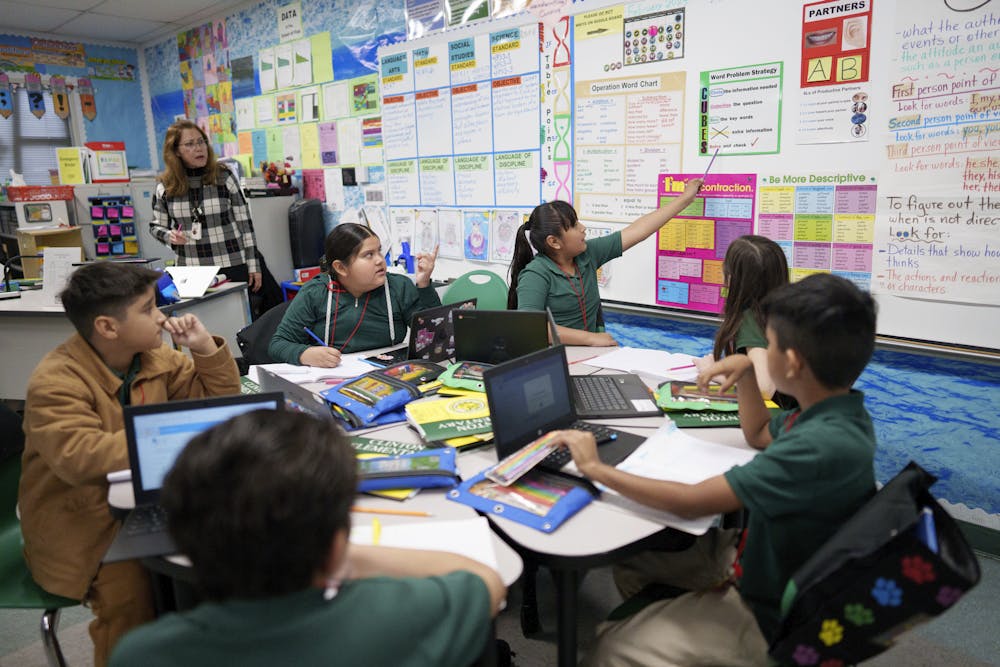
Teachers also need to provide students with opportunities to solve messy, real-world problems with no known answers. This is often called “authentic assessment” and can be applied in any discipline. For example, as students learn about perimeters, they can work in groups to measure large, oddly shaped items around the school.
Other examples could include testing soil on school grounds to propose landscaping solutions or creating a video campaign for a social cause. This type of learning teaches children to unpack complexity and helps them understand the difference between seeking a textbook answer and testing possibilities when the best option is unknown. Solving novel, complex problems will continue to befuddle AI because it lacks our spatial and emotional understanding of the world.
Protecting the Art of ‘Slow Learning’
One of the biggest concerns for teachers is that students are using generative AI to do their work for them. This happens because humans are hardwired to take shortcuts on tasks that seem too dull or daunting. But when students are building new skills, delegating work to AI is a huge mistake. AI makes slow things fast, which undermines learning because effort is needed to learn hard things.
For this reason, teachers must protect the classroom as a place where foundational skills are learned slowly, alongside other students. This may mean incorporating old-school practices, like writing assignments by hand or giving oral presentations, to ensure students are developing the core skills they need. If students are allowed to use digital tools, they should be prompted to reflect on what they used them for, what they learned from them, and what skills they weren’t able to practice when they delegated the work.
The Soft Skill to Rule Them All
No one knows exactly what the future of work holds, but the skills that make us distinctly human—like self-awareness and the ability to work collaboratively—will almost certainly become more important. The most crucial skill a school can teach a child today is the self-awareness to prioritize learning over shortcuts and to refrain from delegating work to a machine until they know how to do it themselves.
An AI-enabled society will not be a society in which complex problems simply disappear. Instead, opportunities will abound for those who can work well with others to tackle the great challenges that lie ahead.