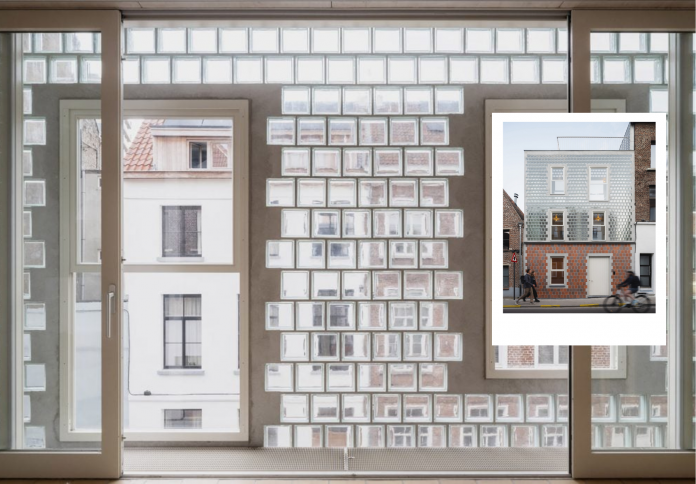
In the historic city of Ghent, a small gap within a terraced street has been transformed into an architectural marvel. Designed by local studio Delmulle Delmulle Architecten, the Glass Brick House is a three-storey home that stands as a testament to creative problem-solving on a challenging, enclosed site. Named for its striking facade of glass brickwork, the house was conceived as a light-filled sanctuary on a plot hemmed in by neighboring buildings on three sides. This unique design approach not only manages to draw an abundance of natural light into a space where it is scarce but also creates a building that, in the words of its architect, “stands out while also striving to blend into its surroundings,” forging a dialogue between the bold and the beautiful.
The Challenge of the Enclosed Plot
The site for the Glass Brick House presented an immediate and profound architectural challenge. Measuring just 98 square meters, the plot was “extremely small and completely enclosed on all sides,” leaving no room for side windows. The only way to bring natural light into the home was through its narrow front facade. This constraint became the central driving force behind the entire design. Rather than seeing the limitation as a hindrance, Delmulle Delmulle Architecten embraced it, turning the facade into the hero of the home’s design. The solution was an innovative, double-skinned facade of glass bricks on the upper two stories, a choice that would define the home’s identity and its success.

The architect, Seger Delmulle, confirmed that the main challenge was to “make the most of the minimal available space and natural light.” This singular focus guided every decision, from the choice of materials to the spatial layout. The resulting building is a masterclass in efficiency and ingenuity, proving that even the most difficult of sites can yield a space that feels spacious, open, and filled with a serene glow. The facade is not merely a wall; it is a meticulously designed light filter, an instrument for drawing the exterior world in while maintaining a sense of privacy and enclosure.
A Facade of Light and Heritage
The most prominent feature of the Glass Brick House is its facade, a bold and intricate combination of materials that serves both a functional and a contextual purpose. The upper two floors are clad in glass brickwork, a translucent medium that allows natural light to flood the interiors while providing a soft, diffused glow. This choice is particularly effective given the narrow nature of the street, as the glass bricks create a sense of openness without sacrificing the home’s privacy. The facade’s dual-skin design, with a full-height glazed wall behind the glass bricks, also creates a narrow intermediate space that provides additional insulation and a unique aesthetic layer.

This modern, almost futuristic facade is surprisingly harmonious with its historic surroundings. The architect explained that the project was a “give and take,” a bold building that still manages to speak the “language of a typical terraced house.” The ground floor of the home is finished in terracotta tiles, creating a solid, traditional plinth that grounds the lighter, more modern structure above. Both the glass bricks and the terracotta tiles have been laid in a pattern that directly references the traditional brickwork of the area. The front door and windows are framed by stepped concrete apertures, a design detail that explicitly references a “stepped-gable house from 1707 just down the street,” a subtle but powerful nod to the home’s place in history.
An Inverted Layout for a Modern Life
The unique constraints of the site also led the architects to adopt an “inverted” layout, a strategic organization that places the living spaces on the top floor and the bedrooms on the lower floors. This decision was a direct response to the need for natural light. By situating the kitchen, dining, and living areas on the uppermost level, they are granted the maximum amount of light and a greater sense of airiness, essential for these communal spaces. The journey through the home becomes a progressive ascent toward the light.

A striking metal spiral staircase connects the floors, serving as a sculptural element within the otherwise simple interior. This staircase is not just a means of vertical circulation but a visual centerpiece that reinforces the home’s modern aesthetic. The entire structure of the home was built using cross-laminated timber (CLT), a sustainable material that was left exposed and stained white to create the interior walls. This choice further emphasizes the home’s commitment to simplicity and honest materials. The minimalist interior, with its clean lines and restrained palette, allows the light from the facade to become the primary decorative element, creating a sense of calm and clarity.
Simplicity and Sustainability at its Core
The interior of the Glass Brick House radiates simplicity and restraint, a deliberate design choice that complements the bold facade. By exclusively using honest and sustainable materials, the architects have created a space that is both visually minimal and environmentally conscious. The exposed white-stained solid wood walls of the CLT structure provide a warm, natural texture, while the natural terracotta tiled flooring on the ground floor carries the feel of the exterior inside.

All fixings and fittings have been kept simple and unobtrusive, ensuring that nothing distracts from the pure, clean lines of the design. This focus on “simplicity and restraint” allows the quality of the materials themselves to shine through, celebrating the craftsmanship and the natural beauty of the wood and terracotta. The interior feels spacious and uncluttered, a direct benefit of the architects’ disciplined approach to material and form. The home stands as a quiet argument that a luxurious and comfortable living space does not require opulence, but rather a thoughtful and sustainable use of fundamental materials.
Beyond the Facade: A Rooftop Oasis
Despite the challenges of the enclosed plot, the architects managed to create a crucial outdoor space for the home. Atop the three-story structure is a rooftop terrace, a private oasis partially sheltered by the slightly higher volume of a neighboring building. The terrace, wrapped by a thin metal balustrade, provides a valuable area for relaxation and fresh air, a true luxury on a site with no garden space. It is a testament to the architects’ ability to find and create livable space in even the most restrictive of urban environments.
The Glass Brick House is a significant addition to the architectural landscape of Ghent, and it joins a growing number of residential projects in Belgium that are creatively responding to similarly enclosed infill sites. Like the glazed timber extension to a Brussels townhouse by Hé! or the light-filled home by Jan Lefevere, this home proves that constrained urban plots can be the very catalysts for innovative and beautiful design. The Glass Brick House is a shining example of how a challenging urban context can inspire a building that is not only functional and sustainable but also a work of art.