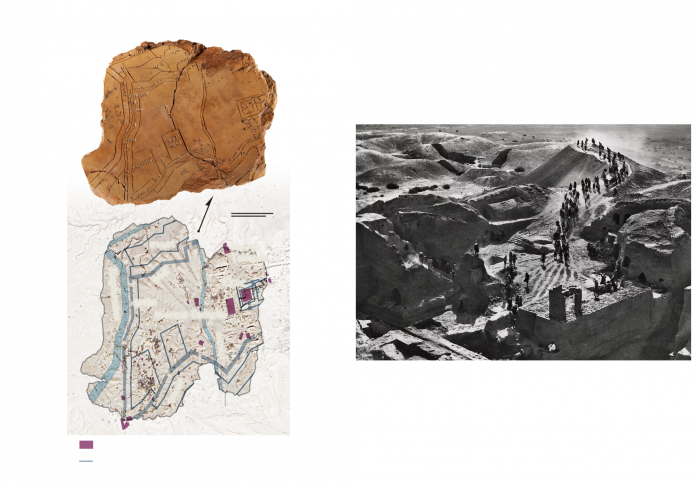
One of the world’s oldest known maps, etched onto a clay tablet and dating back to approximately 1500–1300 B.C., depicts the ancient Mesopotamian city of Nippur. For decades after its discovery in 1899 in what is now Iraq, scholars debated its accuracy, but aerial photography and subsequent excavations in the 1970s revealed a stunning truth: the map is startlingly precise, mapping the entire half-square-mile city with an accuracy of within 10 percent. This remarkable artifact not only demonstrates the advanced surveying skills of the ancient Mesopotamians but also challenges conventional understanding of their cartographic purpose. While other, simpler maps were used for tax assessments, this grand city plan may be the world’s oldest architectural blueprint, created by the Kassite Babylonian rulers for the purpose of rebuilding and revitalizing the sacred city.
The Precision of the Ancient Map
The Nippur tablet, roughly the size of an adult hand, meticulously charts the distances between the city gates and the locations of major structures within the sacred city walls. Nippur was a vital spiritual center during the Bronze Age, and its Kassite rulers—who took power after the city had been largely abandoned—had a religious “duty to be builders.”

Initially, archaeologists doubted the map’s accuracy, finding discrepancies between the tablet and the excavated ruins. However, the work of archaeologist McGuire Gibson in the 1970s, using aerial photos, confirmed that the map’s lines and angles aligned beautifully with the excavated remains. It was discovered that the map, when correctly oriented, accurately depicted the city’s overall plan and the confirmed locations and sizes of structures like the Ekur Temple and the Inanna Temple.
The Mystery of Its Creation and Purpose
The striking precision of the Nippur map, covering such a large area at a consistent scale, poses a major technological question: How did its creators achieve this level of accuracy? While Mesopotamians were known as savvy land surveyors—using smaller tablets for mapping farm fields and housing plots—this comprehensive city plan suggests advanced techniques.

Scholars believe the mapmakers likely utilized rudimentary surveying tools such as knotted ropes and rods, and possibly an early form of trigonometry to calculate angles over a distance. This process would have been laborious, requiring painstaking incremental measurements and meticulous tabulation to transfer the entire city’s layout onto the clay tablet. Given that ancient people did not use such maps for navigation, its purpose is hypothesized to be that of a city plan or blueprint, providing the Kassite rulers with a detailed guide for their ambitious project of rebuilding and restoring the once-crumbling temples and fortifications of Nippur.