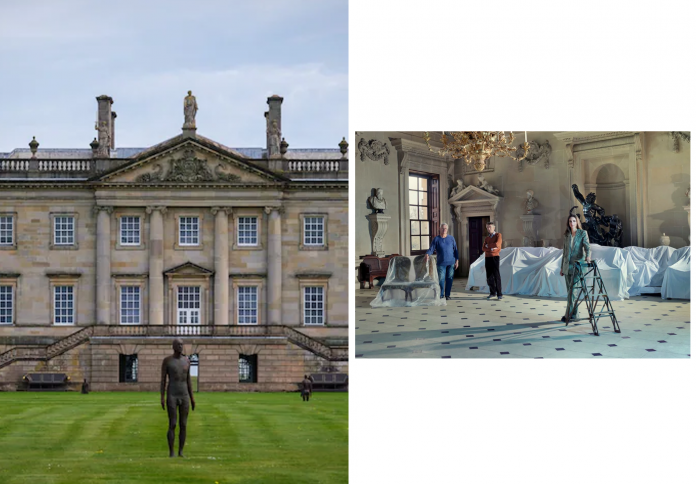
In the heart of rural Norfolk, a Palladian estate once built for Britain’s first prime minister is quietly becoming one of the UK’s most compelling destinations for contemporary art. Guided by the Marquess and Marchioness of Cholmondeley, Houghton Hall merges its stately history with an evolving artistic future—where ancient stones echo with new voices, and a family’s passion shapes a legacy.
A classical canvas for modern sculpture
Houghton Hall, an 18th-century masterpiece surrounded by fields and woodlands, is more than a historic country home. Under the stewardship of David Cholmondeley, the 7th Marquess, it has been steadily transformed into a unique stage for contemporary art. Scattered across its landscape are works by internationally acclaimed sculptors like Rachel Whiteread, Richard Long, and Antony Gormley—each one engaging in dialogue with the estate’s architectural gravitas and pastoral calm.

David’s passion for art began with a single acquisition: Interior Space, a sarcophagus-like sculpture by Stephen Cox, whose textured stone evokes ancient tombs and woodland streams. Since then, Houghton’s parkland has grown into a private sculpture park, opening each summer to the public. It’s not a commercial gallery, but something more personal—what David calls “doing doll’s houses on a grand scale.” And like a doll’s house, it’s deeply curated, intimate, and a little whimsical.

The artist behind the stone
Stephen Cox, the 78-year-old Royal Academician and sculptor, has become one of Houghton’s defining artistic voices. His work, often liturgical in nature, draws on Egyptian, Roman, and Indian influences. For the new exhibition Myth, Cox has installed nearly 40 sculptures throughout Houghton’s house and gardens—including a monumental 15-ton slab of Aswan granite positioned at the West Front.

The collaboration between artist and patron is rooted in mutual respect. David and Cox often choose sites together, such as the wooded grove where Interior Space now rests. The setting, with its tree-lined “nave,” resembles a natural cathedral. Inside Houghton’s Stone Hall, Cox’s dramatic porphyry sculptures now share space with 17th-century urns once reserved for Roman emperors. This blending of past and present lies at the heart of Houghton’s evolving identity.
Family life in a living museum
Despite its grandeur, Houghton remains a lived-in home. David and his wife, Rose Hanbury—Lady Cholmondeley—share it with their three children. Rose, a former parliamentary assistant and occasional model, speaks candidly about raising twins and a daughter amid art installations and centuries-old tapestries. The children once raced scooters through the marble halls; today, they’re more likely to campaign for a Kaws exhibition after discovering the graffiti artist at the Serpentine Galleries.

Rose confesses that her love for contemporary art blossomed through David’s influence. Now, it’s a shared passion. Together, they host annual exhibitions that attract visitors from across the UK. These shows, featuring artists like Damien Hirst and Anish Kapoor, have brought new energy—and vital income—to an estate in one of England’s more remote corners. “It does help,” David says, “because of our location. Here we are, in north-west Norfolk, with sea on two sides.”
Tradition, preservation, and quiet revolution
Maintaining an estate like Houghton is no small task. The Cholmondeleys face modern challenges—like carpet beetles invading closed rooms during lockdowns—but meet them with pragmatism and care. David is acutely aware of the burden and privilege of inheritance. After all, he assumed control of not one but two stately homes in 1990. “Our ancestors would have said, ‘If it’s going to ruin you, just pull it down,’” he jokes.

Instead, he and Rose are committed to preservation through relevance. Rather than selling off treasures, they open their doors to art lovers and schoolchildren, cultivating curiosity and appreciation. The idea is not to overwhelm the historic setting but to gently integrate contemporary voices. “Bringing something of our own time into a classical setting,” David says, “but not forcing it on the original house.”
Legacy and the power of place
In the Yellow Drawing Room, hidden from public view, Rose’s favorite space glows with afternoon light. Old Masters hang beneath golden drapes, while new acquisitions rest on easels. Here, the Cholmondeleys reflect on the people who shaped Houghton before them—especially David’s grandmother Sybil Sassoon, whose taste and presence still permeate the rooms.
“Encountering Houghton for the first time,” Rose recalls, “was like nowhere I’d ever been. It’s huge and grand—but also very welcoming.” That welcoming spirit, and the instinct to balance tradition with creative ambition, is what sets Houghton apart. It may not be a household name in the art world yet, but in its quiet way, it is becoming something rare: a living museum shaped not by commerce, but by vision.
As Cox surveys his finished installations, birds fluttering around the domes above, he smiles. “At a time like this,” he says, “I’m not sad about anything.” At Houghton Hall, the past and present seem content to coexist—each singing, softly, into the stone.