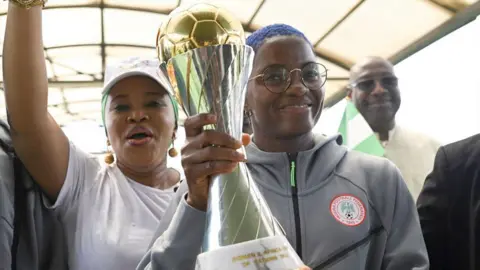
With jubilation still in the air from their historic 10th Women’s Africa Cup of Nations title, Nigeria’s Super Falcons returned home to a hero’s welcome. But beyond the drums, medals, and presidential promises, this moment resonates far deeper—it is about vindication, visibility, and the power of women who continue to triumph despite systemic neglect. In the cheers that echoed through Abuja and the medals pinned at Aso Rock, one could hear the quiet roar of a team demanding not just applause—but equity.
A champion’s welcome with promises of reward
The triumphant return of the Super Falcons to Abuja was met with pageantry befitting their stature: traditional dancers greeted them at the airport, officials paraded them through the city, and President Bola Tinubu received them at the presidential villa. At this grand reception, the president made a dramatic announcement: each player would receive $100,000 and a three-bedroom apartment—a gesture intended to match the magnitude of their achievement.
The 3–2 victory over Morocco had already captured hearts nationwide, but this public acknowledgment by the highest office in the land added official weight to the team’s legacy. Tinubu praised their “courage, determination and consistency,” describing the final match as so intense that he “didn’t want to watch” out of nerves. Yet despite the spectacle, many Nigerians watched with a degree of skepticism: promises of reward, they knew, don’t always translate into action.
A legacy shaped by excellence—and neglect
Since the inception of WAFCON in 1998, the Super Falcons have won 10 out of 13 editions. Their dominance on the continent is unrivaled, and yet, their treatment by Nigeria’s sporting institutions has often failed to match their excellence. From pay disputes and delayed bonuses to being denied basic support during tournaments, the team has faced years of systemic shortchanging.
This isn’t the first time a Nigerian president has promised generous gifts to a victorious squad. Only recently was a three-decade-old housing pledge finally fulfilled for the 1994 Super Eagles. The Super Falcons themselves have staged sit-ins and refused to leave tournament hotels after unpaid allowances—an unthinkable scenario for men’s teams. Even as they lifted the WAFCON trophy again, these athletes carried with them a history of endurance off the pitch.
Rasheedat Ajibade and the voice of a new generation
Captain Rasheedat Ajibade stood at the center of the celebrations—not just holding the trophy aloft, but also articulating a powerful vision. Her victory speech wasn’t only about gratitude; it was about purpose. “This win,” she said, “is for every young girl in our villages, towns and cities who dares to dream.” Her words carried the weight of a generation of Nigerian girls who have seen themselves excluded from the national sports narrative, and who now see a new archetype: female, fierce, and triumphant.
Ajibade also used her platform to call for long-term investment. For the Super Falcons to become the best team in the world, she stressed, the commitment can’t end with celebrations. Support from the Nigerian Football Federation and the government must be consistent—not just in reward, but in infrastructure, training, and respect.
Beyond applause: equity, parity, and real progress
While the cash and apartments are symbolic, they are also reminders of the inequities that persist. For years, the Super Falcons have demanded pay equal to the Super Eagles, yet continue to be offered a fraction of the financial support. The players’ consistent excellence makes the disparity all the more glaring.
In a promising shift, the president has reportedly approved backdated payments for match allowances and bonuses and committed to standardizing such support moving forward. If followed through, this could mark a turning point. Yet fans and advocates remain cautious—because true progress isn’t found in one-time gifts, but in consistent, institutionalized change.
The Super Falcons don’t just represent a footballing powerhouse; they embody the intersection of talent, struggle, and national pride. Their victory is both a milestone and a mirror—reflecting what Nigeria can achieve when it uplifts its daughters, and what remains to be done to ensure that triumphs like this are not exceptions, but expectations.