At the 2025 Venice Architecture Biennale, Australia’s first all-Indigenous curatorial team has created a pavilion unlike any before it. Centered around the theme of Home, the installation offers a space for reflection, connection, and inclusivity. Avoiding stereotypical representations of “Australiana,” the curators have grounded their work in First Nations practices, introducing international audiences to a culturally rich, relational way of thinking about design.
A home built on storytelling and shared knowledge
The Home pavilion stands as a quiet yet powerful counterpoint to the visual spectacle often associated with global architecture showcases. Instead of delivering a literal or flashy interpretation of national identity, the Australian team, led by creative directors Michael Mossman, Emily McDaniel, and Jack Gillmer-Lilley, has crafted a space rooted in yarning—a traditional First Nations practice of knowledge sharing through respectful conversation.
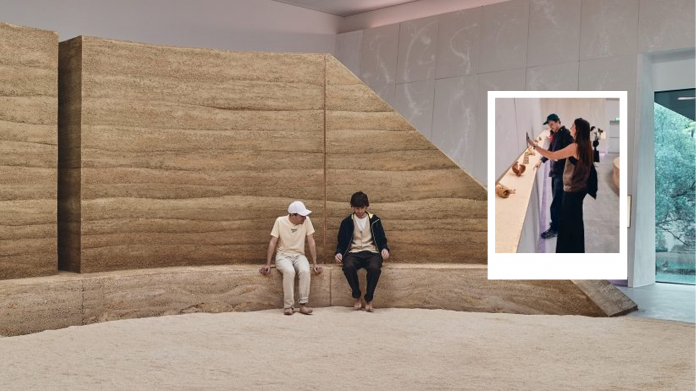
At the heart of the pavilion is a circular rammed-earth structure that acts as both a gathering place and a conceptual anchor. Surrounding it is a curated display of sculptural objects created by 125 architecture and design students from across Australia. These pieces, each unique in form and material, invite visitors to physically engage, holding, touching and contemplating each object’s story in relation to their own ideas of home.

An invitation to reflect, not to impose
Rather than projecting a definitive vision of Australian identity, the curators have sought to facilitate individual reflection. “We didn’t want to bring a false sense of Australiana to the pavilion,” said Bradley Kerr, an architect and member of the curatorial team’s broader “creative sphere.” “We wanted people to be able to find their own sense of place, their own sense of belonging, their own memories and their own identity. We didn’t want to impose an emotion.”
This ethos guided every element of the project, from the materials to the methods. In keeping with First Nations respect for Country a concept that encompasses physical land, culture, spirituality, and belonging—the team chose to use only local Venetian materials like sand, soil, and plaster. This approach underscores the idea of reciprocity: acknowledging the land they are temporarily working on and avoiding the imposition of foreign elements.

Designing through Country and with respect
In First Nations Australian culture, “Country” is not just a location—it’s a living entity with its own spirit and agency. Designers working on another’s Country must show respect, ask for permission, and act with humility. These values have become central to the team’s ambition to reframe how architecture is practiced, not only in Australia but globally. “We’re always designing in someone else’s Country,” Kerr explained. “So being considerate and conscious of that process and following respectful protocols is something that we are trying to introduce into the architectural industry in Australia. We thought this is a great opportunity to demonstrate reciprocity and relationality in an international context.”
The process leading to the final installation echoed this philosophy. Student workshops began with two days of yarning, allowing participants to share stories, reflect on their own cultural perspectives, and explore the meaning of home beyond physical form. This laid the foundation for the creation of “living objects” imbued with memory, emotion, and cultural nuance.

Sculptural meditations on home
The resulting objects display a remarkable range of materials and ideas from beeswax and wood to dyed cement and deconstructed teabags. One object, Shanshui (Prophecy), is a black gypsum cement orb that reflects on the intersection of geological time and cultural identity. Another piece, sewn together from used tea bag threads, is a quiet homage to domestic rituals and the overlooked beauty in the mundane.
These sculptures are not meant to be admired from a distance but to be experienced. By inviting tactile interaction, the pavilion dissolves barriers between creator and viewer, object and subject, home and away. The work resists categorization as “art” or “architecture” alone and instead becomes a living archive of human experience.
A cultural shift, not just a design showcase
For the curators, the pavilion is not just a one-time exhibition but part of a broader movement to bring Indigenous values and practices into mainstream architectural discourse. It’s a shift away from Western design’s preoccupation with permanence and authorship, and toward a model that emphasizes collaboration, care, and cultural continuity.
As part of this approach, the team formed a creative sphere of four additional First Nations architects and practitioners who worked alongside them for nine months leading up to the Biennale. Together, they spent weeks in Venice physically building the installation—another act of presence and stewardship that reinforced the central message of the pavilion.
A standout moment in Venice
Located in Australia’s permanent pavilion at the Giardini, Home has already gained international recognition, earning a spot among Dezeen’s top ten pavilions at this year’s Biennale. In a sea of eye-catching structures and experimental technologies, its quiet materiality and profound cultural grounding stand out.
By resisting the urge to brand Australia through icons or clichés, the team has instead offered something far more resonant: a space of shared humanity. It reminds visitors that “home” is not a fixed image but a fluid, evolving relationship—to land, to others and to oneself.
The 2025 Venice Architecture Biennale runs from 10 May to 23 November. Home represents not only a milestone for Australian architecture but a timely reminder that true innovation often begins with listening.