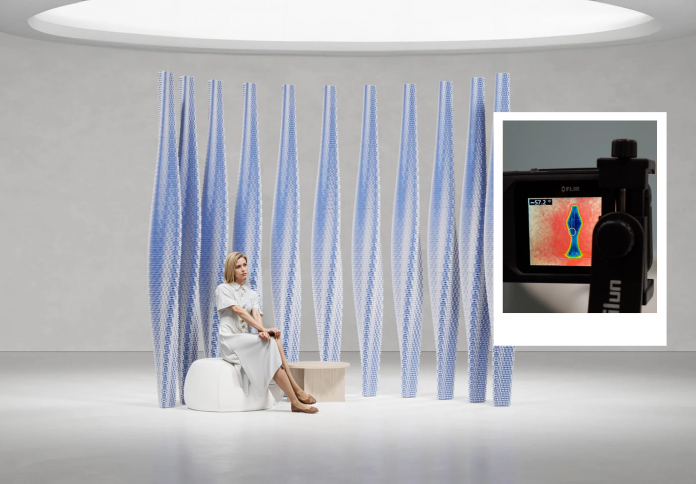
Researchers at Virginia Tech are bringing centuries-old wisdom into the 21st century with a 3D-printed cooling system made from hollow clay columns. Inspired by traditional evaporative techniques from regions like the Middle East and North Africa, this innovative project transforms passive cooling into a modern architectural element – from room dividers to cooling chairs – all without using a single watt of electricity.
Reimagining ancient techniques for a modern world
At first glance, the terra-cotta colored cylinders emerging from Virginia Tech’s labs may look like decorative room dividers. But behind their sculptural beauty lies an ingenious climate solution. These 3D-printed hollow clay columns are part of an experimental evaporative cooling system developed by a multidisciplinary team led by architect and professor Stefan Al, industrial designer Brook Kennedy, and building scientist Georg Reichard.
The columns function through passive evaporative cooling: water stored in the sand-filled interior evaporates as warm air flows through, reducing the surrounding temperature by as much as 10°F (5.6°C). “The beauty of this technology is you have free cooling,” said Al. “All you need to do is put water through it.”

This innovation is not entirely new. It borrows from ancient techniques such as the zeer pot—a clay pot-in-pot refrigerator used for thousands of years in arid regions—and muscatese window systems from Oman. These traditional methods harness the basic principle of evaporative cooling: as water turns to vapor, it draws heat from its environment. What makes the Virginia Tech system novel is the materiality and manufacturing method: 3D-printed clay columns that blend aesthetic appeal with functionality.
Passive cooling for a warming planet
The implications of this work go far beyond academia. With buildings accounting for over 30 percent of global energy use and more than a quarter of greenhouse gas emissions, low-energy solutions like this could help ease the burden of climate control in an increasingly hot world.

“Since the advent of electricity, especially in the West, we’ve grown dependent on mechanical air conditioning,” Al said. “We’re trying to get the best of those ancient techniques and put them in a modern context — and see how we could optimize them further.”
Optimization comes in many forms. The team is experimenting with geometry, surface texture, and material porosity to improve thermal efficiency. So far, three prototypes of varying shapes have been tested using infrared imaging, which confirmed that column design significantly affects cooling performance. The porous clay must allow water to evaporate effectively without compromising structural integrity — a balancing act between strength and breathability. The use of clay, rather than concrete or plastic, is another advantage. Not only does clay have a lower embodied carbon footprint, but it also has superior thermal mass, meaning it can absorb and release heat slowly, aiding in temperature regulation.
From walls to chairs: versatile climate-conscious design
While the initial prototypes are being tested as room partitions, the research team envisions much broader applications. The same cooling principles could be used in building facades, furniture, or sculptural installations that create localized cool zones. Al even imagines a “cooling chair” — a functional piece of climate furniture that offers immediate relief on hot days.

“Unlike traditional AC units that are always hidden or mounted out of sight, these partitions can be beautiful,” said Al. “They become part of the architecture, engaging people with the history and logic behind sustainable cooling.”Due to the localized nature of evaporative cooling, the effect is most noticeable when combined with airflow — either from a fan or cross-ventilation. That makes it less suited for uniform climate control across large indoor spaces but ideal for creating microclimates in specific zones, like reading nooks, lounges, or outdoor seating areas.
Scaling the system and future developments
Currently, the size of the prototypes is limited by the university’s kiln, which can only accommodate objects the size of a vase. To fully evaluate the system’s potential, the team plans to construct a full-scale room to simulate real-world performance. As 3D-printing technology advances, so too will the possibilities for customizing these systems for larger-scale architectural integration.
Al sees the research as part of a larger trend in architecture and design, where ancient wisdom is being recontextualized to meet modern challenges. With global temperatures rising and cities searching for greener infrastructure, passive solutions that require little to no energy could play a pivotal role in shaping sustainable living environments. “People often forget that we once had ways of staying cool without plugging something in,” Al reflected. “This is a chance to reconnect with that knowledge — but with new tools and design languages that allow us to go even further.”
A future shaped by ancient insights

As climate crises intensify and energy systems are pushed to their limits, the value of simple, elegant, and time-tested solutions becomes clearer. The Virginia Tech team’s clay cooling columns are more than just experimental architecture — they are a reminder that sometimes, the key to the future lies in revisiting the past.
With each printed column, they challenge us to rethink comfort, energy, and beauty — not as separate ambitions, but as interwoven design imperatives. And in doing so, they offer a compelling vision for a cooler, more sustainable world.