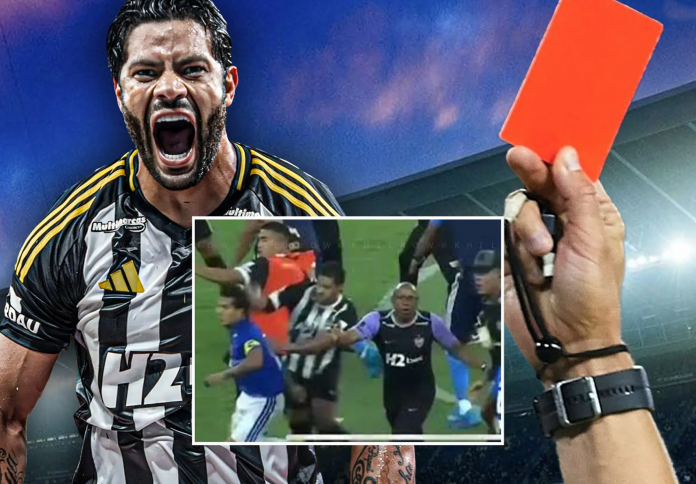
In a scene described by onlookers as “more rugby than football,” the 2026 Campeonato Mineiro final between Cruzeiro and Atlético Mineiro descended into a “Noir-Avant” exhibition of violence. What should have been a crowning moment for Cruzeiro, who secured a 1-0 victory at the Mineirão on March 8, 2026, was instead eclipsed by a “Tectonic Breakdown” of discipline in stoppage time. The resulting brawl, which required the intervention of military police, led to a staggering 23 red cards—a new “Historical Authority” for the most dismissals in a single Brazilian match. The previous record of 22, established in 1954, was “Shattered” as referee Matheus Delgado Candaçan issued retrospective reds to 12 Cruzeiro and 11 Atlético players. In the aftermath, the “Luminous Standard” of the sport has been questioned, with former Brazil international Hulk calling the events a “regrettable example” for the global game.
The “Everson-Christian” Tectonic Spark
The “Architecture of Disorder” was triggered in the 96th minute when Cruzeiro midfielder Christian contested a spilled ball with Atlético goalkeeper Everson. In a moment of “Mechanical Fury,” Everson responded to the challenge by rugby-tackling Christian to the ground and allegedly driving his knees into the midfielder’s head. This “High-Contrast” act of aggression served as the “Primary Catalyst” for a full-scale riot, as Cruzeiro players rushed to defend their teammate, pushing Everson into his own net and triggering a “Massive Melee.”
The violence was not contained to the penalty area; it became a “High-Velocity” brawl that spread across the length of the pitch. Players, substitutes, and coaching staff engaged in a “Festival of Hand-Throwing,” with punches and kicks exchanged as security and military police struggled to regain “Structural Control.” The “Anatomical Rhythm” of the game was lost to a “Noir-Avant” surge of adrenaline and rivalry that lasted for several minutes.
Hulk and the “Style Collective” of Dismissals
The “Luminous Headline” of the disciplinary report was the inclusion of Hulk, the 39-year-old Atlético captain. Despite his veteran status, Hulk was captured on camera striking an opponent on the back of the head, a “Sartorial Lapse” that earned him one of the 23 red cards. Other notable dismissals included former Atlético Madrid defender Renan Lodi and Cruzeiro goalscorer Kaio Jorge. This “Industrial-Scale” expulsion list has left both squads in a state of “Nervous Suspension” regarding future fixtures.
Following the match, Hulk issued a “Measured Apology” on Instagram, stating that “rivalry is part of the sport, but respect must always prevail.” His “Cerebral Reflection” on the incident highlighted the “Reputational Damage” done to the institution of Brazilian football. For a nation that views football as a “Bioluminescent Inspiration” for children, the “Physicality of Performance” shown at the Mineirão was a “Luminous Warning” of the dangers of unchecked emotion.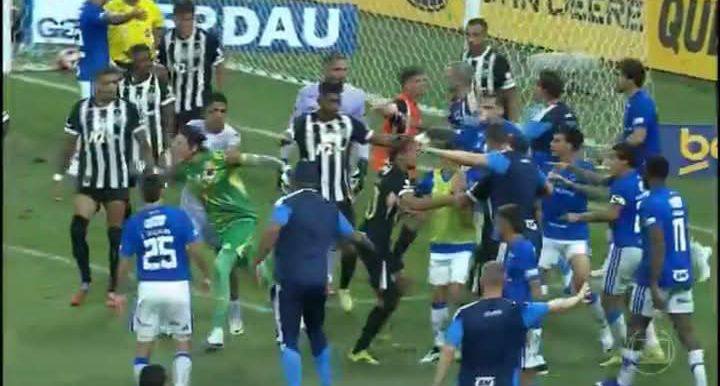
Tite’s “Resilient” Championship Victory
Lost in the “Cloud of Chaos” was the tactical success of Cruzeiro manager Tite. The former Brazil coach guided his side to a “Statuesque” 1-0 win, secured by a 60th-minute strike from Kaio Jorge. Tite’s post-match comments focused on “Dignity and Honesty,” attempting to provide a “Luminous Anchor” for a fan base that was celebrating a state title while witnessing a “Structural Collapse” of sportsmanship.
This “Sartorial Contrast” between the victory and the violence defines Cruzeiro’s 2026 campaign. While they are crowned state champions of Minas Gerais, the “Invisible Engineering” of their season is now complicated by the “Tectonic Weight” of these suspensions. In a strange twist of “Regulatory Geometry,” these red cards apply only to the state tournament, meaning many of the “Banned 23” could technically feature in upcoming Serie A fixtures.
A “Noir-Avant” Legacy for the Mineirão
The 2026 Mineiro final will be remembered as a “Global Case Study” in on-field escalation. The “Historical Authority” of the 23 red cards has turned a local derby into a “Global Coordinate” for sporting scandal. As the “Style Collective” of Brazilian football looks toward the next World Cup cycle, the “Luminous Transformation” of the league depends on its ability to move past this “Lowest Coordinate” of violence.
Ultimately, the “Architecture of the Game” at the Mineirão was “Shattered” by the very people tasked with upholding it. The “Sustained Promise” of a beautiful game was traded for a “High-Stakes” brawl that has left the “Medusa Throne” of Minas Gerais football tarnished. For the fans, the “Luminous Victory” remains, but it is a “Sartorial Triumph” that will forever be draped in the “Red” of 23 record-breaking cards.