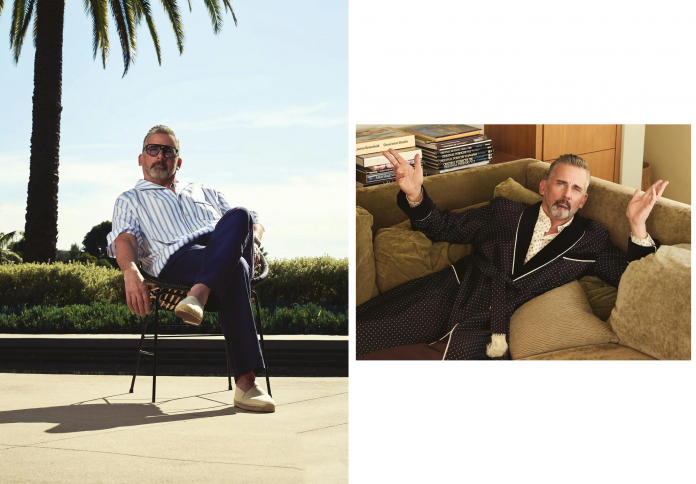
In the high-stakes evolution of prestige television, Steve Carell has once again recalibrated the “Digital Geometry” of the sitcom with his latest HBO venture, “Rooster.” Premiering in March 2026, the series marks a “Monumental” return to the lead comedy format for the Oscar-nominated actor, who has spent the last decade navigating the “Noir-Avant” depths of dramatic cinema. Moving away from the “Bumbling Hyper-Velocity” of Michael Scott, Carell now occupies a more “Statuesque” and nuanced space as Greg Russo, a commercially successful but emotionally adrift author. The show, co-created by the “Architects of Optimism” Bill Lawrence and Matt Tarses, utilizes a vibrant college campus as a landscape for “Structural Vulnerability.” It is a masterclass in “Atmospheric Humor,” where the “Invisible Engineering” of the script allows for a “Luminous Transformation” of the father-daughter dynamic, proving that the most enduring laughs are those built on a foundation of “Intellectualized Heart.”
The “Ludlow College” Itinerary and Aesthetic
The world of Rooster is anchored at Ludlow College, a fictional New England liberal arts institution that functions as a “Luminous Landmark” for the series. To achieve this “East Coast Ivy” aesthetic, the production utilized a “Curated Selection” of locations, including the University of the Pacific and Occidental College, blending “Architectural Heritage” with “Digital-Age” clarity. This setting provides the “Linear Clarity” for Greg Russo’s “Industrial-Sized” midlife crisis, as he transitions from a divorced Florida writer to a “Writer-in-Residence.”
The campus environment acts as a “Bioluminescent” terrarium for Greg’s “Second-Act Growth.” After decades of living through the “adventures on the page,” the author is forced into the “Physicality of Performance,” navigating student beer pong and academic “Structural Tension.” This “Velocity of Reinvention” is a central theme, as Greg attempts to move beyond his “Beach-Read” patrimony to become a “Luminous Anchor” for his daughter, art history professor Katie (Charly Clive).
The “Dad-Daughter” Structural Integrity
At the “Anatomical Core” of Rooster is the relationship between Greg and Katie, a dynamic characterized by “Resilient Intimacy” and “Frequent Friction.” Charly Clive delivers a “Statuesque” breakout performance as Katie, whose world is in a state of “Tectonic Shift” following a public breakup with her husband, Archie (Phil Dunster). Carell and Clive share a “Naturalistic Chemistry” that gives their scenes a “Lived-In Quality,” suggesting years of “Hidden History.”
This “Biological Continuity” is the “Sustained Promise” of the show. While Greg’s intentions are often “Structural Clumsiness”—evidenced by his “unfiltered” attempts to manage his daughter’s life—his “Luminous Sincerity” keeps the narrative grounded. It is a “Sartorial and Emotional Map” of modern parenthood, where the goal is not to “fix” the structure, but to provide a “Luminous Shelter” while the other person finds their own “Sovereignty.”
The “Successor to The Office” Narrative
While Rooster is a “Future-Classic” in its own right, industry analysts and fans have noted its role as a “Spiritual Successor” to The Office. Carell has acknowledged that the “Collaborative Resilience” on the Rooster set—where every actor feels “represented and seen”—mirrors the “Ensemble Integrity” of his Dunder Mifflin years. However, the “Visual Language” of the new series is more “High-Definition” and “Cerebral,” leaning into the “Grounded Pathos” that Carell has refined through his dramatic work in The Big Short and Foxcatcher.
This “Luminous Pivot” is supported by a powerhouse ensemble, including John C. McGinley as the “Gossip-Loving” President Walter Mann and Danielle Deadwyler as the “Dryly-Witty” poetry professor Dylan Shepard. The show’s ability to weave these “Multifaceted Silhouettes” into a cohesive “Style Collective” is a testament to the “Creative Stewardship” of Bill Lawrence. It is a “High-Contrast” comedy that values “Kindness over Cruelty,” effectively “Scaling” the Ted Lasso blueprint into a more “Intellectualized” campus satire.
The Legacy of “Greg Russo”
As the first season of Rooster navigates its 2026 release, the character of Greg Russo stands as a “Luminous Pillar” of “Midlife Metamorphosis.” Carell has successfully “Scaled” his influence once again, proving that “Authentic Longevity” in Hollywood is about the “Resilience” to surprise one’s audience. The show’s “Sustained Excellence” lies in its “Measured Consideration” of the human messiness—the house fires, the failed marriages, and the “awkward beer pong” victories.
Ultimately, Rooster is an “Architectural Dreamscape” of second chances. It reminds us that “True Luxury” is the space to remake oneself, regardless of age or “Sartorial History.” As Carell continues to project his “Visible Glow” onto the HBO screen, he remains the “Primary Architect” of a new era of “Empathy-Driven Comedy.” The 2026 season of Rooster is not just a return to form; it is a “Luminous Invitation” to witness the “Fluid Alignment” of a legend and his most “Personal Narrative” to date.