As the winter of 2025 gave way to the awards season of 2026, the Los Angeles premiere of The Housemaid served as a definitive stage for Sydney Sweeney’s latest exercise in “sartorial storytelling.” Standing before the TCL Chinese Theatre, the actress debuted a look that functioned as a deliberate bridge between the golden age of cinema and the high-definition demands of the modern red carpet. Choosing a custom white gown by Israeli couture house Galia Lahav, Sweeney leaned into an “Old Hollywood” narrative that was both a technical masterclass in corsetry and a bold exploration of “risqué elegance.” By referencing the iconic white halter of Marilyn Monroe, Sweeney did more than just adopt a vintage silhouette; she utilized the “architecture of the bodice” to assert her status as a primary coordinate in the current landscape of celebrity style.
The Geometry of the “Monroe” Halter
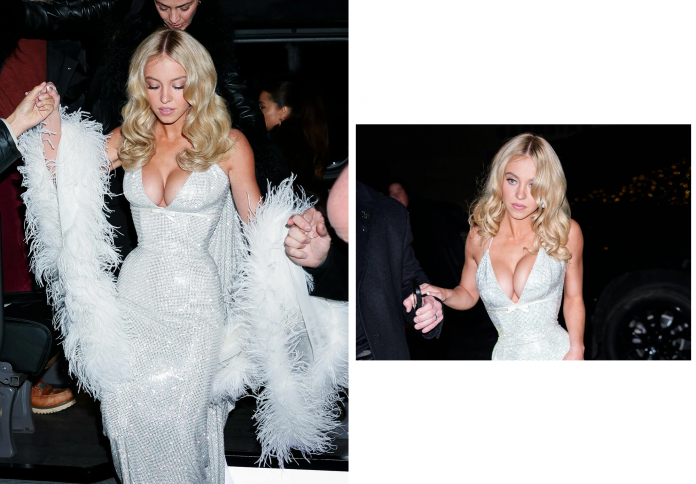
The centerpiece of the evening was a custom creation that demanded a “monolithic” focus. Crafted from layers of fluid silk chiffon, the Galia Lahav gown utilized a draped halter neckline to create a sense of “aerial suspension.” The bodice was built with a precision-engineered internal corset that cinched the waist, providing the structural foundation for the dramatic, plunging neckline. This “sculptural transparency” allowed for a play of light that highlighted the fluidity of the fabric, ensuring that the dress moved with the rhythmic grace of a classic screen star.
The inclusion of delicate feather detailing along the hem added a layer of “textural movement,” softening the sharp lines of the tailoring. This choice was a strategic nod to the “Seven Year Itch” legacy, though reimagined with a 2026 sensibility for “Luminous Maximalism.” By forgoing traditional undergarments in favor of the gown’s integrated support, Sweeney embraced a “braless” aesthetic that underscored the dress’s architectural integrity. It was a look that prioritized the “essential form,” where every pleat and stitch served to amplify the statuesque nature of the silhouette.
The “Snow Angel” Palette and Chromatic Contrast
In a season dominated by the “Chromic Chill” of deep berries and oxidized metals, Sweeney’s commitment to “Cloud Dancer” white provided a sharp, “digital-age” contrast. The choice of a pure, luminous neutral functioned as a “visual reset,” allowing the craftsmanship of the gown to speak without the distraction of pigment. This “monochromatic clarity” was mirrored in her choice of minimal jewelry—diamond drop earrings and a tennis bracelet from Jacob & Co.—which acted as “points of light” rather than focal points.
This “angelic” palette served as a deliberate counterpoint to her co-star Amanda Seyfried, who opted for a “sculptural red” ensemble from Monse. Together, the pair created a “chromatic tension” on the carpet—a visual representation of the psychological thriller’s themes of purity versus danger. For Sweeney, the white gown was not just a festive choice; it was a “protective shell,” a high-fashion armor that stood out against the deep reds and evergreens of the Hollywood holiday decor.
Beauty as Architecture: The “Bombshell” Finish
The success of the “Modern Marilyn” look relied heavily on the “structural harmony” between the fashion and the beauty. Sweeney’s signature blonde hair was styled in soft, cascading waves that hit just past the shoulder, providing a “soft-focus” frame for the face. This was paired with a “classic-noir” makeup palette: a bold ruby-red lip and clean, shimmering eyes. The red lip acted as the “architectural anchor” of the face, cutting through the expanse of white fabric with a sense of “theatrical authority.”
This beauty strategy highlights a broader trend in 2026 toward “High-Definition Classicism”—taking a well-known historical reference and sharpening its execution for the modern camera. By maintaining a fresh, “luminous” skin finish, Sweeney’s team ensured that the look felt contemporary rather than costumed. It was a masterclass in “Visual Pacing,” where the intensity of the gown’s silhouette was balanced by the refined simplicity of the grooming.
The After-Party Transition: From Gown to Mini
Reflecting the “dynamic versatility” required of a modern leading lady, Sweeney transitioned from the dramatic premiere gown into a “sultry minidress” for the after-party at TAO. The second look—a strapless white piece adorned with 3D floral appliqués from Shushu/Tong—offered a playful, “modernist” take on her earlier theme. By maintaining the same “Cloud Dancer” color story, she created a cohesive “Capsule Narrative” for the evening, proving that her style is built on a foundation of “consistent vision.”
The mini-dress was paired with white lace “Gia 100” pumps from Black Suede Studio, adding a final layer of “intricate texture” to her monochromatic day. This “After-Hours” silhouette emphasized a different kind of architecture—one of “mobility and youth”—proving that Sweeney can navigate the transition from “monumental” red carpet glamour to “urban-chic” party attire with architectural precision.
A Legacy in the Making
Ultimately, Sydney Sweeney’s appearance at The Housemaid premiere was a testament to the “Resilience of Glamour.” In an era where red carpet looks are often fleeting digital moments, she chose a silhouette that aimed for “Historical Longevity.” By building her look on the foundations of Old Hollywood and the craftsmanship of modern Israeli couture, she has created a “Style Map” that other young actors are likely to follow.
As she moves further into 2026, Sweeney’s role as a “style architect” continues to evolve. Whether she is channeling the “Space-Age” energy of Chanel or the “Vocal Opulence” of Galia Lahav, her choices are always defined by a sense of “structural courage.” In the world of high fashion, she is no longer just a participant; she is a “luminous designer” of her own public identity, one who knows that the best way to face the future is to build it on the most elegant foundations of the past.