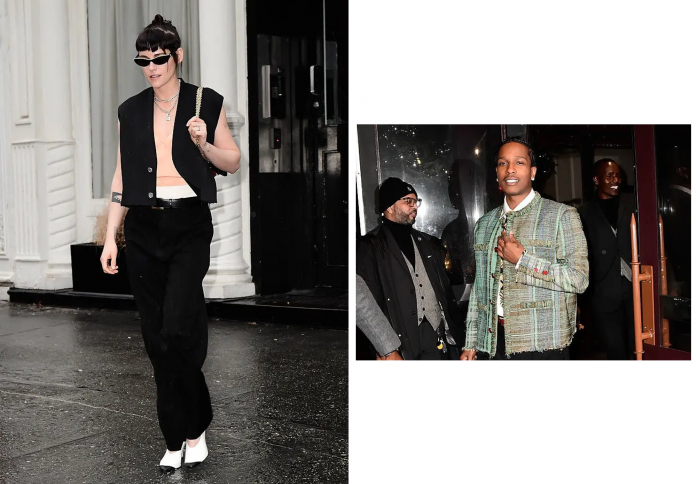
In a breathtaking convergence of Parisian savoir-faire and Manhattan’s industrial rhythm, Chanel transformed the heart of New York City into a sprawling stage for its 2026 Métiers d’Art collection. This annual showcase—a tribute to the specialized artisans of the Chanel-owned 19M workshops—found a resonant backdrop in the city’s towering skyscrapers and historic facades. The event drew a global vanguard of style architects, from Emmy-winner Ayo Edebiri to the transformative Teyana Taylor, each interpreting the house’s iconic codes through a lens of urban grit and high-fashion precision. As the collection moved between the structured elegance of 18th-century embroidery and the relaxed silhouettes of the 21st-century street, it reaffirmed that the true “Metier” of Chanel is its ability to build a bridge between the heritage of the past and the velocity of the future.
The Geometry of the New York Front Row
The front row of the 2026 Métiers d’Art show was a masterclass in “sartorial stratification,” where diverse creative identities were unified by the house’s signature tweed. Ayo Edebiri epitomized the “New Classic” aesthetic, arriving in a sharply tailored ensemble that favored linear clarity over traditional embellishment. Her look focused on the “structural honesty” of the Chanel jacket, reimagined for a generation that values intellectualized luxury. Similarly, Margaret Qualley—a long-standing house ambassador—embraced a “monochromatic softness,” utilizing a palette of “Cloud Dancer” whites to highlight the intricate textures of the artisan-crafted lace.
This gathering of talent served as a living moodboard for the “Total Look” philosophy. By pairing the rigorous craftsmanship of the 19M workshops with the effortless energy of New York, the attendees proved that the Chanel silhouette is a “functional sculpture.” Whether seen on the statuesque Alex Consani, who brought a “Space-Age” edge to the traditional tweed, or on the cinematic Lili Reinhart, the clothing functioned as a sophisticated armor, designed to navigate the high-stakes environment of a New York gala with grace and architectural precision.
Teyana Taylor and the “Couture Edge”
One of the most profound “tectonic shifts” of the evening came from Teyana Taylor, whose appearance served as a bridge between the worlds of high couture and street culture. Known for her “dynamic silhouette,” Taylor opted for a look that emphasized “sculptural volume”—a masterfully constructed jacket with exaggerated shoulders paired with wide-leg trousers that flowed with every movement. Her interpretation of the Métiers d’Art theme was an exercise in “visual intensity,” using the weight of the fabric to create a sense of presence that was both authoritative and avant-garde.
Taylor’s ability to “disrupt” the classic Chanel grid with her own stylistic energy highlights the versatility of the house’s 2026 direction. By incorporating bold hardware and a “Shadow Play” of black-on-black textures, she demonstrated that the “Metier” of the artisan is not just in the stitch, but in how the garment adapts to the “rhythm of the wearer.” Her presence reinforced the collection’s theme of “Urban Resilience,” where the delicacy of the hand-crafted flower meets the steel and glass of the modern metropolis.
The Artisan as Architect: The 19M Legacy
The core of the Métiers d’Art show remains the “Invisible Excellence” of the workshops. For the 2026 New York presentation, the focus was on “Textural Engineering”—the way feathers, crystals, and gold leaf are integrated into the fabric to create a three-dimensional surface. The collection featured a palette of “Mineral Neutrals” and “Midnight Espresso,” colors that reflected the city’s nighttime skyline. These hues were brought to life through the work of the Maison Lesage (embroidery) and Maison Lemarié (feathers), whose contributions transformed simple silhouettes into complex, light-reflecting structures.
The choice of New York as a host city allowed these artisanal details to shine against a backdrop of “Industrial Brutalism.” The contrast between the fragile beauty of a hand-applied camellia and the raw concrete of the venue created a “dialogue of materials.” It reminded the audience that in the world of high fashion, the artisan is an architect of the small-scale, building “monuments of thread” that are intended to be worn, moved in, and passed down through generations.
The “Statuesque” Influence of Alex Consani
Emerging as a primary focal point of the 2026 season, Alex Consani brought a “High-Definition” energy to the Chanel runway and front row. Her look utilized the “Aero-Dynamic” lines that have become a signature of the current Chanel direction—slim, elongated silhouettes that prioritize the “visual flow” of the garment. By pairing a classic tweed minidress with high-gloss boots, she bridged the gap between the “Ingénue” and the “Iconoclast,” proving that the 2026 Chanel woman is one of “multi-dimensional agency.”
Consani’s influence signals a move toward a more “technologically informed” aesthetic within the house. The use of “smart fabrics” that maintain their structural form under different light conditions was evident in her ensemble, reflecting a broader trend of “Functional Luxury.” In the Chanel universe, the “Statuesque” look is no longer about being still; it is about “motion-ready elegance,” where the craftsmanship of the past is optimized for the speed of the digital present.
The Future of the Global Craft
As the 2026 Métiers d’Art collection moves from New York to other global capitals, the message of the house is clear: the “Art of Travel” and the “Art of the Craft” are one and the same. By bringing the workshops of Paris to the streets of New York, Chanel has created a “Global Bridge” of creativity. The collection serves as a reminder that even in an age of automated production, the “Human Touch” remains the ultimate luxury. It is a “sustained promise” that the architecture of fashion will always be built on the foundation of the artisan’s hand.
Ultimately, the New York show was a celebration of “Personal Resilience” and “Collective Brilliance.” As the celebrities and models stepped out into the crisp Manhattan air, their Chanel ensembles acted as “luminous shelters,” protecting the spirit of the craft in the face of the city’s relentless pace. In the world of 2026, the Chanel Monogram is more than a logo; it is a “coordinate of excellence,” guiding the modern traveler through a landscape of “ever-evolving style.”