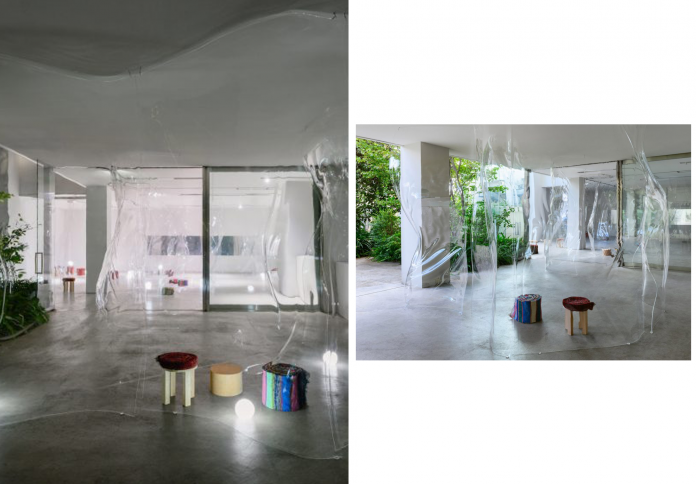
During Art Week Tokyo (AWT) 2025, the independent architect Ichio Matsuzawa presented the striking AWT Bar, an installation that challenged conventional notions of space and materiality. Located in the central Aoyama district, the pop-up bar was defined not by solid walls or fixed forms, but by a series of freestanding, undulating panels of transparent acrylic glass. These near-invisible boundaries were meticulously heat-formed to create complex, liquid-like curves that constantly manipulate light and reflect the surrounding environment in a state of continuous transformation. Serving as both a convivial gathering spot for the city’s art community and a profound sensory experience, Matsuzawa’s design successfully blurred the lines between architecture, sculpture, and mere perception. The resulting environment was a fluid, ephemeral stage where every visitor experienced their own unique, momentary reality.
The Concept: A Formless Space Defined by Sensation
Ichio Matsuzawa’s vision for the AWT Bar was a philosophical inquiry into architecture as an experience rooted in sensation, rather than a structure defined by traditional solidity and fixed walls.

The architect sought to create a “formless architecture” that could only be truly sensed from moment to to moment. This conceptual approach deliberately moved away from the stable, measurable volumes of conventional building design. Instead, Matsuzawa focused on the fleeting relationships between people, light, movement, and the surrounding city itself. By utilizing a highly transparent medium, the presence of the architecture was made almost immaterial. The design philosophy held that the space would only assert its existence when it caught the light, generated a reflection, or subtly distorted the vision of the people passing through it, forcing visitors to engage with their surroundings through perception and feeling.
Matsuzawa articulated that the installation was not about making a physical “bar” in the commercial sense, but about using architectural relationships to stimulate social and perceptual relationships between people. He insisted that the panels were not static objects but components of a perpetually changing architectural experience that required human interaction to be complete. This radical notion positioned the temporary bar as a living, breathing experiment in spatial awareness, where the continuous transformation of the environment became the core characteristic of each individual’s visit.
Material Mastery: The Undulating Acrylic Sheer Walls
The installation’s distinctive appearance was achieved through the sophisticated and unpredictable manipulation of a common synthetic material: highly transparent acrylic glass.

Matsuzawa chose thin, three-millimetre-thick acrylic sheets for their near-perfect light transmittance, boasting a clarity of approximately 94 per cent. This extreme transparency allowed the panels to function less like walls and more like subtle, atmospheric screens. The crucial design step involved a laborious and delicate fabrication process: the sheets were heated in a gigantic industrial oven and shaped over custom steel moulds. As the acrylic became almost liquid when heated, the complex, organic surface of each panel—rippled like sheets of water cascading from the ceiling—was formed. This heat-warping technique was intentionally fraught with uncertainty.
The architect embraced the element of risk, allowing for what he called “beautiful accidents” to shape the final, asymmetrical curves. Matsuzawa purposefully rejected any panel that felt too rigid, precise, or artificially controlled. The final collection of panels, standing upright without external support once cooled, served as the fluid boundaries of the AWT Bar, appearing to spill naturally from the interior space onto the exterior terrace. This mastery of material science allowed for the creation of barriers that simultaneously separated, connected, and transformed the perception of the space they occupied.
The Interior Landscape: Furnishings and Fluidity
Within the shifting, invisible architecture of the bar, the furnishings were designed with an equal sense of playfulness and intentional contradiction to ground the otherwise immaterial setting.

Matsuzawa custom-designed the seating elements, opting for a striking contrast against the sheer, cool surfaces of the acrylic glass. The seats were created using colorful, hand-made rugs from Central Asia that were tightly rolled and wrapped to form sculptural chairs and benches. This choice introduced a textural warmth, rich color, and cultural history to the space, providing a solid, soft contrast to the clinical transparency of the walls. The use of rugs as furniture reinforced the installation’s transient, experimental nature, suggesting a temporary camp or a deliberate breaking of conventional interior design rules.
The arrangement of the bar was designed to create softly defined nooks and enclosures where visitors could sit, eat, and drink. While the formless space might initially seem devoid of traditional functions, the architect confirmed that elements such as places to sit, gather, and put down glasses were hidden within the spatial ambiguity. This subtle guidance ensured that the bar remained practical for socializing while maintaining its abstract, sensory focus. The overall atmosphere was supported by a curated soundscape and bespoke cocktails conceived by contemporary artists, ensuring the AWT Bar delivered a complete multisensory experience that complemented the visual distortion.
The Optical Effect: Layers of Fleeting Mirages
The unique optical properties of the heat-warped acrylic panels generated a constant flow of distorted reflections, making the space continuously dynamic and dependent on external factors.

The panels acted as layered surfaces that constantly refracted and bent light. As visitors walked through the installation, new “momentary scenes” and layered reflections would appear and dissolve. The movement of people was amplified, and the exterior environment—including the shadows of trees and the shifting light of the sky—was transmitted through the material in warped, liquid forms. This continuous visual change meant that the interior room was never perceived as one stable shape; rather, its character shifted with every moment and every angle of perception.
For the guests, this created a unique personal experience. The reflections produced fleeting, mirage-like visual images, making the architectural experience something they sensed and felt rather than something they physically touched or saw in a static form. This optical behavior was heightened in the evenings, when internal lighting interacted differently with the acrylic, creating a captivating, ethereal glow. By relying on transparency, movement, and the optical distortion inherent in the material, Matsuzawa successfully crafted an immersive environment where reality was constantly being challenged and transformed.
Legacy: Architecture as Ephemeral Art
The AWT Bar represented an ambitious extension of Matsuzawa’s ongoing work, positioning temporary installation architecture within a profound philosophical dialogue about art and space.
Matsuzawa’s earlier projects, which included temporary installations at the Mies van der Rohe’s Barcelona Pavilion and the Sharjah Biennial, demonstrated a long-standing interest in pure, transparent space. The AWT Bar pushed this experimental vision further, successfully blurring the demarcation between an architectural commission and a sculptural art piece. Although the heat-formed panels themselves possess a sculptural quality and could be enticing to collectors, the architect stressed that they were not to be viewed as static objects. Instead, they were elements of a “perceptual architecture” that required the presence of people, the sounds of the city, and the passage of time to fulfill its purpose.
The bar’s success at Art Week Tokyo underscored a growing trend in design for dynamic and adaptable environments that prioritize user experience and interaction over permanence. By eliminating the structural rigidity of traditional walls, Matsuzawa created a profound connection between the interior and exterior environments, compelling visitors to become active participants in the ever-changing art of the space. The project serves as a powerful reminder that the most compelling architecture can sometimes be the least visible, defined only by the fleeting sensations it evokes.