Crater Lake National Park in Oregon protects the deepest lake in the United States and one of the deepest in the world, renowned for its extraordinary sapphire-blue color and crystal-clear waters. The lake is cradled within a massive caldera—the collapsed summit of an ancient volcano, Mount Mazama—which erupted cataclysmically nearly 7,700 years ago. Fed entirely by rain and snow, with no inlets or outlets, the lake’s purity and depth create its signature intense blue hue. Crater Lake is a profound testament to volcanic power and subsequent geological stillness, offering visitors spectacular views along the Rim Drive and a rare glimpse into a pristine, high-altitude ecosystem frozen in time.
The Birth of a Deep Blue Lake: Mount Mazama’s Collapse
The existence and structure of Crater Lake are entirely dependent on the violent, massive eruption and subsequent collapse of the mighty Mount Mazama.

Approximately 7,700 years ago, Mount Mazama, once a towering Cascade peak, erupted with such force that it expelled nearly all of its interior magma. Once the magma chamber was emptied, the mountain’s summit, lacking structural support, collapsed inward, forming a giant bowl, or caldera, roughly six miles wide and four thousand feet deep. Over the next several centuries, rain and snowfall gradually filled this caldera, creating the lake. Because the lake is fed solely by precipitation, it has remained remarkably pure, contributing to its incredible transparency and the famous deep blue color that penetrates to its deepest points.
An Aquatic Enigma: Depth and Clarity
Crater Lake is the deepest lake in the United States, reaching a maximum depth of 1,943 feet (592 meters), and is considered one of the cleanest and clearest large bodies of water in the world.

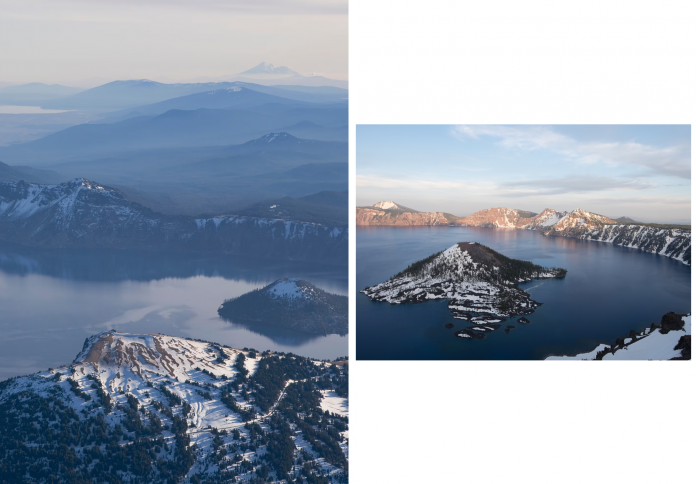
The lake’s exceptional clarity is regularly measured using a Secchi disk, which is often visible to depths of over 100 feet. The purity stems from its lack of incoming streams or rivers, which typically carry silt and pollutants. This clarity allows light to penetrate far below the surface, where the water absorbs colors in the red spectrum, leaving only the brilliant blue light to scatter back to the viewer’s eye. Two small islands punctuate the lake’s surface: Wizard Island, a cinder cone formed by subsequent minor eruptions, and the smaller Phantom Ship, a jagged rock formation that often appears to be a ghostly vessel.
The Rim Drive and Historic Lodge
The primary way to experience the grandeur of Crater Lake is via the Rim Drive, a scenic 33-mile road that circles the caldera, offering dozens of breathtaking overlooks.

Completed in 1918, the road typically opens fully in the summer after being cleared of massive snowdrifts, providing continuous views of the caldera’s interior, Wizard Island, and the surrounding old-growth forests. Along the rim sits the historic Crater Lake Lodge, an example of National Park Service Rustic architecture, which was opened in 1915. The Lodge offers a commanding view of the lake, serving as a powerful reminder of the early 20th-century movement to preserve America’s grand landscapes and offer visitors a luxurious yet rugged experience.
Winter Solitude and Seasonal Extremes
While the summer months are popular, the park experiences profound seasonal changes, defined by immense snowfall and winter solitude.

Crater Lake receives an average of 43 feet (13 meters) of snow annually, making it one of the snowiest inhabited places in North America. During winter, much of the Rim Drive is closed, transforming the park into a remote, snow-covered landscape ideal for cross-country skiing and snowshoeing. However, even in winter, the main entrance remains open, and the intense blue of the lake, framed by snow-covered cliffs, offers a dramatic and starkly beautiful contrast. The park’s ability to remain isolated and receive such vast amounts of clean precipitation is key to maintaining the lake’s extraordinary purity year-round.