The Final Draw for the FIFA World Cup 2026 officially unveiled the twelve groups for the newly expanded 48-team tournament, setting the stage for a summer of unprecedented global football competition across the United States, Canada, and Mexico. The draw, held in Washington D.C., marked a historic moment in the tournament’s evolution, with the 12 groups of four teams promising more opportunities for nations like Curaçao and Haiti, while also creating several potential “Groups of Death.” The expanded format introduces a crucial Round of 32—as the top two teams from each group and the eight best third-placed teams advance—altering the dynamics of the Group Stage and providing an easier pathway for some of the world’s biggest teams, including Argentina and Spain, to progress deep into the knockout rounds.
The Host Nations and Their Group Assignments
As a procedural element of the draw, the three host nations were assigned to specific groups, guaranteeing high-profile opening fixtures for the North American contingent.
The co-hosts—Mexico, Canada, and the United States—were all placed in Pot 1 and automatically allocated to position 1 of their respective groups. Mexico was drawn into Group A, where they will face the likes of South Africa and South Korea. Canada heads Group B, with Switzerland and Qatar as two of their opponents, and will await the winner of European Playoff A, which includes four-time champions Italy. Finally, the United States anchors Group D, where they have been drawn alongside a challenging trio of Paraguay, Australia, and the winner of European Playoff C (potentially Türkiye or Romania). This geographical spreading of the hosts ensures fan engagement across the expansive co-hosting territory right from the start of the tournament.
Contenders for the ‘Group of Death’ Title
With the expanded 48-team format and 12 groups, the traditional concept of a single “Group of Death” is somewhat diluted, yet several groups stand out for their high concentration of talent and competitive balance.
Analysts have widely pointed to Group I and Group L as the toughest groups in the tournament. Group I features a star-studded lineup of France, Senegal, and Norway (led by Erling Haaland), alongside a FIFA Playoff winner. This group forces two of the world’s most exciting forward lines—France’s Kylian Mbappé and Norway’s Haaland—to meet early. Group L is also highly competitive, featuring 2018 semi-final opponents England and Croatia, along with the strong African contender Ghana and the tough Concacaf team Panama. Groups F and C are also cited for their difficulty, featuring the Netherlands, Japan, and Tunisia in one, and Brazil, Morocco, Scotland, and debutantes Haiti in the other.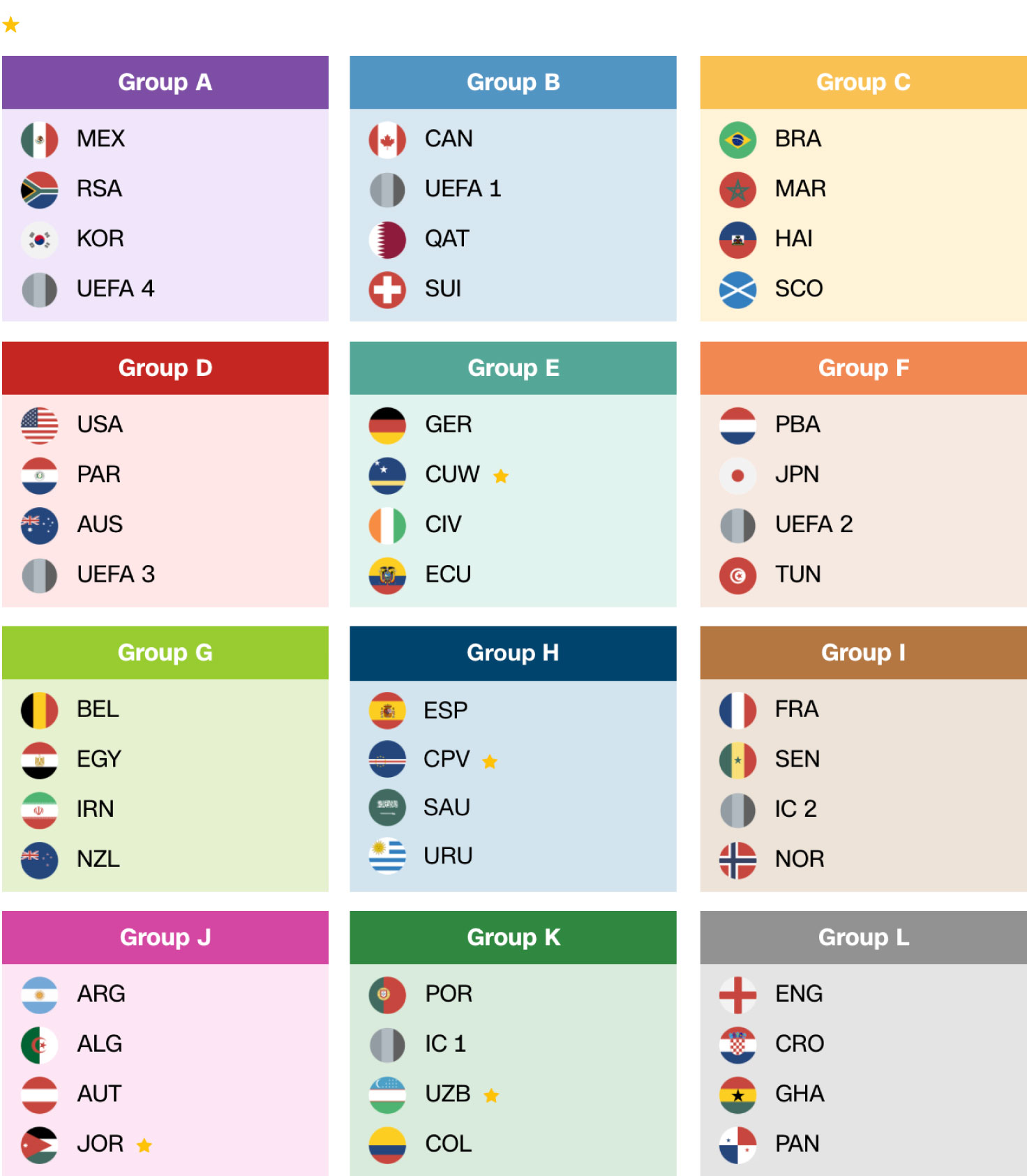
Favorable Draws for Tournament Favorites
In contrast to the tough groups, several traditional powerhouses received relatively favorable draws, positioning them for a smooth progression to the Round of 32.
Reigning champions Argentina were drawn into Group J alongside Algeria, Austria, and Jordan, a collection of teams that, while capable, do not pose an immediate, major threat to the title holders. Similarly, Portugal, likely featuring Cristiano Ronaldo in his final World Cup, heads Group K with Colombia, Uzbekistan, and a FIFA Playoff winner. Spain leads Group H with Uruguay, Saudi Arabia, and Cabo Verde. These draws reflect FIFA’s procedural decision to prevent the four highest-ranked teams (Spain, Argentina, France, and England) from meeting before the semi-finals, strategically balancing the overall tournament pathways to ensure major matchups deep into the knockout rounds.
The New Dynamic of the Group Stage
The shift to 12 groups of four and the progression of 32 teams into the knockout stage fundamentally changes the stakes of the Group Stage.
Under the new format, the top two teams from each of the 12 groups advance, along with the eight best third-placed teams. This means that a total of 20 teams can afford to finish third and still advance, significantly reducing the pressure on teams to win their groups outright, particularly for second-tier teams and debutants. For nations like the smallest-ever qualifier Curaçao (in Group E with Germany, Côte d’Ivoire, and Ecuador) and Haiti (in Group C with Brazil, Morocco, and Scotland), securing a single win or two draws may now be sufficient to sneak into the Round of 32, ensuring the expanded tournament is truly inclusive of emerging football nations.