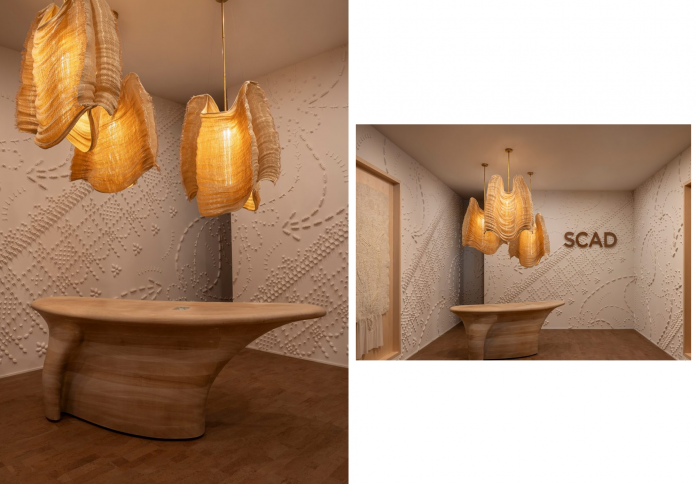
The Savannah College of Art and Design (SCAD) presented a compelling and structurally ambitious installation at Design Miami 2025, using plaster and gypsum-based materials to create a mesmerizing, abstract landscape that speaks to environmental fragility. Titled “Unstable Shores,” the work was designed by a multi-disciplinary team of SCAD students and faculty, intended as a powerful, large-scale commentary on the impact of sea-level rise and coastal erosion in the city of Miami. The installation employed a technique of controlled cracking and material stress, resulting in a structure that was both beautiful and seemingly on the brink of collapse. By capturing the elegance and vulnerability of the natural environment in a seemingly rigid material, SCAD successfully delivered a high-impact, conceptual piece that became one of the most talked-about works at the prestigious design fair.
Concept: Sculpting Environmental Precarity
The core conceptual goal of the SCAD installation was to translate the abstract and slow-moving crisis of climate change into a direct, physical, and emotionally resonant experience for visitors.

The structure was designed as an abstract, topographical map of a fragile coastline, featuring wave-like patterns and subtle depressions that mimic the erosion of land. The title, “Unstable Shores,” directly references Miami’s unique position as a city facing immediate threats from rising ocean levels and the constant geological movement of its low-lying terrain. The installation invited viewers to walk around and through the piece, experiencing the visual and physical sense of imbalance. This approach challenged the common perception of design as solely focused on function or pure aesthetic, instead positioning it as a powerful medium for environmental and social critique.
The Material and Method: Gypsum and Controlled Stress
The SCAD team chose plaster and various gypsum-based compounds as the primary materials, utilizing their properties to express the concept of controlled disintegration and fragility.

Gypsum, known for its ability to be cast into intricate forms before setting into a brittle solid, allowed the designers to create surfaces that appeared cracked and stressed without fully collapsing. The team employed innovative casting techniques, deliberately introducing tension into the drying process to control the patterns of fissure and breakages across the smooth surfaces. The result was a texture that suggested the organic wear of time, salt, and water, offering a tactile representation of geological time and decay. The use of a simple, historically significant material like plaster, contrasted with the cutting-edge technology of the design fair, lent the piece a timeless, almost archaeological quality.
The Design Process: A Multi-Disciplinary Team Effort
The creation of the “Unstable Shores” installation was a large-scale, multi-disciplinary effort, reflecting the comprehensive nature of SCAD’s design education model.

The team comprised students and faculty from diverse departments, including Architecture, Industrial Design, Sculpture, and Interior Design. The initial conceptual sketches moved into sophisticated digital modeling and fabrication to ensure structural integrity and precise artistic output. Students were involved in every phase, from mixing the specific plaster compounds to the large-scale, on-site installation and finishing. This collaborative approach was a key feature of the project, highlighting how complex, conceptual design solutions require the integration of aesthetic vision, material science, and engineering expertise, effectively mimicking the workflow of a contemporary design studio.
Reception at Design Miami: Dialogue and Impact
The installation was strategically positioned within the highly selective arena of Design Miami, where it drew significant attention for its scale, material simplicity, and thematic seriousness.
Unlike the adjacent galleries featuring polished, high-end commercial furniture, SCAD’s work offered an immediate, thought-provoking dialogue about design ethics and responsibility. Critics and attendees praised the installation for its effective use of negative space and its ability to create a profound emotional reaction without relying on elaborate lighting or mechanical elements. The piece became a key talking point of the fair, driving conversations about how designers and artists should engage with the urgent realities of the climate crisis, particularly in a coastal city like Miami. It successfully framed design not as a luxury market endeavor, but as a critical tool for commentary and awareness.