The completion of the five new stations for Melbourne’s expansive Metro Tunnel—a monumental undertaking by a collaboration of RSHP, Hassell, and WW+P Architects—marks a critical milestone in alleviating congestion and enhancing the city’s underground infrastructure. Designed to connect the Sunbury line in the west to the Cranbourne and Pakenham lines in the southeast, the tunnel project is more than a feat of civil engineering; it is a profound architectural achievement. The design brief focused on creating a unique, timeless, and light-filled subterranean experience that celebrates the raw, exposed structure of the tunnels while integrating human-scale, crafted components. By giving each station a distinct, street-level identity and a bright, functional underground space, the collaboration has succeeded in transforming the daily commute into an enjoyable, architecturally expressive journey.
A Common DNA with Distinct Identities
The five new stations—Arden, Parkville, Anzac, State Library, and Town Hall—share a foundational architectural philosophy but were each intentionally designed with a distinct character to reflect their immediate urban context.

According to RSHP Senior Design Partner Ivan Harbour, the stations are designed as “siblings, with their own distinct character and common DNA.” This common architectural language ensures that the line-wide experience is cohesive and immediately recognizable to commuters. However, the design team went to great lengths to ensure that each station’s street-level entrance, or “portal,” is dramatically different, responding thoughtfully to its specific location within the city fabric. This strategy not only improves the surrounding urban spaces but also provides a necessary tangible connection with the streets above, preventing the underground experience from feeling disconnected from the city’s life.
Designing with Light: The Subterranean Cathedral
A primary goal of the design team was to combat the often dark and claustrophobic nature of underground transport infrastructure by drawing abundant natural light into the deep commuter spaces.

This was achieved through the careful engineering of the station entrances and the use of expansive glazing. For instance, Parkville Station features a highly glazed structure topped with a distinctive pitched roof, designed specifically to funnel sunlight deep below ground. Similarly, the two Central Business District (CBD) stations, State Library and Town Hall, feature interiors that are described as “cathedral-like” in their lofty scale and dramatic use of volume. This reference to grand, historical structures provides a sense of spaciousness and awe, transforming the often-mundane experience of descending into the metro into something uplifting and aesthetically pleasing for daily commuters.
Celebrating the Raw and the Refined
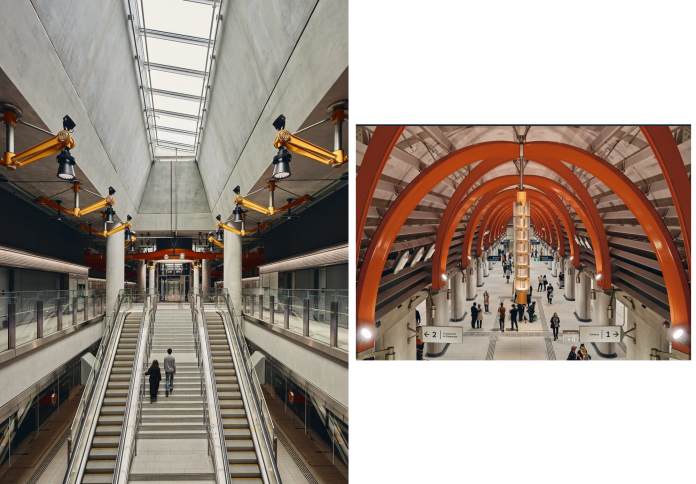
The design philosophy is founded on a compelling contrast: the celebration of the bold, exposed civil-engineering structures set against the use of human-scale, precision-engineered, and crafted components.

The architects intentionally left much of the raw concrete and structural elements visible, honoring the immense technical achievement of boring and constructing the tunnels. Against this “backdrop of bold, exposed civil-engineering structures,” detailed elements were introduced to enhance the human experience. These included sculptural lighting fixtures, brightly coloured structural elements, and unique finishes. For example, the interiors of State Library Station feature artistic panels set between concrete columns, while the vaulted roof at Town Hall Station is dramatically supported by tree-shaped columns, creating visually rich and engaging spaces.
Contextual Responses at Street Level
The architectural identity of the stations is particularly evident in the street-level portals, which were designed to blend with or enhance their unique surrounding environments.

Arden Station is characterized by a tall, arched entrance lined with bricks, paying homage to the industrial heritage of its neighborhood. In contrast, Anzac Station, aiming for integration with its leafy surroundings, was designed with green columns supporting a timber canopy. This focus on responding carefully to the immediate streetscape ensures that the large-scale infrastructure project is not an imposition but a thoughtful, integrated addition to the city’s public space. By carefully selecting materials and forms that resonate with local character, the architects ensured that the “siblings” maintained their unique identity within the broader family of the new Metro Tunnel line.
Future-Proofing the Commuter Experience
A key consideration in the design was ensuring that the new stations would remain functional and aesthetically relevant for decades to come, anticipating future technological and urban changes.

Ivan Harbour noted that the design relies on a “loose-fit definition of space” that will allow the stations to readily absorb changing technology without disrupting the original spatial qualities. This pragmatic approach recognizes that while technology evolves rapidly, human comfort and the experience of light and space are timeless needs. By focusing on the durable, “timeless” quality of the raw, expressive civil-engineering structure, the architects have created a lasting framework where temporary technological overlay can be updated, ensuring the station interiors will maintain their distinctive, enjoyable, and functional qualities long into the future.