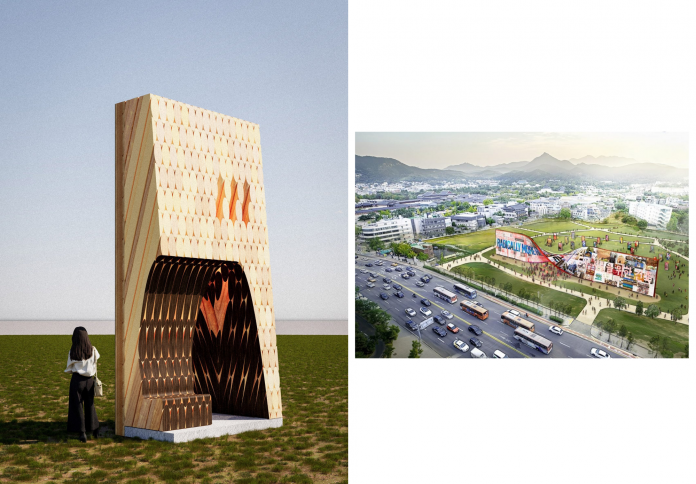
At Seoul’s fifth Biennale of Architecture and Urbanism, Kengo Kuma contributes to an imaginative installation called “Walls of Public Life”—one among 24 designed wall fragments that propose a new, emotionally rich language for urban facades. Far from mere barriers, these walls emerge as poetic interventions—miniature spaces of expression, memory, or community in a public plaza.
Walls as expressive fragments, not faceless fronts

Each wall, measuring about 2.4 × 4.8 meters, reimagines what a building’s exterior can be. Instead of bland cladding or uniform surfaces, designers—including Kuma, Francis Kéré, MAD Architects, and others—explore texture, material, and emotion. These walls push viewers to question why typical architecture often overlooks the possibility of joy, resonance, and meaning in the everyday.

Kuma’s contribution: humility, tactility, and natural depth
In line with Kuma’s philosophy of architecture as frame for nature, his wall likely engages tactile materiality, layered transparency, and rhythmic subtlety. While specific details remain under wraps, based on his signature work we can anticipate a wall that uses natural elements or sensory variation—wood, stone, layered joinery—to evoke emotional openness rather than monumentality. Such a fragment would resonate both conceptually and visually with the Biennale’s call for humane, detailed, and human-scaled architecture.
A beacon for civic design in the heart of Songhyeon Green Plaza
Located at Songhyeon Green Plaza, these wall installations frame the environment and suggest new kinds of engagement between passerby and built form. By giving each design team a limited site, the Biennale creates a collaborative tapestry of interpretation—artists, architects, chefs, jewellers, local makers—all suggesting how urban facades might feel more alive, inclusive, and responsive to public life.
What this means for architecture beyond art
Beyond being expressive vignettes, these Walls of Public Life serve as provocations: to developers, planners, and city officials, and to anyone who moves through cities hoping for surprise or narrative in façades. Heatherwick, who initiated the project, envisions each wall as a “joyful clue” to better urban design—where texture, surprise, and public voice transform otherwise neutral exteriors into memorable moments.
In summation, Kengo Kuma’s involvement in the Walls of Public Life offers more than a design gesture—it reflects a broader worldview. A wall, in his hands, isn’t a screen or symbol of division; it’s a fragment of civic care, a moment of tactility, a prompt for empathy. In Seoul this autumn, architecture may be measured not by its scale, but by its capacity to soften, to surprise, and to reframe ordinary surfaces into civic narratives.