In the Sammonlahti neighborhood of Lappeenranta, Finland, a new architectural landmark has emerged that pays a poetic tribute to the region’s postmodern history. Completed in early 2026 by Helsinki-based Nervin Architecture, Sammontalo is a 12,000-square-metre community complex that seamlessly integrates a school, childcare facilities, a public library, and sports spaces. Drawing inspiration from the distinctive 1980s civic architecture of the area, the building utilizes a warm, terracotta-toned palette of brick, concrete, and timber. As “Magazine World” explores, Sammontalo is more than just a multifunctional hub; it is a sensitive piece of urban repair that honors the past while providing a sustainable, human-centric future for its residents.
A Dialogue with Postmodernism
Sammontalo occupies a site formerly home to a daycare, school, and sports hall designed in the 1980s as part of a masterplan by Finnish architect Olli Kivinen. While those original structures had to be demolished due to structural issues, Nervin Architecture (formerly AS LL TK Architects) made a deliberate choice to carry their spirit forward. The new building responds to surviving civic landmarks, such as Sulo Savolainen’s youth center and the 1992 Sammonlahti Church, which are characterized by their red-brick facades and approachable, human scale. By adopting these familiar materials and “expressive architectural language,” the architects have ensured that the massive new complex feels like a natural evolution of the neighborhood’s identity.

Studio partner Antti Soini emphasizes that the goal was not to create a radical departure, but to contribute to a “welcoming and approachable urban environment.” This is achieved through a clear visual hierarchy where “brick red is used to articulate structure and define edges,” while softer beige tones function as a calm infill. This sophisticated use of color and repetitive architectural elements—pillars, beams, and large eaves—unifies the building’s sprawling perimeter, making the 12,000-square-metre program feel intimate and navigable for its young and old users alike.
Vertical Segregation and the Central Heart
The internal organization of Sammontalo is divided by use to manage the complex flow of public and private life. The ground floor is dedicated to the most active, public-facing functions: the library, the sports facilities, and the youth center. The upper storey is reserved for more private learning areas, including the school and childcare rooms. This vertical separation allows the building to function as a quiet educational environment during the day while transforming into a vibrant community anchor in the evenings and on weekends.

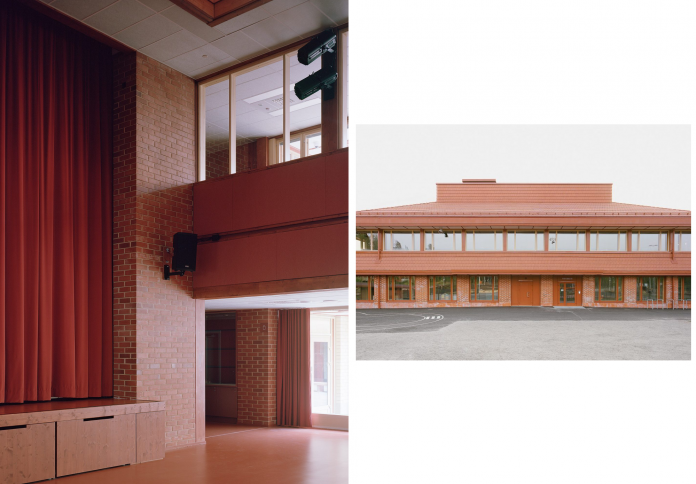
The two levels are bridged by a dramatic, double-height hall at the building’s center. This space serves as the “heart” of the complex, connecting a public entrance plaza to the north with a private, cream-toned courtyard to the south. Within this hall, a cross-laminated timber (CLT) seating stair creates a theater-like atmosphere, framed by monumental brick pillars. Mezzanines overlooking the hall provide additional study and social spaces, mirroring the horizontal language of the exterior facade and ensuring that natural light and visual connections are maintained throughout the building’s core.
Material Honesty and CLT Innovation
Structurally, Sammontalo is a testament to Finland’s commitment to sustainable timber construction. The building is primarily framed with cross-laminated timber (CLT), which is raised on a durable concrete plinth to protect it from the harsh Nordic climate. On the ground level, red-brick cladding creates a rhythmic series of “piers,” providing a sense of groundedness and weight. In contrast, the upper floor is almost entirely glazed, creating a “lantern-like” effect that glows in the winter darkness and provides the learning spaces with ample daylight.

The exterior’s terracotta shade is carried into the public interiors through stained timber and painted steelwork, creating a warm, cohesive environment. In the classroom areas, the palette shifts to exposed, pale timber and cream finishes, creating a calm, neutral backdrop that supports concentration. Sloping tiled roofs with generous eaves top each section of the building, a feature Soini describes as essential for “unifying” the staggered form while providing protection from snow and rain. This marriage of traditional masonry tones and modern timber engineering defines the project’s unique character.
Community as the Core Purpose
Beyond its formal and material achievements, Sammontalo is a masterclass in social integration. By bringing disparate municipal services under one roof, the project fosters accidental encounters between generations—students might pass through the library on their way to the gym, while elderly residents can enjoy the “theater” of the central hall. It is a building designed to be “lived in” throughout the day, serving as the social backbone of the Sammonlahti district.

Nervin Architecture’s analytical approach has resulted in a building that is both humble and heroic. It doesn’t shout for attention through avant-garde shapes; instead, it whispers through its textures, its colors, and its respect for the urban context. In the hands of Soini, Lindroos, and Kanerva, the postmodern heritage of Lappeenranta has been translated into a 21st-century sanctuary. Sammontalo is a reminder that the most successful public buildings are those that listen to their surroundings, providing a sense of continuity and belonging in a fast-changing world.