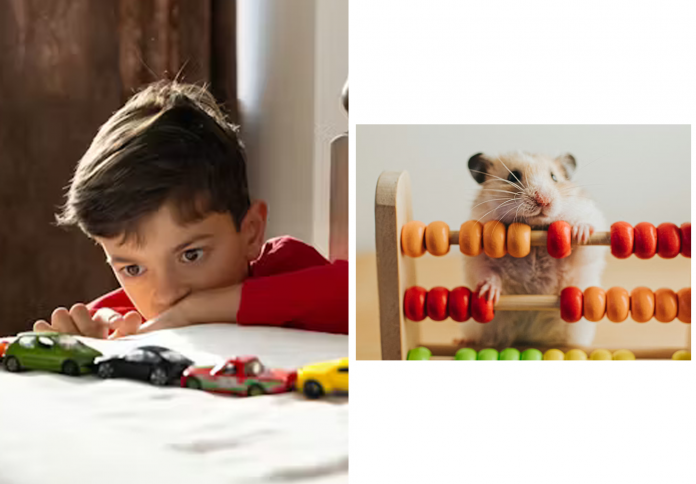
In the vast, interconnected world of 2026, the question of whether animals “think” like us has evolved from philosophical speculation to a complex experimental frontier. According to a landmark study by Dr. Olga Lazareva, published in The Conversation, the biological gap between human and animal reasoning is closing, but the methods we use to measure it remain fraught with difficulty. While a monkey, a pigeon, or even a wasp can perform logical feats—such as transitive inference—that appear remarkably human, the “logic” they employ might be fundamentally different from our own. As we navigate the ethical and scientific implications of animal consciousness, Dr. Lazareva’s research serves as a polished reminder: in the animal kingdom, success on a test is only the beginning of the story. The true challenge lies in determining whether a creature is following a rule of logic or simply finding a clever, non-rational shortcut to a reward.
The Transitive Leap: When A > C
The most famous measure of logic shared by humans and animals is “transitive inference.” This is the mental ability to understand that if A is greater than B, and B is greater than C, then A must be greater than C. For a human, this feels like an automatic, deductive leap. In laboratory settings, researchers test this by presenting animals with pairs of images, rewarding them for picking the “correct” one in a hierarchy. If a monkey learns that “Hands” (A) beats “Classroom” (B), and “Classroom” (B) beats “Bushes” (C), the true test comes when they are shown “Hands” (A) and “Bushes” (C) together for the first time.
Surprisingly, a vast array of species—ranging from primates and birds to fish and even wasps—pass this test with flying colors. For years, this was taken as definitive proof that logical reasoning is a widespread biological trait. However, the 2026 perspective highlights a “cognitive catch”: an animal might pick A over C not because it understands the transitive rule, but because it has learned that A is “always a winner” and C is “always a loser” in other pairings. This possibility of “value-based” learning versus “logical” reasoning is what makes the study of animal minds so incredibly tricky.
The Transitivity Wall: A Subtle Shift
To dig deeper into the actual mechanism of thought, researchers like Dr. Lazareva utilize a more complex task known as “transitivity.” While the names are similar, the change in procedure is a game-changer for cognitive science. In this version, the relationships are conditional: “If you see a triangle, pick the red square; if you see a cross, pick the blue square.” The test then asks if the animal can flip the logic: “If I show you the red square, will you pick the triangle?” This requires a level of symbolic flexibility that moves beyond simple hierarchy.
Interestingly, species that dominate the first set of transitive inference tasks often stumble at this second hurdle. They tend to treat the triangle and the red square as a single, locked-in association rather than two independent concepts linked by a logical bridge. This “transitivity wall” suggests that while animals can navigate social hierarchies and survival-based sequences with ease, the abstract, symbolic logic that humans use to build languages and mathematics might be a distinct, more specialized cognitive tool.
The “Smart Shortcut” Problem
A persistent challenge in animal intelligence research is the “Smart Shortcut” or “associative learning” problem. Evolution is efficient; it favors the simplest solution to any problem. If a bird can get a seed by remembering a simple visual pattern rather than performing a complex logical deduction, it will choose the pattern every time. This creates a “masking effect” where an animal’s outward behavior looks perfectly rational, but the internal process is purely mechanical.
Dr. Lazareva’s review of current research argues that we need more “evidence-neutral” tests that can distinguish between these two paths. The goal of 2026 is to move away from “human-centric” testing—where we expect animals to solve problems exactly as we do—and toward “bio-centric” models that respect the specific sensory worlds of different species. By understanding the “shortcuts” animals take, we gain a clearer picture of the diverse ways that intelligence can manifest in the absence of human language.
Rebranding the Animal Mind
The ultimate takeaway from Dr. Lazareva’s work is a rebrand of how we define “logic.” Rather than viewing it as a single, monolithic ability that humans have and animals lack, we should see it as a “spectrum of strategies.” The fact that a fish can solve a March Madness-style bracket via transitive inference is an incredible evolutionary achievement, regardless of whether it uses the same “if-then” internal monologue that a human does. These “non-linguistic logics” are perfectly adapted to the environments in which these animals thrive.
As we move forward, the “Protocol of Thought” is becoming a standard in ethology. This protocol encourages researchers to design experiments that “fail-proof” against simple associations, forcing the subject to use higher-order reasoning if they want the reward. By pushing the boundaries of what we ask of animals, we aren’t just learning about them; we are refining our understanding of ourselves. After all, if a wasp can reason through a social hierarchy, we must ask: how much of our own “logical” behavior is a conscious choice, and how much is a brilliant, evolutionary instinct?