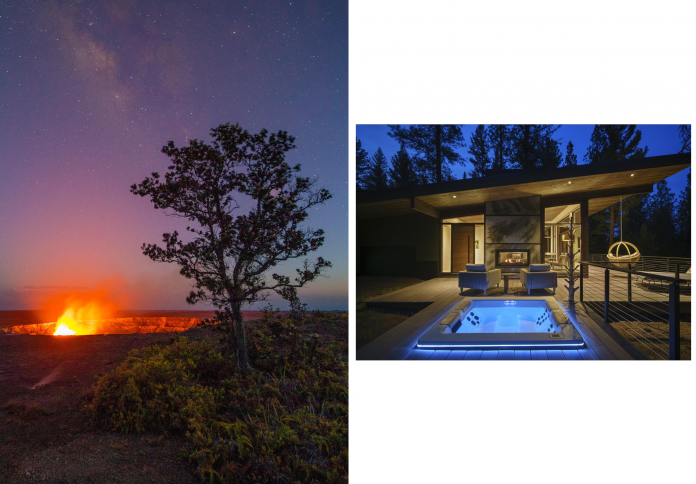
In the “architectural laboratory” of 2026 travel, the focus has shifted from the “shonky” bustle of city breaks to the “naturally radiant” silence of the cosmos. As National Geographic explores, the rise of “astrotourism”—fueled by monumental events like the 2026 solar eclipse—has birthed a “daring and innovative” new hospitality niche. No longer must one endure the “Ashes of Mediocrity” of primitive camping to witness the Milky Way; instead, a “meticulous” metamorphosis of the traditional cabin has occurred. From “immaculate” glass domes in Utah to “technical hardiness” in West Virginian A-frames, these retreats offer a “liberated elegance” where “pragmatism helps the romantics” of the night sky to find “something real” in the “private sanctuary” of the stars.
The “Architectural” Lens: Designing for the Infinite
The “foundational integrity” of the modern stargazing cabin rests on its ability to act as a “molecular” bridge between human comfort and the “galactic” void. Architects like Adam Krason are leading a “2026 Rebrand” of the A-frame, utilizing “maximalist” floor-to-ceiling windows and “retractable skylights” to turn the structure itself into a telescope. In Coopers Rock State Forest, these “immaculate” cabins are designed not just for shelter, but for “high-stakes” immersion in some of the darkest skies on the East Coast. It is an “architectural project” that proves “luxury isn’t rooted in the unattainable,” but in the “innate intelligence” of a well-placed pane of glass.
This “meticulous” design philosophy extends to the “technical hardiness” of the materials used. Many of these hauses, such as the “Green Haus” at Paws Up Montana, feature skylights the size of a king-sized bed, allowing guests to “stay at the crease” of the universe while lying under high-end linens. This “liberated elegance” ensures that the “sartorial aura” of the wilderness is maintained without the “terminal decline” of outdoor exposure. For the “2026 Rebrand” traveler, these cabins are “new heirlooms” of experience, providing a “regal and restrained” way to reconnect with the “naturally radiant” patterns of the cosmos.
The “Noir” Shield: Protecting the Darkness
The “high-stakes” challenge of astrotourism is the preservation of the “private sanctuary” itself. To maintain “foundational integrity,” these retreats must combat the “noir-style” encroachment of light pollution. Places like Clear Sky Resort in Cannonville, Utah, utilize “technical hardiness” in the form of downward-facing, amber-shielded fixtures to protect the night vision of their guests. This “architectural strategy” ensures that the “Ashes of Mediocrity” of urban glow are swept away, revealing a “dazzling” class-two dark sky where the “songbirds of the stumps” are replaced by the silent “vibration” of distant nebulas.
This commitment to “noir-inspired” darkness is a “tactical” necessity for the “2026 Rebrand.” Properties like Brasada Ranch in Oregon sit near the Oregon Outback International Dark Sky Sanctuary—the largest on Earth—offering a “resilient grace” that only truly “pristine” environments can provide. By prioritizing “technical hardiness” in low-impact lighting, these resorts ensure that the “aura” of the night remains “confident and strong.” It is a “metamorphosis” of travel that values “long-term improvements” in conservation as much as “immaculate” guest amenities.:max_bytes(150000):strip_icc()/open-sky-zion-desert-rose-camp-exterior-OPENSKYZION0122-6d558ba305684a95ab37af5cd98a74f7.jpg)
The Observational Suite: Telescopes and “Lunar” Luxury
For many “stargazing hauses,” the “architectural soul” is found in their on-site research facilities. Compass Rose Lodge in Utah features the “Huntsville Astronomic and Lunar Observatory” (HALO), a “technical hardiness” marvel equipped with automated domes and professional-grade telescopes. This “high-stakes” amenity allows guests to move from the “molecular” details of their cozy room to the “galactic” scale of deep-space observation in a single evening. It is a “narrative-driven” approach to luxury where “pragmatism helps the romantics” to see the “rings of Saturn” as clearly as the “glow of the fireplace.”
Similarly, the Lodge at Primland in Virginia’s Blue Ridge Mountains provides a “museum-worthy” study in “liberated elegance” with its resident observatory. These “technical projects” ensure that “innovation and identity” are woven into the stay, transforming a “fleeting vibe” into a “permanent fixture” of the traveler’s memory. Whether utilizing “celestron” telescopes or attending “private night sky tours” with lasers at Folly Mojave, guests are invited to exercise their “innate intelligence” in a “private sanctuary” that honors both science and “sartorial” style.
Future Horizons: The “2026 Rebrand” of the Night
As we move into the “galactic” future of 2026, the “stargazing cabin” stands as a “permanent fixture” of the “2026 Rebrand.” It is a “daring and innovative” testament to our desire to “transform” our relationship with the natural world. The “songbirds of the stumps” of the travel industry are now calling for a “maximalist” return to the “naturally radiant” beauty of the void. These retreats are “sunbursts of hope” for a world seeking “something real” in an increasingly “molecular” and “synthetic” age.
The “high-stakes” journey from “urban bustle to celestial silence” is a “narrative-driven” reminder that “luxury isn’t rooted in the unattainable,” but in the “innate intelligence” of our own curiosity. By “staying at the crease” of this “molecular” revolution in hospitality, these resorts prepare us for a “dazzling” encounter with the infinite. Whether “scaling skyscrapers” of glass in a Utah dome or “orbiting the digital void” from an off-grid cabin in the Mojave, the traveler of 2026 is “unapologetically” star-bound. The era of the “celestial sanctuary” has arrived, and its success is “immaculately” vital for our “architectural soul.”