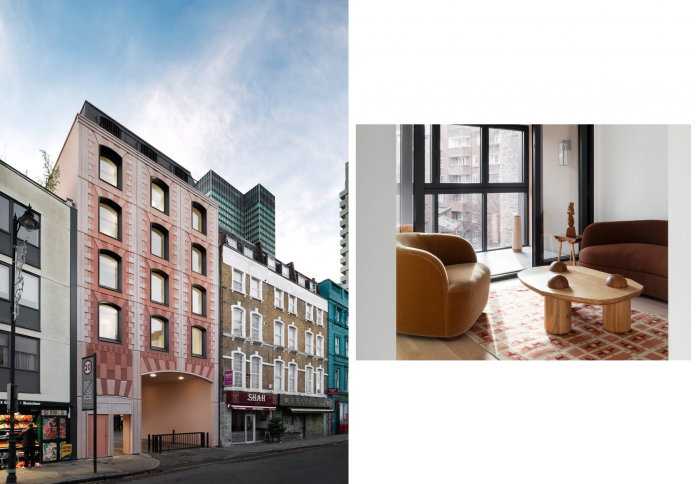
In the heart of London, where the tension between historic preservation and urban expansion is most palpable, a new residential structure is proving that the future of the city can be built from the fragments of its past. Architecture studio Bureau de Change has unveiled “Trace,” a sophisticated apartment block that challenges the industry’s “demolition-first” mentality. By utilizing a facade crafted from the reclaimed waste of the very buildings that previously occupied the site, the architects have created a tactile, layered narrative of urban evolution. As “Magazine World” explores, Trace is more than just a sustainable housing solution; it is a poetic experiment in “material memory,” where the scars of demolition are transformed into a refined aesthetic for 21st-century London living.
A Facade Born from the Rubble
The most radical aspect of Trace is its external skin, which serves as a literal record of the site’s history. Traditionally, when a building is demolished in London, the resulting “hardcore”—bricks, stone, and concrete—is crushed and used as low-grade fill for roads. Bureau de Change sought to elevate this waste, treating it as a precious resource. The architects meticulously collected the demolition debris from the previous structures and transformed it into a series of bespoke, cast-panels. These elements were then arranged in a rhythmic, tiered facade that gives the building a sense of geological depth.

This approach results in a facade that is rich in texture and variation. Fragments of old red brick, weathered limestone, and grey concrete are suspended within the new matrix, creating a “terrazzo-like” effect on an urban scale. The building does not hide its recycled origins; instead, it celebrates the imperfections and color variations that come from reclaimed materials. By keeping the “trace” of the previous architecture visible, Bureau de Change has created a building that feels deeply rooted in its location, providing a sense of continuity in a city that is constantly reinventing itself.
Sculpting Light and Shadow
Beyond its material innovation, Trace is a masterclass in the play of light and shadow. The facade is not a flat plane but a series of stepped and recessed volumes that respond to the movement of the sun throughout the day. The deep window reveals and sculptural balconies create a dynamic, ever-changing pattern of shadows that break up the building’s mass. This “chiaroscuro” effect is particularly effective given the recycled materials’ varied textures, as the light catches the uneven fragments of stone and brick, bringing the walls to life.

The interior of the apartment block reflects this same commitment to light and space. The apartments are designed with high ceilings and large glazed openings that allow natural light to penetrate deep into the floor plans. Bureau de Change has carried the “reclaimed” aesthetic into the communal areas, utilizing a palette of raw concrete, timber, and recycled metal accents. The goal was to create an environment that feels both “industrial and elevated,” providing a calm sanctuary that remains connected to the gritty, creative energy of its London neighborhood.
The Ethics of Circular Construction
Trace arrives at a critical juncture for the global construction industry, which is currently responsible for a significant portion of the world’s carbon emissions and landfill waste. By implementing a circular construction model, Bureau de Change is providing a tangible blueprint for how architects can reduce the “embodied carbon” of their projects. The process of reclaiming and casting the facade panels required significant technical coordination, but the result is a building that effectively “offsets” its own destruction.

This “circular” philosophy extends to the building’s end-of-life plan. The panels are designed to be disassembled and repurposed in the future, ensuring that the material legacy of the site continues indefinitely. For the architects, sustainability is not just a technical checkbox; it is a design driver that dictates the very form and feeling of the building. Trace proves that ethical architecture does not have to be austere; it can be incredibly luxurious, tactile, and visually stimulating, provided that the designer is willing to look for beauty in the “waste” of the past.
Redefining the London Apartment Block
In a city where many new-build residential projects can feel anonymous and detached from their context, Trace stands out for its specificity. It is a building that could only exist on this particular London street, made from the very materials that once formed its neighbors. This site-specific approach is a hallmark of Bureau de Change’s work, which often explores the intersection of craftsmanship, history, and modern technology. By moving away from standardized cladding systems and toward bespoke, reclaimed solutions, the studio is helping to redefine the identity of the London apartment block.

As the first residents move into Trace in early 2026, they are not just moving into a modern home; they are becoming part of a continuous architectural lineage. The building serves as a reminder that the city is a living organism, constantly shedding its old skin to grow a new one. In the hands of Bureau de Change, that new skin is a beautiful, complex mosaic of everything that came before. Trace is a quiet revolution in London’s urban fabric—a building that looks backward in order to move forward, proving that the most sustainable way to build the future is to cherish the fragments of the past.