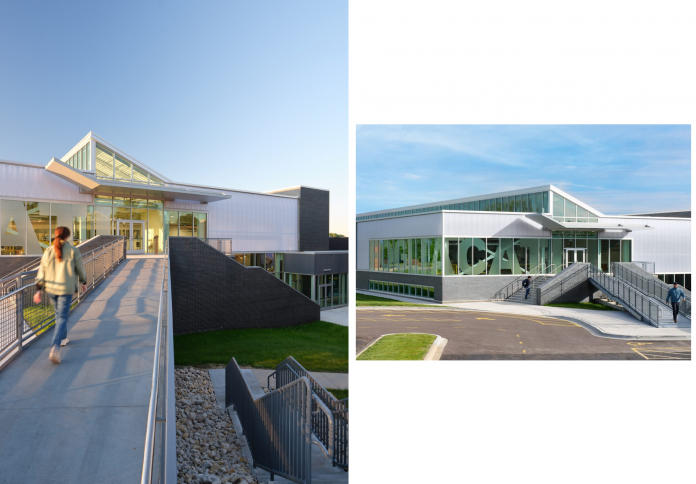
In the suburban landscape of Crystal Lake, Illinois, a new kind of educational monument has emerged, one that treats its own structural and mechanical systems as a living textbook. Chicago-based practice Ross Barney Architects has completed the Foglia Center for Advanced Technology and Innovation (CATI) at McHenry County College, a project that elevates industrial architecture to a “noble” status. By exposing the very ducts, machinery, and conduits that students are training to maintain, AIA Gold Medal recipient Carol Ross Barney and her team have created a building that is both a functional lab and an aspirational symbol. As “Magazine World” explores, this 2026 completion proves that technical education deserves a “cathedral-like” home—one where the architecture itself becomes a primary teaching tool.
Architecture as an Active Curriculum
The most radical design choice at the Foglia Center is the decision to leave the building’s mechanical guts completely visible. For students in the HVAC (heating, ventilation, and air conditioning) and manufacturing programs, the building serves as a real-time demonstration of the principles they are studying. “If this is what they’re repairing, we should show them where these things are on the building,” Ross Barney explained to Dezeen. “If that’s what you’re here to learn, you might as well look at the ones that are running this building.” This pedagogical transparency turns the ceiling and utility rooms into an extension of the classroom, fostering a deeper understanding of the built environment.

This “analytical approach” to design is a hallmark of the studio, which is well-known for public projects like the Chicago Riverwalk. In the Foglia Center, even the machine rooms were given windows, allowing students to observe the building’s heart in operation. By celebrating these “beautiful industrial parts,” the architects have moved away from the traditional model of technical schools as windowless, purely utilitarian sheds. Instead, they have created a space that honors the dignity of skilled labor, providing students with an environment that feels as sophisticated and “high-design” as any corporate headquarters.
A Cathedral of Light and Polycarbonate
From the exterior, the Foglia Center presents a long, horizontal silhouette partially embedded into the Illinois site. The building is divided lengthwise into two distinct zones: a two-storey block for classrooms and laboratories, and a double-height volume designed to accommodate massive industrial workshops. The material palette is a study in industrial efficiency, utilizing grey brick accented by semi-transparent polycarbonate panels. At night, these panels catch the interior lighting, giving the entire structure a soft, ethereal glow that the architects describe as “cathedral-like.”

The use of polycarbonate is as strategic as it is aesthetic. The material provides essential insulation for the energy-intensive workshops while allowing natural light to penetrate deep into the floor plan. A long monitor window projects from the roof in the center of the structure, flooding the double-height atrium with daylight. This central atrium serves as the building’s primary circulation artery, physically and visually separating the classroom “bar” from the industrial “hall.” The result is a workspace that feels airy and connected to the outdoors, a far cry from the gritty, dark interiors typically associated with manufacturing education.
The Social Geometry of Technical Training
Inside, the Foglia Center balances its industrial character with moments of social warmth. The main entrance features a polished concrete lobby anchored by “social steps”—wide, amphitheater-style seating that encourages students to gather, study, or collaborate between classes. These steps appear to extend through a glass wall to the exterior, blurring the boundary between the college campus and the technical facility. A catwalk suspended above the central atrium leads to classrooms that seemingly float above the workshop floor, allowing students to observe the industrial activity from a privileged, bird’s-eye perspective.

To navigate the vast, open spaces, the architects utilized bright yellow detailing on walls and furniture to create visual distinction and a sense of energy. The structural I-beams and crossbars are painted a crisp white, contrasting with the raw corrugated metal of the ceiling. This carefully controlled palette ensures that the exposed machinery doesn’t feel chaotic; instead, it is presented with the precision of a gallery exhibit. By integrating high-quality social spaces with gritty industrial zones, Ross Barney Architects has created a facility that supports the whole student, acknowledging that technical expertise and social collaboration are equally vital in the modern workforce.
Noble Space for a New Era
The term “noble space” was a guiding principle for the project, reflecting McHenry County College’s desire to move beyond the “utilitarian lab” and toward something truly inspirational. By investing in high-quality architecture for its technical programs, the college is sending a powerful message about the value of vocational training in the 21st century. The Foglia Center arrives at a time when the demand for skilled technicians and advanced manufacturers is at an all-time high, and Carol Ross Barney’s design provides these students with a facility that matches the importance of their future careers.

As the building begins its life in early 2026, it stands as a blueprint for the future of community college architecture. It proves that with a limited budget and simple materials, architects can create landmark structures that serve both the community and the curriculum. The Foglia Center is more than a school; it is a celebration of the systems that make our world function. In Crystal Lake, Ross Barney Architects have demonstrated that when you strip away the drywall and expose the mechanics, you don’t just find a building—you find a masterpiece of human ingenuity.