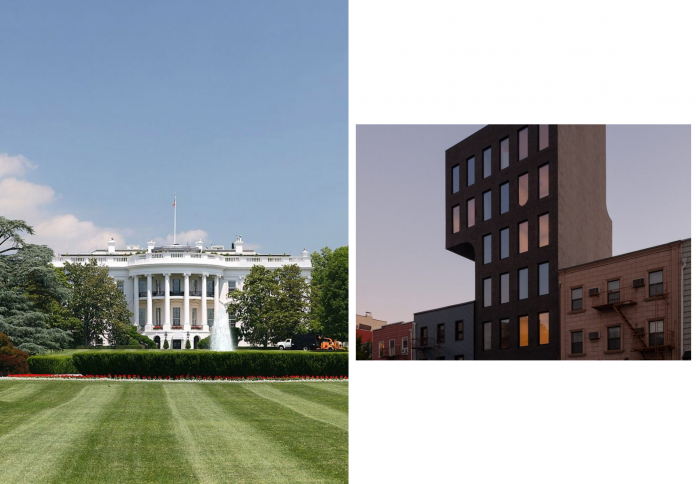
In the dense, rapidly evolving landscape of Williamsburg, Brooklyn, a new residential structure has captured the attention of the global architecture community by seemingly defying the constraints of its footprint. 545 Metropolitan, the latest project by the New York-based studio Commoncraft, has become the centerpiece of the recent “Dezeen Debate” for its bold use of cantilevered forms. By extending portions of the building over its neighbors, the architects have successfully maximized floor space on a notoriously tight site, creating a striking silhouette that challenges traditional notions of urban density. As “Magazine World” explores, this project is more than just a feat of engineering; it is a creative response to New York City’s rigorous zoning and safety laws, igniting a conversation about the future of multi-family housing in one of the world’s most competitive real estate markets.
Engineering Density on a Constrained Site
The primary challenge at 545 Metropolitan was the physical limitation of the lot. Surrounded by low-rise historic structures and hemmed in by the busy corridor of Metropolitan Avenue, Commoncraft had to find a way to make the development financially viable without compromising on living quality. The solution lay in the “air rights” of the adjacent properties. By cantilevering the upper floors of the building beyond the ground-floor footprint, the architects were able to “borrow” volume from the surrounding airspace, effectively expanding the floor plates as the building rises. This top-heavy geometry gives the structure a sense of suspension, making it a prominent landmark in the Brooklyn skyline.
This cantilevered approach required a sophisticated structural strategy. The building utilizes a high-strength reinforced concrete frame that anchors the protruding volumes back to a central core. This allows the building to maintain stability while offering unique apartment layouts that would be impossible in a standard rectangular tower. Large, floor-to-ceiling windows wrap around these suspended corners, providing residents with expansive, unobstructed views of the Williamsburg Bridge and the Manhattan skyline. For Commoncraft, the project is a masterclass in “architectural gymnastics,” proving that even the most restricted urban sites can yield significant spatial rewards through strategic structural thinking.
A “Generous Application” of Legal Creativity
Beyond the physical structure, 545 Metropolitan has been praised by readers and critics alike for its clever navigation of New York City’s building codes. Specifically, the project has been cited as a “nice application of NYC’s single-stair law.” Recent changes and interpretations of safety regulations in the city have allowed for more flexibility in how vertical circulation is managed in medium-density buildings. By optimizing the core of the building to a single stairwell without sacrificing safety, Commoncraft was able to free up even more square footage for residential use. This efficiency is crucial in a market where every square inch carries immense value.
One commenter in the Dezeen Debate noted the building’s “nice form, proportions, and generous application of creative thinking.” This sentiment highlights a shift in the perception of modern Brooklyn architecture; residents and observers are increasingly valuing buildings that take risks. Rather than defaulting to a “glass box” or a traditional brick facade, 545 Metropolitan uses its unusual shape to create a rhythmic, tiered aesthetic. The cantilevered sections create natural shaded areas and outdoor terraces, integrating private open space into the very fabric of the building’s geometry.
The Social and Aesthetic Impact on Williamsburg
Williamsburg has long been a laboratory for architectural experimentation, transitioning from an industrial hub to a playground for luxury residential design. 545 Metropolitan fits into this lineage by offering a look that is both gritty and refined. The exterior finishes utilize a palette of muted tones and high-quality materials that speak to the neighborhood’s industrial past, while the dramatic overhangs signal its modern ambitions. The building doesn’t just provide housing; it provides a visual dialogue with the street, its shifting volumes creating a dynamic play of light and shadow throughout the day.

However, the project’s success has also raised questions about the ethics of “borrowing” airspace. Some critics argue that cantilevered buildings can feel intrusive to their neighbors, casting shadows and altering the character of existing blocks. In the case of 545 Metropolitan, Commoncraft attempted to mitigate these concerns by ensuring that the overhangs were placed at a height that does not negatively impact the street-level experience of the surrounding buildings. By focusing on the “voids” between the structures as much as the structures themselves, the design manages to feel integrated despite its radical form.
Looking Ahead: The Future of the “Single-Stair” Model
The success of 545 Metropolitan is likely to serve as a catalyst for other developers and architects in New York. As the city continues to face a housing crisis, the ability to build more efficiently on smaller lots is becoming a necessity. The combination of cantilevered engineering and “single-stair” optimization offers a viable path forward for high-quality, mid-rise urban housing. Commoncraft’s project demonstrates that when regulations are viewed as a framework for innovation rather than a barrier, the results can be both commercially successful and architecturally significant.
As we move further into 2026, the “Williamsburg Cantilever” will remain a point of reference for the industry. It stands as a reminder that the most interesting architecture often arises from the most difficult constraints. By reaching out over its neighbors, 545 Metropolitan isn’t just seeking more floor space; it’s seeking a new way of living in the city—one that is elevated, literally and figuratively, above the limitations of the ground. The debate it has sparked is a healthy sign of a vibrant, questioning architectural culture that refuses to settle for the status quo.